
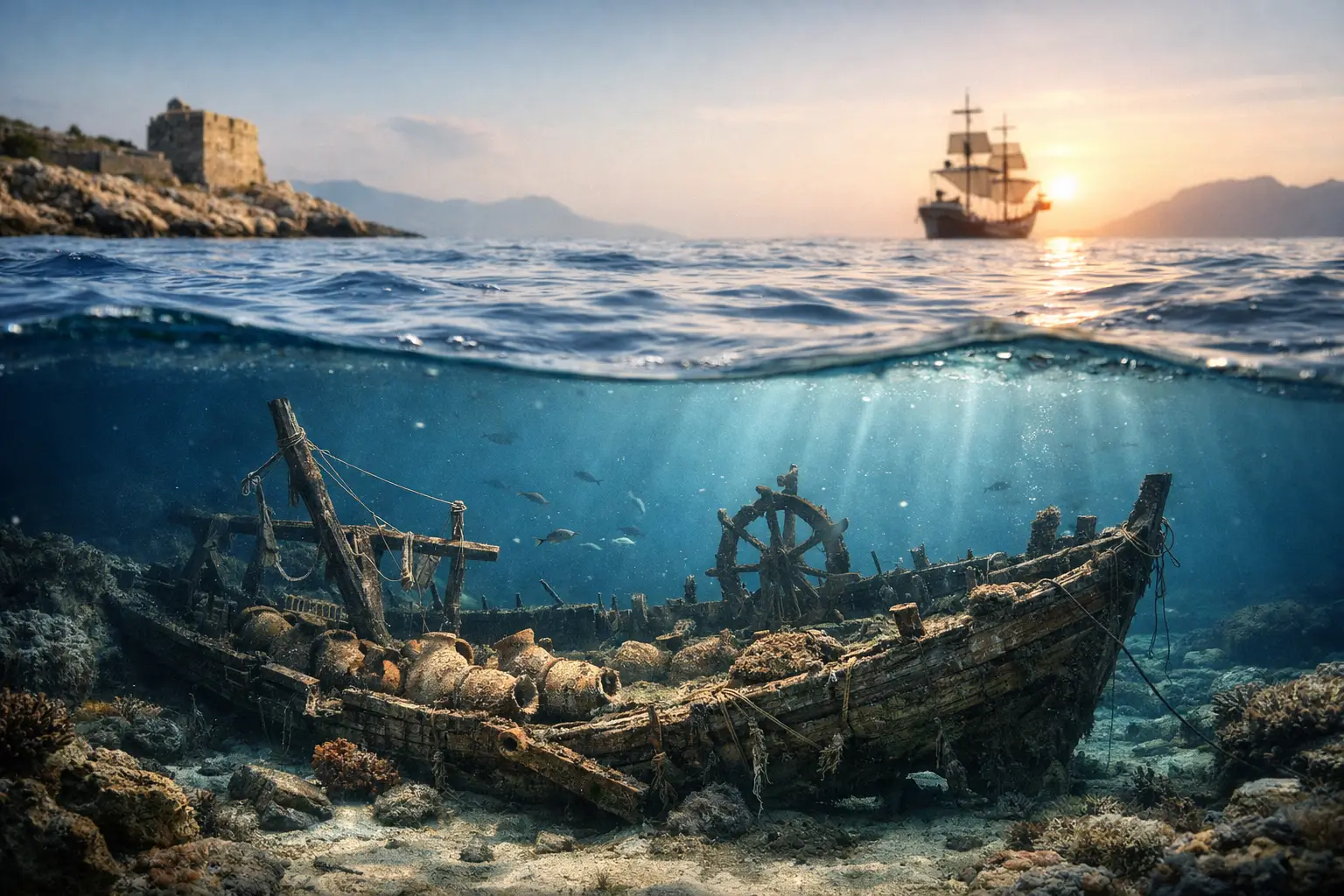

A ship sinks in silence, but its cargo can speak for centuries. The most famous ancient shipwrecks are not simply maritime disasters preserved underwater – they are time capsules of trade, taste, technology and human ambition, carrying everything from porcelain and spices to bronze, glass and gold across once-busy sea routes.
For anyone drawn to maritime history, shipwrecks hold a particular fascination because they collapse distance. A single wreck can connect courtly dining tables, merchant ports, imperial workshops and the dangers of open water in one vivid story. What survives beneath the sea is rarely random. It reflects what people valued, what they traded, and how far they were willing to travel to obtain it.
Why famous ancient shipwrecks matter
Ancient shipwrecks matter because they preserve ordinary evidence of extraordinary worlds. On land, ceramics break, metals are melted down and timber decays or is reused. Underwater, however, a wreck may remain sealed by sand and silt, preserving a moment with surprising clarity. Archaeologists can sometimes recover not only cargo, but also clues about ship construction, navigation, diet, social status and patterns of exchange.
That is especially true in maritime Asia, where sea routes shaped entire civilisations. Long before modern shipping lanes, merchants crossed monsoon waters carrying ceramics, metals, resins, textiles and luxury goods between China, Southeast Asia, India and beyond. Many of these voyages ended safely. The few that did not have become invaluable historical archives.
Still, not every wreck tells the same kind of story. Some are famous for spectacular treasure. Others matter because they reveal everyday commerce at scale. Some are celebrated because they transformed scholarship, while others remain powerful because they bring regional history into tangible, human focus.
10 famous ancient shipwrecks and what they reveal
Uluburun
Discovered off the coast of present-day Turkey, the Uluburun shipwreck is often regarded as one of the most important Late Bronze Age wrecks ever found. Dating to the 14th century BCE, it carried a remarkable cargo of copper ingots, tin, glass, ivory, jewellery and exotic raw materials.
Its significance lies in the breadth of its trading network. The wreck suggests an interconnected eastern Mediterranean world in which goods, ideas and diplomatic gifts moved between major powers with striking sophistication. Rather than a romantic tale of treasure alone, Uluburun shows how international trade was already highly developed more than 3,000 years ago.
Antikythera
Also found in the Mediterranean, the Antikythera shipwreck is best known for one astonishing object: the Antikythera mechanism. This complex geared device, often described as an ancient analogue computer, changed modern understanding of Greek scientific knowledge.
Yet the wreck was important even before the mechanism captured public imagination. It yielded bronze and marble statues, luxury items and cargo that pointed to elite patronage and long-distance movement of art. It reminds us that shipwreck fame can rest on a single object, but the wider context is what gives that object historical meaning.
Kyrenia
The Kyrenia ship, found near Cyprus, offers a different kind of importance. Dating to around the 4th century BCE, it is celebrated for how much it taught scholars about ancient Greek merchant ship design. Its hull was sufficiently preserved to allow detailed study and even reconstruction.
That makes Kyrenia less dazzling than treasure-heavy wrecks, but arguably more revealing in practical terms. Sometimes the greatest value of a wreck lies in architecture rather than cargo. It tells us how ships were built to survive open sea trade, and how maritime commerce depended on engineering as much as mercantile daring.
Belitung
For Asian maritime history, the Belitung shipwreck is among the most important ever recovered. Found in Indonesian waters and dating to the 9th century CE, it carried a vast cargo of Tang dynasty ceramics, together with gold and silver objects.
Its importance is hard to overstate. The wreck demonstrated the scale of early maritime trade between China and the Islamic world, with Southeast Asia positioned as a crucial corridor rather than a passive backdrop. It also brought global attention to the beauty, variety and commercial reach of Chinese export ceramics. For visitors interested in shipwreck porcelain, Belitung offers a powerful reference point for how objects made in one courtly and commercial world travelled across another.
Intan
The Intan wreck, discovered in Indonesian waters and generally dated to around the 10th century, carried a richly mixed cargo of ceramics, metalwork, glassware and religious objects. Unlike single-origin cargoes, Intan reflects the complexity of Southeast Asian trade networks, where goods from multiple regions circulated together.
That mixed character makes it especially valuable. It does not present trade as a neat one-way route from producer to buyer. Instead, it reveals a dynamic maritime marketplace in which merchants assembled diverse cargos for varied consumers. The result is a more layered picture of the region’s commercial life.
Cirebon
Another major Indonesian discovery, the Cirebon wreck is thought to date to the late 10th century. It held a substantial cargo of Chinese ceramics, along with luxury goods and artefacts linked to broader Asian exchange.
Cirebon illustrates one of the recurring truths of shipwreck archaeology: ceramics endure. Porcelain and stoneware survive immersion far better than many organic materials, which is why they often dominate what we can study and display today. That can slightly skew the record, of course. A ship may once have carried textiles, spices or timber that left little trace. Even so, ceramics remain among the clearest surviving witnesses to taste, status and commerce.
Nanhai No. 1
The Nanhai No. 1 wreck, found off the southern coast of China and dating to the Southern Song period, became famous not only for its cargo but for the scale of its conservation effort. The vessel and its contents were recovered in a way that allowed prolonged archaeological study under controlled conditions.
This is where the story of shipwrecks becomes more complicated. Recovery is never simply about bringing beautiful objects to the surface. It involves conservation, documentation, ethical decisions and long-term stewardship. Nanhai No. 1 stands out because it showed how a wreck could be treated as an integrated archaeological site, not just a source of collectable artefacts.
Wanli
Among the shipwrecks that have captured attention in the region, the Wanli wreck is closely associated with blue and white porcelain linked to the late Ming era. Wrecks of this kind fascinate audiences because they reveal export ceramics in transit – not in palace storerooms, but packed for trade, stacked for shipment and destined for distant markets.
That shift in perspective matters. It places porcelain within a lived commercial network. What we often admire today as art was also a traded commodity, handled by merchants, stowed by sailors and ordered by buyers who understood both beauty and market demand.
Turiang
The Turiang wreck is notable for the window it offers onto regional maritime commerce in Southeast Asia. Its ceramic cargo, varied in type and origin, helps reconstruct the movement of goods through waters that linked producers, ports and consumers across the archipelago and the South China Sea.
What makes wrecks such as Turiang compelling is their regional intimacy. They speak not only to grand civilisational exchange, but to the sea routes that shaped local histories, coastal economies and collecting traditions still appreciated today. In that sense, they are deeply connected to how maritime heritage is interpreted in museums and cultural spaces across the region.
Desaru
The Desaru wreck is another important example for those interested in shipwreck ceramics and the maritime past of this part of the world. Its recovered cargo reinforces the idea that Asian waters were once among the busiest and most culturally significant trade highways on earth.
For visitors encountering such artefacts in a curated setting, the impact is immediate. A bowl, jar or plate lifted from a wreck is not merely decorative. It is evidence of movement, risk and exchange. Institutions such as Straits & Oriental Museum bring that significance to life by placing authentic recovered ceramics within a broader journey through maritime history, material culture and regional memory.
What makes a shipwreck famous?
Fame is not always the same as importance. Some wrecks become famous because they contain precious metals or dramatic stories of loss. Others earn lasting recognition because they answer serious historical questions. In truth, the most meaningful wrecks often do both. They capture the imagination while also changing what historians know.
There is also a trade-off between spectacle and scholarship. Highly publicised discoveries can bring welcome attention to maritime heritage, yet they can also tempt people to focus too narrowly on rarity and market value. The better approach is to see a wreck as a whole historical environment. A humble storage jar, timber joint or ballast stone may matter just as much as a gilded object.
Why these wrecks still resonate
Ancient shipwrecks endure in the public imagination because they are stories of interruption. A voyage begins with purpose – trade, diplomacy, migration, survival – and ends abruptly beneath the sea. What remains is a suspended moment, one that allows us to look closely at the networks that once connected distant shores.
For travellers, collectors and museum-goers, that is part of the appeal. Shipwreck artefacts are visually compelling, but they are also wonderfully specific. They were touched, packed, purchased, loaded and lost. They belong to history at its most tangible.
The next time you stand before a recovered ceramic from a maritime wreck, it is worth pausing over the journey it never completed. That unfinished voyage is precisely what allows the object to speak so clearly now.