
A porcelain bowl raised from the seabed can carry the grace of an imperial kiln, the evidence of a centuries-old trade route and, sometimes, a complicated legal history. So, is shipwreck porcelain legal to own or buy? The honest answer is: it depends on where it was found, who recovered it, whether the recovery was authorised, and whether its journey from sea to collector can be clearly documented.
For visitors drawn to the splendour of Asian maritime heritage, this is not merely a technical question. Shipwreck ceramics are tangible witnesses to the networks that connected China, Southeast Asia, India, the Middle East and Europe. Treating them with care means respecting both their beauty and the laws designed to protect the stories they carry.
Is shipwreck porcelain legal? Start with provenance
Shipwreck porcelain is not automatically illegal simply because it came from the sea. Legitimate collections exist, including material recovered through licensed archaeological projects, authorised commercial salvage operations and long-established collections with a documented ownership history.
The difficulty begins when provenance is missing. Provenance means the recorded history of an object’s ownership, location and movement. For shipwreck ceramics, a credible provenance trail should explain where the piece was recovered, when it was recovered, who had the right to recover it, and how it was exported and sold.
A dealer saying that an object is “from a private collection” is not, by itself, enough. Nor is a vague label naming a wreck without a recovery date, permit details or supporting paperwork. The more remarkable, rare or apparently intact the porcelain, the more carefully a buyer should ask questions.
This is especially significant because underwater sites are easily damaged. A cargo of bowls, jars and dishes may reveal how goods were packed, where a vessel was travelling and which communities traded with one another. Once objects are removed without recording their position, much of that archaeological evidence disappears forever.
Ownership at sea is rarely straightforward
The law governing shipwrecks sits at the meeting point of maritime law, heritage law, property law and national export controls. There is no single worldwide rule that makes every piece legal or illegal.
A wreck may be located in a country’s territorial waters, in an area subject to a particular coastal state’s jurisdiction, or in international waters. Its ownership can also depend on the vessel’s flag, the nature of its cargo, whether it was a state vessel, whether it has been legally abandoned, and the terms of any salvage agreement.
In some places, historic wrecks and their contents are the property of the state. In others, recovery may be possible only under a licence and with archaeological supervision. Some jurisdictions permit carefully regulated commercial salvage, while others place a strong emphasis on preservation in situ – leaving the site undisturbed on the seabed.
International heritage principles also influence the picture. The UNESCO Convention on the Protection of the Underwater Cultural Heritage promotes protection, research and responsible public access rather than commercial dispersal of underwater finds. Not every country applies the Convention in the same way, but its central idea has shaped museum practice, archaeological standards and public expectations around submerged heritage.
A porcelain dish can therefore be legally offered for sale in one place while still raising serious questions about its original recovery or export. Lawful possession in the present does not always answer every ethical question about the past.
Salvage rights are not a blank cheque
Salvage evokes images of divers finding a lost cargo and bringing it safely to shore. Yet a finder’s effort alone does not usually create an unrestricted right to sell what has been recovered.
Salvage law can reward those who save property at sea, but it is not designed as a free-for-all for historic sites. Courts and authorities may distinguish between a recent maritime casualty and an archaeological wreck resting undisturbed for centuries. The latter can be protected as cultural heritage, even where individual objects have a market value.
Authorised recovery commonly requires permits, reporting, conservation plans and professional recording. These conditions matter. Porcelain that has spent centuries underwater is often fragile when first exposed to air. Salt can remain within the ceramic body and surface deposits may hold valuable information. Conservation is not simply a matter of cleaning an attractive object for display.
For this reason, responsible recovery is measured not only by what reaches the surface, but by what is recorded, preserved and made available for future study.
Export rules can make a lawful purchase unlawful
Even when an object was recovered legally, it may need an export licence before leaving its country of origin. Cultural-property laws often control the export of antiquities, archaeological material and nationally significant objects. Customs authorities may seize material that lacks the required permissions, and buyers can face loss, expense and reputational damage.
Import rules matter too. A collector should understand the rules of the destination country before arranging shipment, rather than assuming that a seller will handle every legal obligation. Auction houses, dealers and shippers can provide useful information, but the purchaser should retain copies of all documents.
For Malaysian collectors and visitors, heritage protection is particularly relevant. Malaysia’s National Heritage Act 2005 provides a framework for safeguarding heritage, and archaeological discoveries or movements of cultural material may be subject to official controls. Anyone considering the purchase, import or export of a shipwreck ceramic connected to Malaysia should seek advice from the appropriate heritage and customs authorities before proceeding.
The same care applies across Southeast Asia. These waters have carried extraordinary cargoes for centuries, and national rules differ from one coastline to the next. A piece described as “Asian shipwreck porcelain” is not a legal category. Its specific wreck, recovery location and documentary history are what matter.
What a careful buyer should ask for
A serious seller should be prepared to discuss provenance plainly and provide records that match the object being offered. Before purchasing shipwreck porcelain, ask for the recovery details, the name and location of the wreck if known, evidence of authorised salvage, prior ownership records, export permissions where relevant, and a proper invoice describing the piece.
Photographs of the object before sale, published catalogues, conservation reports and auction history can strengthen the record. They do not replace official permissions, but they can help establish a coherent chain of custody. Be wary of paperwork that is undated, overly general or unrelated to the specific object.
There are also practical signs worth noticing. A very low price for a supposedly rare cargo piece, an insistence on cash without paperwork, pressure to decide quickly, or a story that shifts when questions are asked should all prompt caution. A reputable purchase ought to withstand respectful scrutiny.
For higher-value objects, independent advice is sensible. A qualified maritime archaeologist, heritage lawyer, specialist appraiser or established auction professional can help assess documentation and identify gaps. Their role is not to turn an uncertain object into a certain one, but to help a buyer avoid an expensive mistake.
Collecting with respect for the wreck
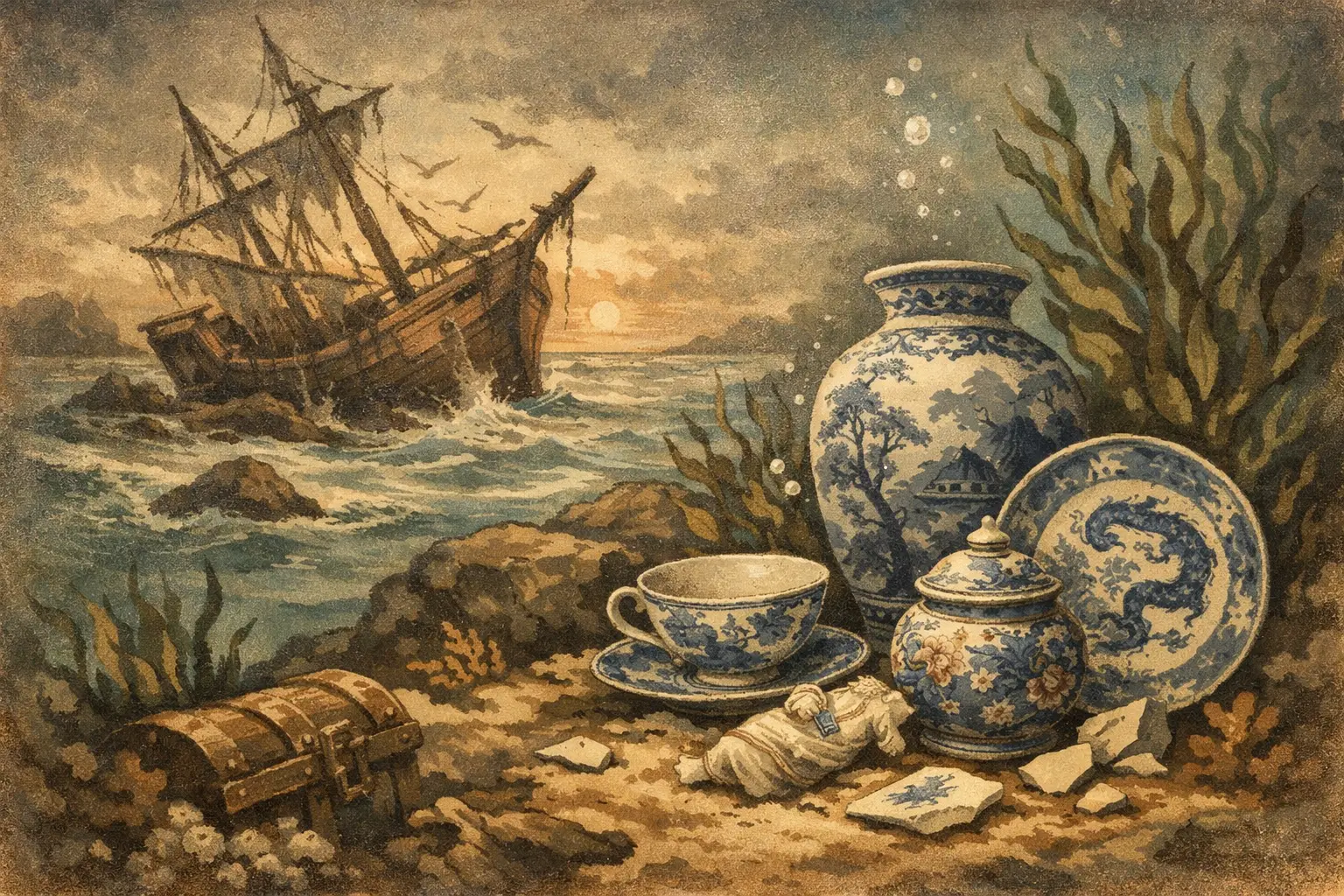
There is an understandable allure to shipwreck porcelain. A humble blue-and-white bowl may have travelled in the hold of a trading vessel through monsoon seas, survived a disaster and remained hidden for hundreds of years. Its surface can hold traces of both craftsmanship and voyage.
Yet the most meaningful way to encounter these objects is not always to acquire one. Museum collections preserve context: the scale of a cargo, the variety of forms, the relationship between ceramics and the lives of sailors, merchants and port communities. At Straits & Oriental Museum, shipwreck ceramics are presented as part of a wider journey through the maritime histories that shaped the region, allowing each object to speak beyond its price or decorative appeal.
Collectors who do buy can contribute to better practice by choosing fully documented material, keeping records intact and being transparent if a piece is later sold or donated. The aim is not to remove pleasure from collecting. It is to ensure that admiration for porcelain does not come at the cost of a wreck’s history.
A fine shipwreck ceramic deserves more than a place on a shelf. It deserves a story that can be told with confidence: where it came from, how it was recovered, and why its passage from seabed to display honours the heritage it represents.