
The waterfront is where George Town’s story becomes tangible: in the salt air, old godowns, clan jetties and streets laid out for commerce rather than ceremony. This Penang waterfront history guide follows the shoreline as a living record of migration, maritime trade and cultural exchange – a place where the Straits of Malacca connected Penang to China, India, the Indonesian archipelago and Europe.
To walk it well is not simply to photograph a heritage façade. It is to notice how a harbour created fortunes, communities and a city with an unusually cosmopolitan character. Some landmarks are polished and prominent; others are modest, working places whose value lies precisely in their continued use.
Why Penang’s waterfront mattered
Penang’s position on the northern approach to the Strait of Malacca made it strategically valuable long before modern container shipping. The strait was one of Asia’s great maritime corridors, carrying spices, textiles, tea, tin, ceramics and people between the Indian Ocean and the South China Sea. Ships did not merely pass through this region. They stopped, repaired, provisioned, traded intelligence and formed relationships that could endure for generations.
When Captain Francis Light established a British settlement on Penang Island in 1786, the deep-water harbour and free-port policy accelerated that existing maritime logic. George Town offered merchants a place to exchange goods with fewer restrictions than many rival ports. Traders, labourers and families arrived from across the region, bringing languages, faiths, foodways and commercial networks with them.
The result was never a single, uniform port city. Penang developed through overlapping communities: Chinese merchants and dock workers, Malay seafarers, Indian traders, Arab and Armenian business families, Europeans, Eurasians and many others. The waterfront was the threshold through which these worlds met. Its history is therefore as much about people and exchange as it is about colonial administration or cargo.
A Penang waterfront history guide: the essential stops
Swettenham Pier and the changing harbour
A contemporary cruise vessel at Swettenham Pier offers a striking contrast with the sailing ships, steamers and cargo craft that once dominated the roadstead. The pier area reflects Penang’s long role as a point of arrival. In the nineteenth century, the harbour handled an expanding flow of regional produce and imported goods, while ferries and smaller vessels connected the island with the mainland and nearby coastal settlements.
It is useful to remember that harbours continually adapt. The waterfront seen today is not a museum set preserved at one moment in time. Reclamation, changing shipping technology and the growth of Port Klang altered trade patterns, while tourism and heritage conservation brought new uses to historic districts. The best way to read this area is to hold both truths together: Penang remains a maritime gateway, though its working port has changed profoundly.
Weld Quay and the warehouses of trade
Along Weld Quay, the scale and purpose of the former commercial waterfront become clearer. Warehouses, offices and mercantile buildings once stood close to the movement of cargo. Rice, rubber, tin, copra, spices and manufactured goods travelled through systems of credit, brokerage, storage and shipping insurance as much as through ships’ holds.
Many visitors encounter the area quickly on their way to the ferry or the jetties. Slow down instead. Look for the practical details: broad openings for loading, upper-storey shutters, durable masonry and streets that lead directly back into the old commercial quarter. These buildings explain how the sea shaped George Town’s urban plan. The waterfront was not an edge of the city. It was one of its principal engines.
The Clan Jetties and a waterfront still lived in
The Clan Jetties are among Penang’s most recognisable waterfront communities, yet they deserve more than a brief stop for photographs. Built on stilts above the water, the jetties developed from Chinese immigrant communities connected by surname, kinship and occupation. Their residents worked in trades tied closely to the port, including cargo handling, lighterage and waterfront services.
The surviving jetties reveal an aspect of history that grand civic buildings cannot: the domestic life of a port. Timber walkways, shrines, homes and small businesses speak to adaptation and endurance. They are heritage places, but also residential neighbourhoods. Visitors should keep noise low, avoid blocking doorways and treat private homes as homes, not props.
Chew Jetty is the most visited and offers the easiest introduction, while other jetties can feel quieter and more residential. The trade-off is simple. Popular places may provide more visible visitor facilities, but quieter sections reward patience and consideration. Early morning is often the most respectful time to appreciate the setting, before the heat and crowds build.
Church Street, Beach Street and the mercantile city
Move inland from the waterfront and the commercial geography of old George Town begins to unfold. Beach Street became a centre for banks, trading houses and offices, while nearby Church Street gathered religious and civic landmarks that reflected the city’s plural society. Temples, mosques and churches were not separate from trade. They were part of the social infrastructure that supported communities who lived by it.
This proximity is one of Penang’s great historical distinctions. A short walk can reveal different architectural traditions and faiths standing side by side, shaped by the same maritime economy. It is tempting to describe this solely as harmonious cosmopolitanism, but the fuller picture is more complex. Port cities create opportunity, yet they also expose workers and migrants to inequality, uncertainty and colonial power. The richness of George Town lies in acknowledging both its splendour and its strains.
The sea beneath the story: shipwreck ceramics
No account of Penang’s waterfront is complete without considering the objects that travelled through Asian waters. Porcelain was among the most coveted commodities in maritime trade. Chinese ceramics reached courts, households and trading ports across Southeast Asia, the Indian Ocean and beyond, carrying not only beauty but information about taste, technology, wealth and cultural exchange.
Shipwreck discoveries make this history unusually immediate. A bowl recovered from the seabed can preserve evidence of what merchants expected to sell, where a vessel may have travelled and how fragile sea trade could be. Cargoes were lost to storms, reefs, warfare and human error, then kept beneath the water for centuries.
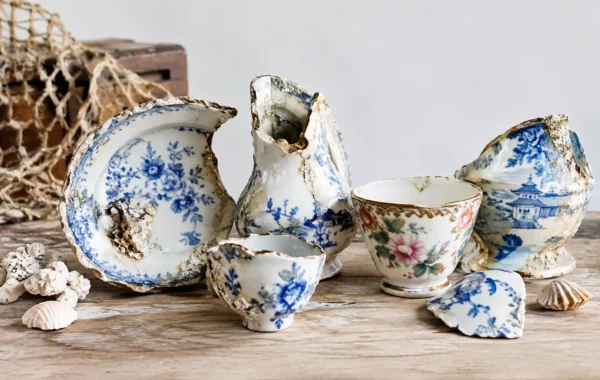
At Straits & Oriental Museum, authentic ceramics recovered from significant Asian shipwrecks offer a rare encounter with this maritime world. Pieces associated with wrecks including the Wanli, Turiang, Royal Nanhai, Nanyang, Xuande and Desaru transform an abstract trading route into a human-scale story. Consider the object closely: its glaze, form, kiln tradition and signs of age. It may once have been packed among thousands of similar wares, destined for a market far from the workshop where it was made.
This is where a waterfront visit gains depth. The harbour tells us that Penang was connected; shipwreck ceramics show what those connections carried. They also prompt a useful caution. Not every beautiful old ceramic is alike, and provenance matters. Archaeological context is what enables an object to speak credibly about a particular vessel, date and trading network.
How to experience the waterfront with greater care
A rewarding route need not be rushed. Begin near the pier while the waterfront still feels open, then follow Weld Quay towards the Clan Jetties before turning inland through the historic commercial streets. Allow time for a museum visit, a coffee or meal, and unplanned pauses at an arcade, shrine or old shopfront. The pleasure lies in seeing the connections between places rather than ticking off isolated sights.
Weather matters in Penang. Midday heat can make the exposed waterfront demanding, while heavy rain can arrive quickly. Mornings and later afternoons are kinder for walking, but the best timing depends on whether you want quieter lanes, stronger light for photographs or time to linger indoors with collections and exhibitions.
Respect also improves the experience. Dress appropriately when entering religious sites, ask before photographing people, and remember that heritage districts are workplaces and homes. The waterfront has survived because it has remained useful to successive generations. Treating it as a living place is the most meaningful way to see it.
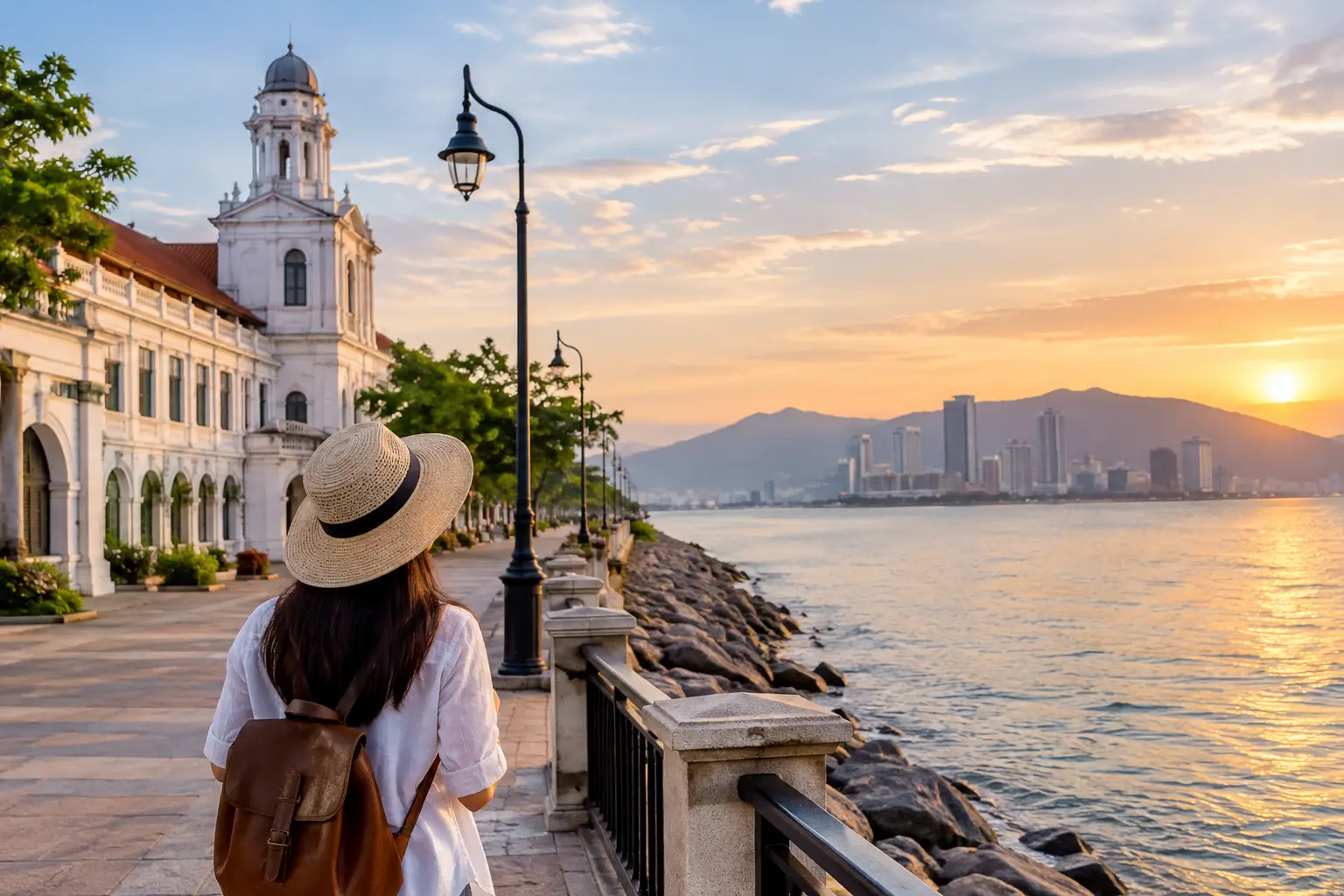
As evening settles over the strait, watch the ferries, fishing boats and distant vessels trace their paths across the water. The view is not merely scenic. It is a reminder that Penang’s finest stories have always arrived by sea – and that every object, street and jetty along the shore still carries a fragment of that journey.