
A Tang ceramic can feel remarkably immediate: a small green-glazed bowl, a lively horse or a vessel once made for a burial chamber still carries the confidence of an empire connected by land and sea. Yet learning how to identify Tang ceramics calls for more than recognising a familiar three-colour glaze. The Tang dynasty lasted from 618 to 907 CE, and its pottery ranges from humble domestic wares to sophisticated objects made for courtly, religious and funerary settings.
For collectors and curious visitors alike, the most rewarding approach is to build a case from several clues. No single feature can prove an object is Tang. Form, material, glaze, decoration, condition and, above all, provenance must be read together.
Begin with the Tang world, not just Tang sancai
Tang ceramics reflect an outward-looking period in Chinese history. Trade routes linked workshops in China with Central Asia, the Middle East and Southeast Asia, while new tastes travelled with merchants, diplomats and pilgrims. Ceramic makers responded with bolder forms, richer glazes and decorative motifs that often reveal this wider exchange.
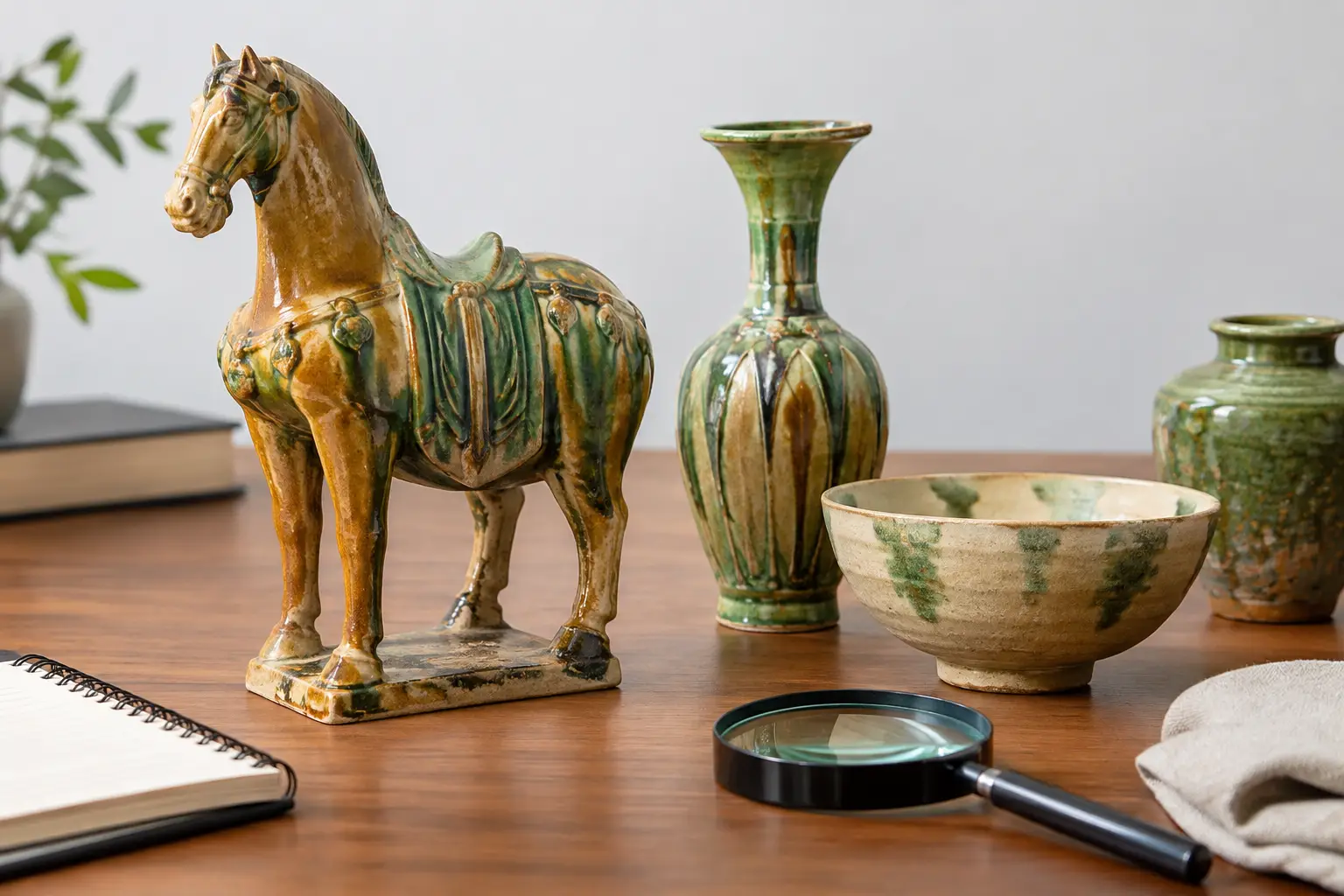
The best-known category is Tang sancai, literally “three colours”. These lead-glazed wares commonly combine amber, green and creamy off-white, although the precise number of colours varies. Sancai was used especially for mingqi, objects placed in tombs to accompany the dead, including figures of horses, camels, musicians, officials and guardians.
But sancai is not the whole story. Tang-period ceramics also include luminous Yue celadons, pale white wares from northern kilns, painted and green-splashed Changsha stonewares, and everyday storage jars. An object without brilliant green and amber glaze may still be very much of the Tang era.
How to identify Tang ceramics by form
Start by asking what the object was made to do. Tang potters created elegant dishes, ewers, jars, cups and pillows, but certain forms are particularly revealing. Ewers may have long, curving spouts and handles, sometimes with a distinctly foreign-inspired silhouette. Jars can be broad-shouldered and sturdy, designed for storage or burial use. Tomb figures tend to possess a confident physical presence rather than the delicate refinement associated with many later figures.
Look for signs of cosmopolitan influence. Camels with high packs, riders in fitted caps, foreign musicians and vessels with lobed bodies or animal-headed spouts speak to a Tang fascination with cultures beyond China’s borders. These details do not automatically date an object, since later workshops often copied them, but they are useful starting points.
Scale matters too. Monumental figures and horses were often funerary commissions, while small dishes and cups may relate to dining, ritual or trade. A form should make practical and historical sense. A supposedly Tang vessel that combines several unrelated motifs or seems designed around modern decorative taste deserves closer scrutiny.
Tomb figures require special care
Tang burial figures are among the most copied Chinese ceramics. Authentic examples can show powerful modelling, but their surfaces are often irregular because the glaze pooled, ran and fired unpredictably. A perfectly glossy, uniform finish is not necessarily wrong, but it should invite questions when paired with an overly neat or theatrical figure.
Genuine age is also not the same as attractive damage. Old repairs, soil deposits and worn surfaces can be meaningful, yet they can also be fabricated. Condition must be assessed by a trained conservator or specialist rather than by appearance alone.
Read the body, glaze and firing marks
The ceramic body is where close looking becomes essential. Tang wares were produced in earthenware, stoneware and porcelain-like white bodies, depending on the kiln and object type. Sancai figures are usually made from a pale, buff or cream-coloured earthenware body under lead glazes. Yue wares are generally denser stonewares with a refined grey body beneath their greenish glaze.
Examine exposed areas such as the foot rim, the underside and small chips, but never damage an object to do so. On an authentic piece, the body, glaze and firing traces should relate naturally to one another. The glaze may have settled more thickly in recesses, thinned along edges or stopped short of the foot to prevent the vessel sticking to the kiln support.
Tang sancai glazes often have a soft, glassy depth rather than a flat painted appearance. Green may range from olive to vivid leaf tones; amber can be honeyed, brownish or deep yellow. Where colours meet, they may bleed into one another in a fluid, unplanned way. This richness comes from the firing process, not simply from colour applied for effect.
Do not rely on crackle alone. Fine cracking can develop in glaze over time, but it can be artificially induced. Equally, genuinely old objects may have little visible crackle. Surface appearance is useful only when considered alongside the clay body, construction and documented history.
Look for workmanship, not perfection
Tang ceramics were handmade and kiln-fired under conditions that allowed for variation. This can produce asymmetry, slight warping, uneven glaze distribution, kiln grit, spur marks or firing scars. Such marks are part of an object’s story, particularly on utilitarian wares and early glazed ceramics.
That said, roughness is not proof of antiquity. Modern copies may be deliberately distorted, stained or abraded to imitate age. The question is whether the irregularities are convincing within the whole object. Does the glaze settle naturally? Are the joins and hollow sections appropriate for the form? Does the wear occur where handling, burial or excavation would plausibly produce it?
Decorative language matters. Tang motifs can include lotus petals, floral scrolls, moulded appliqués, splashes of colour and lively painted designs. On Changsha wares, iron-brown painting beneath or over glaze may show flowers, birds, inscriptions or freely brushed patterns. The brushwork should feel integrated with the vessel rather than added as a decorative afterthought.
Provenance is the decisive clue
An object’s documented history is often more valuable than a persuasive surface. Provenance may include an old collection label, auction record, invoice, exhibition history, publication, conservation report or a clear chain of ownership. For shipwreck ceramics, archaeological documentation can establish not only authenticity but also the object’s commercial and maritime context.
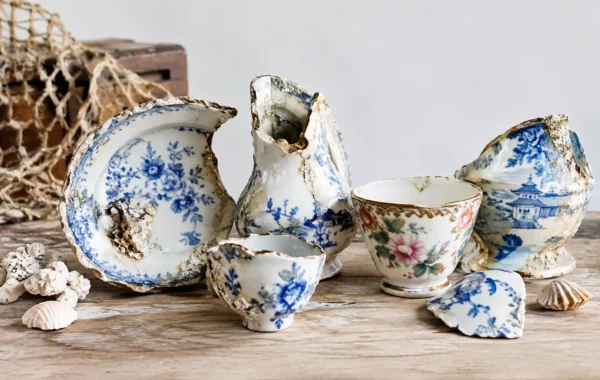
At Straits & Oriental Museum, shipwreck ceramics offer a vivid reminder that objects once travelled far beyond the kilns that made them. Their underwater histories can preserve evidence of trade, packing, cargo selection and the routes that connected China with the wider region. A ceramic recovered from a recorded wreck should be accompanied by transparent collection information, not just a dramatic story.
Be cautious of vague phrases such as “from an old Asian collection” when no supporting paperwork is available. They may be true, but they are not enough to establish a Tang date. Responsible collecting also means respecting export laws, cultural-property regulations and archaeological context. A bargain with no history may carry more risk than value.
When to seek expert examination
If you are considering a purchase, seek an independent specialist before committing. A reputable dealer should welcome sensible questions about provenance, restoration, condition and scientific testing. Thermoluminescence testing can sometimes help date fired clay, particularly terracotta figures, but it has limits: results must be interpreted carefully, samples must be taken properly, and a test cannot replace connoisseurship or provenance.
Useful questions include whether the object has been restored, whether it has been tested, where it was acquired and whether comparable examples have been published. Photographs of the base, interior, joins and damaged areas are often more revealing than a single polished catalogue image.
A final way to look
The finest way to identify Tang ceramics is to let certainty arrive slowly. Compare forms, study glazes under natural light, learn the visual character of different kiln traditions and give provenance the weight it deserves. Each careful observation brings you closer not merely to an attribution, but to the extraordinary journey of an object made more than a millennium ago.