
A bowl lifted from the seabed may carry a bloom painted more than four centuries ago, its glaze softened by salt but its story still remarkably clear. This guide to shipwreck porcelain styles helps visitors read those stories: not simply as beautiful objects, but as evidence of workshops, trade routes, changing tastes and the people who entrusted precious cargo to the sea.
Shipwreck ceramics are often encountered in quantity, which is part of their power. A single vessel may preserve hundreds or thousands of pieces that once travelled together. Seen closely, they reveal a visual language of clay, glaze, form and decoration. Seen together, they document the splendour of porcelain and the immense maritime world that connected China, Southeast Asia and beyond.
Why shipwreck porcelain looks different
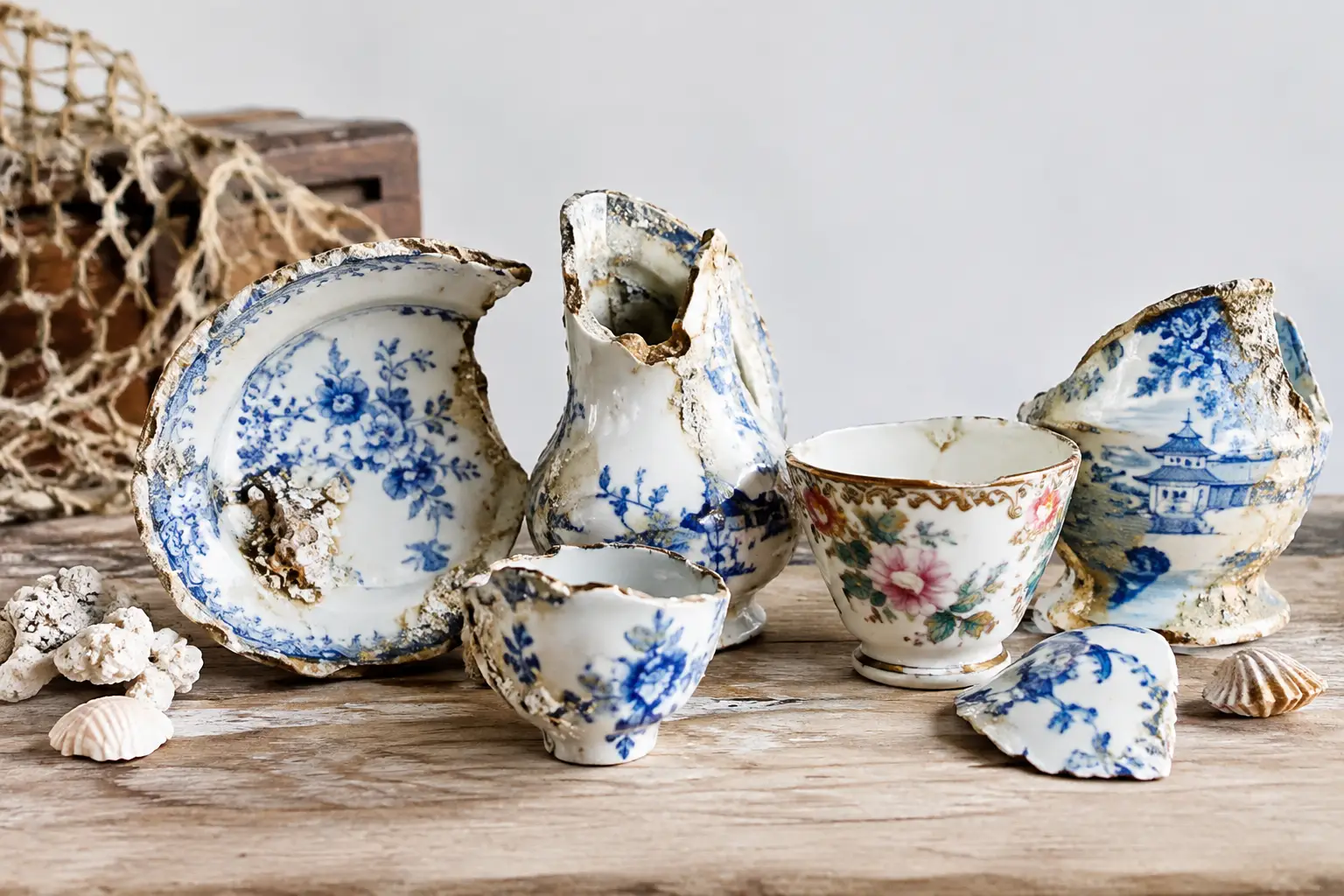
Porcelain and ceramics recovered from wrecks do not all emerge looking pristine. Marine conditions can leave mineral deposits, staining, pitting or a soft, matt surface where glaze has weathered. These marks are not necessarily flaws. They can be physical records of a long underwater journey, and they are one reason an excavated piece has a character quite unlike a similar object kept on land.
Style is shaped by more than decoration. The body of a vessel may be fine and translucent, dense and heavy, or sandy in texture. Its footring, rim and profile can point to a production tradition; its glaze may appear glassy, ivory-toned, celadon green, cobalt blue or richly coloured. A dish made for a courtly table, a storage jar made for a ship’s hold and a small bowl intended for everyday trade each ask to be understood on their own terms.
The sea also creates a useful sense of context. Cargoes were commercial selections, not random assortments. Their contents suggest what merchants believed buyers wanted in particular ports, whether that was elegant blue-and-white tableware, durable jars, refined monochrome wares or bold pieces made for ceremonial and domestic use.
A guide to shipwreck porcelain styles: what to look for
When looking at a shipwreck ceramic, begin with the silhouette before moving to the painted detail. Shape is often the quietest but most revealing clue. A broad dish with a shallow well, a stem cup, a covered box or a tall storage jar carried a distinct purpose and belonged to a recognisable market.
Then look at the clay and glaze. True porcelain is made from a highly refined body fired at high temperatures, usually producing a hard, pale and sometimes translucent material. Stoneware is also hard-fired but commonly denser and less translucent. Earthenware is more porous unless glazed. In museum displays, these categories may sit side by side because all played a role in Asian maritime trade.
Finally, consider repetition. A pattern found across a group of bowls can tell us more than an unusually ornate individual piece. Repeated motifs, standardised dimensions and shared kiln marks can indicate production on a significant scale. Yet small variations in brushwork remind us that these were made by human hands.
Blue-and-white porcelain
Blue-and-white is perhaps the most immediately recognisable style in maritime ceramic collections. Cobalt pigment was painted onto the pale body beneath a clear glaze, then fired to create designs ranging from a soft grey-blue to a deep, energetic cobalt. The technique offered drama and durability, making it well suited to long-distance commerce.
Look for floral scrolls, lotus sprays, peonies, birds, landscapes, auspicious symbols and geometric borders. The quality of painting can vary greatly. Some wares display confident, layered compositions with fine line work; others use brisk, economical strokes intended for broad export markets. Neither is automatically more meaningful. They speak to different workshops, prices and audiences.
Blue-and-white also changes across periods. Earlier examples may favour particular motifs and carefully balanced spaces, while later export wares can become more crowded, expressive or adapted to overseas demand. Dating should never rest on one feature alone, however. Form, glaze, footring and archaeological context must work together.
Celadon and green-glazed wares
Celadon is prized for its restrained, luminous green glaze, which can range from pale jade to olive or grey-green. Its beauty lies in subtlety rather than painted ornament. Light gathers in carved lines, moulded petals and pooled glaze around a foot or rim, creating depth that rewards unhurried looking.
Many celadon pieces were shaped with decoration pressed, carved or incised into the body before glazing. Floral designs, lotus petals, fish, dragons and cloud forms may seem to appear and disappear as the object is turned. In a shipwreck assemblage, this quiet refinement is a reminder that maritime trade was not confined to bold decorative wares.
The condition of celadon requires a careful eye. Burial can alter the surface and make colours appear less vivid than they once were. Rather than judging solely by brightness, notice the relationship between glaze, form and decoration. A calm green tone may be exactly the intended aesthetic.
White wares and monochromes
White-glazed ceramics can appear deceptively simple, but they were technically demanding and visually sophisticated. Their appeal rests on the clarity of the glaze, the purity of the body and the elegance of proportion. A near-white bowl may carry a warm cream cast, a bluish tint or a faint greenish tone, depending on its materials and firing.
Monochromes extend this idea further, using a single glaze colour to let surface and shape take the lead. These objects were not plain substitutes for painted porcelain. They offered a different kind of luxury: controlled firing, balanced form and an appreciation of minute variations in colour.
On a wreck, white wares can be especially evocative where stacks of bowls or dishes have survived close together. They make visible the practical choreography of packing cargo, while each piece retains the grace of a table object designed to be held, used and admired.
Overglaze colour and enamelled decoration
Some porcelain was decorated in stages. A piece could first be glazed and fired, then painted with enamels and fired again at a lower temperature. This created a wider palette of red, green, yellow, black and other colours, allowing more elaborate scenes and bolder contrasts than underglaze cobalt alone.
These wares deserve close attention because overglaze enamels can be more vulnerable in marine environments. Losses and abrasion may be part of the object’s survival history. Where colour remains, it can reveal costume, garden scenes, precious objects, birds, flowers and auspicious imagery with remarkable liveliness.
The trade-off is that a colourful piece is not always easier to identify. Enamelled traditions overlap, and colours can shift through firing and burial. A reputable archaeological provenance remains more valuable than a confident-sounding label based on colour alone.
Vietnamese and Southeast Asian trade ceramics
The sea routes of Southeast Asia carried far more than Chinese porcelain. Vietnamese ceramics, including blue-and-white, underglaze iron-painted and green-glazed wares, reached regional and international markets with distinctive forms and decorative energy. Their presence confirms that the maritime ceramic story is one of many production centres, not a single source flowing outward.
Vietnamese blue-and-white often has a particularly free, spirited manner of painting, though individual examples vary. Motifs may include flowers, birds, fish and scenes arranged with a vigorous brush. Other Southeast Asian wares may favour earthy stoneware bodies, utilitarian jars and local glazing traditions developed for storage, transport and daily life.
These objects are essential to understanding the region’s trading networks. They show local makers responding to shared tastes while maintaining their own technical and artistic identities.
Reading patterns without over-reading them
Motifs offer an inviting entry point, but they are not a shortcut to certainty. A lotus can suggest purity and renewal; peonies evoke prosperity; dragons signify power; fish may carry associations of abundance. Yet symbols travelled, were copied and were adapted for different markets. A flower may be decorative before it is symbolic, and a border may be a workshop convention rather than a coded message.
The most rewarding approach is to ask several questions at once. What is depicted? How was it made? Where is it placed on the vessel? Does the motif recur across the cargo? And what does the shipwreck’s date and route make plausible? Archaeology gives decoration its setting, turning attractive patterns into historical evidence.
Authenticity, condition and the collector’s eye
For collectors, shipwreck ceramics present both exceptional appeal and serious responsibilities. Marine encrustation, fragments and visible wear can support an object’s story, but none alone proves authenticity. Conservation may stabilise an artefact, yet excessive cleaning can remove important surface evidence. A perfectly polished object is not automatically a better one.
Provenance should be central to any assessment. Seek clear documentation of recovery, legal export where relevant, professional conservation and a credible association with a known excavation or collection. Be cautious with vague claims of being “from a shipwreck”, especially where no vessel, recovery history or supporting record is named. The rarity of maritime artefacts makes careful due diligence essential.
Condition also depends on the kind of object. A minor rim chip on a large trade bowl may be unsurprising; a repaired break on a finely painted piece may materially affect both value and interpretation. What matters is honest description, not an unrealistic expectation of perfection.
Seeing shipwreck porcelain as a shared inheritance
Shipwreck porcelain gains its greatest meaning when it is allowed to remain connected to the lives around it: potters at kilns, merchants selecting cargo, sailors crossing monsoon seas and households awaiting goods in distant ports. It is history made tangible, but it is also a record of taste, ambition and exchange across Asia.
At Straits & Oriental Museum, these objects invite visitors to slow down and look beyond the surface – to notice a brushstroke, a stacked footring or a green glaze that has endured beneath the sea. That attentive moment is where a porcelain vessel becomes more than an artefact: it becomes a passage into the human stories carried by the water.