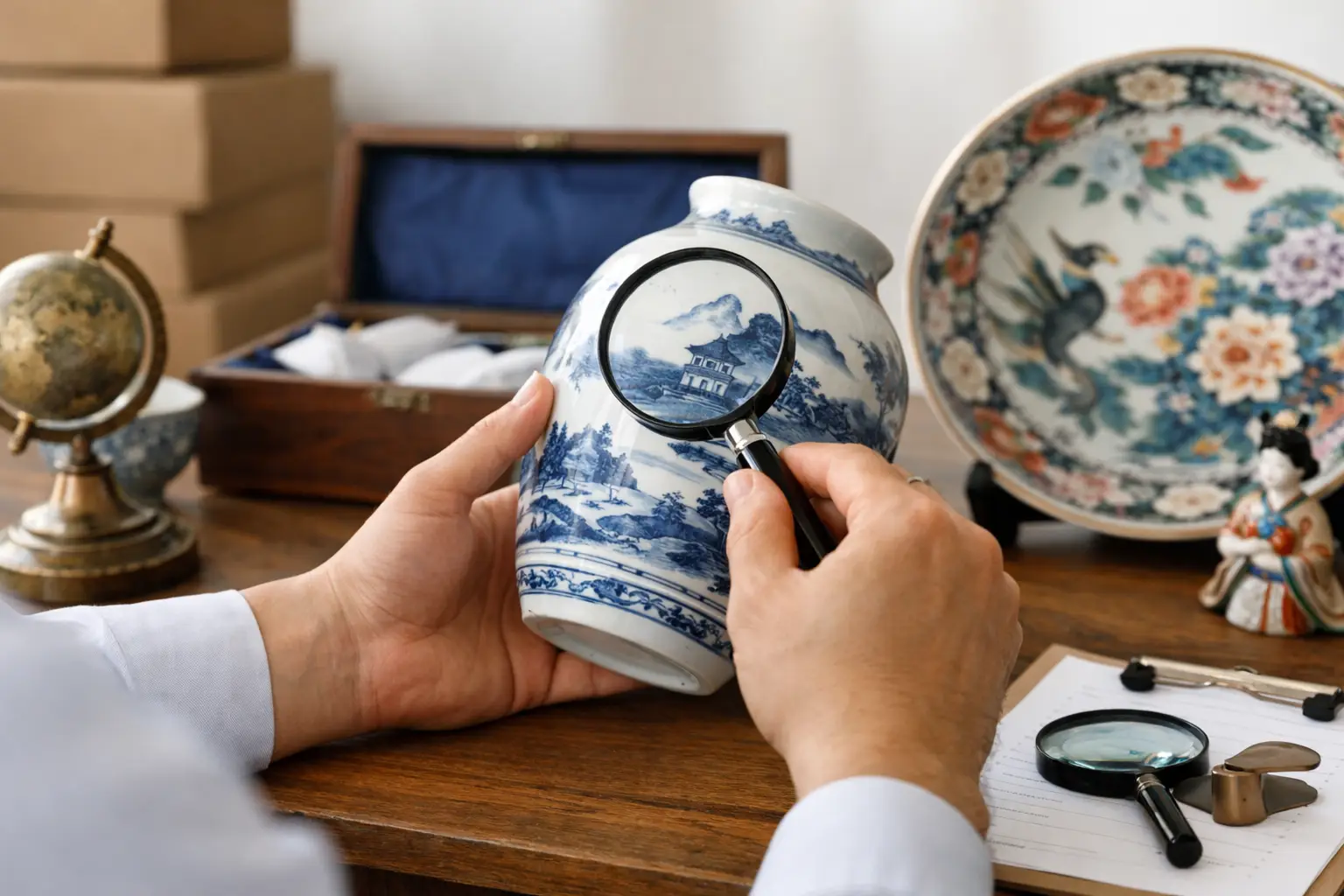

A blue-and-white bowl may look Chinese at first glance. Yet its broad rim, lightly painted flowers and slightly uneven glaze can tell a far richer story: it may have been made for a household thousands of miles from the kiln where it began. To understand how to identify export ceramics is to read those small choices – form, decoration, material and wear – as evidence of a vast maritime world.
Export ceramics were made to travel. From China, Vietnam, Thailand and other Asian production centres, vessels carried porcelains and stonewares across the South China Sea and Indian Ocean to Southeast Asia, the Middle East, Europe and beyond. Some pieces were specially commissioned for overseas buyers; others were domestic wares that found international markets. The distinction is not always absolute, which is precisely what makes careful looking so rewarding.
Start with the object’s purpose
The first question is not, ‘Where was this made?’ It is, ‘Who was it made for?’ Export ceramics often reveal the habits, tastes and dining customs of their intended market.
Look at the form before the painted surface. Large chargers, deep serving dishes, handled ewers, covered boxes and broad-rimmed plates may point towards overseas use, particularly where their shapes differ from the everyday tablewares of the producing region. European markets, for example, encouraged Chinese potters to make large dishes and plates suitable for communal dining. Markets in Southeast Asia often favoured practical bowls, jars and dishes that travelled well and suited local foodways.
Scale matters, but it is not proof on its own. A large plate is not automatically an export piece, and a small cup may still have crossed an ocean. What matters is the relationship between shape, date, place of manufacture and likely consumer. A convincing identification is built from several clues rather than one attractive feature.
How to identify export ceramics by material and make
Turn the object over, if it is safe and permitted. The footring, base and underside frequently hold more useful information than the front.
Chinese porcelain is generally hard, fine and resonant, with a pale body beneath its glaze. Depending on its period and kiln, it may range from luminous white to soft grey-blue. Stoneware is denser and more earthy, while earthenware is usually more porous and often has a coarser body. These distinctions can help narrow a piece’s origin, although they should never be judged by photographs alone.
Examine the glaze closely. A pooled glaze around the foot, tiny iron spots, firing grit, glaze crackle or an unglazed ring can reflect workshop practice and firing conditions. Such details are not defects in the modern sense. They are traces of making. A vessel recovered from a shipwreck may also show marine accretions, staining or surface abrasion, but sea wear does not by itself establish authenticity. It can be imitated, and genuine objects can be cleaned heavily enough to lose obvious traces of burial.
The base may carry a reign mark, an auspicious symbol, a workshop mark or no mark at all. A mark is a clue, not a verdict. Marks were copied during later periods, used decoratively, or added to honour an earlier reign rather than describe the date of manufacture. It is wiser to assess the mark alongside the paste, footring, decoration and provenance than to let it decide the whole case.
Read decoration as a language of trade
Decoration can reveal both a ceramic tradition and an intended audience. Blue-and-white porcelain, with cobalt painted beneath a clear glaze, became one of the great visual languages of Asian trade. But the arrangement of its motifs can be more telling than the presence of blue alone.
Look for the composition. Are floral sprays set within neat panels? Is the rim decorated with a border that frames a central scene? Are there radiating segments, cartouches, scrolls or repeated motifs intended to be read from a distance across a dining table? Export wares often favour clear, bold decoration suited to display and shared use.
Certain motifs travelled particularly well. Peonies, lotus scrolls, dragons, phoenixes, landscapes and precious objects had established meanings in Chinese visual culture, yet they could also be appreciated abroad for their beauty and status. Other designs show more direct adaptation: Islamic-inspired arabesques, European coats of arms, Western figures, or palettes developed for specific markets. Chinese famille rose and famille verte wares, for instance, were widely made for overseas consumers, but their dates and destinations vary considerably.
Decoration may also signal a regional trade network rather than a distant export market. Vietnamese blue-and-white ceramics of the fifteenth century reached consumers across Southeast Asia and beyond. Thai stonewares, valued for their durability, moved through regional ports in jars, bowls and covered vessels. Their story is one of connected Asian markets, not simply goods moving from East to West.
Let the route shape the interpretation
A ceramic becomes more meaningful when considered as cargo. Shipwreck assemblages show what merchants chose to load together, in what quantities, and for which ports. A single bowl can suggest a style; hundreds of related bowls can reveal a commercial system.
This is why shipwreck ceramics are so valuable to the study of export wares. Cargoes can provide a useful date range, especially when they are associated with coins, timber records or closely datable objects. They also show the practical realities of transport: bowls nested in stacks, jars packed with smaller goods, and plates selected for their ability to survive a long voyage.
At Straits & Oriental Museum in George Town, shipwreck collections offer a direct encounter with this maritime history. The ceramics do not sit apart from the sea that carried them. Their forms, surfaces and surviving groups illuminate the trade routes that helped shape Penang and the wider region.
For collectors, however, a shipwreck attribution deserves particular caution. Ask whether the claimed wreck is documented and whether the object has credible paperwork. A vague statement that a piece is ‘from a Southeast Asian wreck’ is not the same as a recorded excavation history. Responsible collecting begins with lawful provenance and respect for cultural heritage, particularly where underwater sites may have been disturbed or illicitly exploited.
Compare, then question your first impression
The most dependable way to identify export ceramics is through comparison with well-documented examples. Museum collections, exhibition catalogues and reputable specialist references can help you compare shape, palette, brushwork, footring and decorative layout. The goal is not to find an identical object immediately, but to place the piece within a plausible family of wares.
Be alert to later copies and revival pieces. Nineteenth- and twentieth-century makers often reproduced earlier Chinese export styles, sometimes with considerable skill. A piece can be old, attractive and collectible without being from the period first suggested by its design. Fresh-looking enamels, an implausibly clean base, overly deliberate ageing and decorative elements borrowed from several periods should all encourage further scrutiny.
Condition also changes what can be known. Chips, hairline cracks, restored rims and re-glazed areas may obscure key evidence. Hold an object in raking light where possible, and ask a specialist to inspect it before making a significant purchase. A professional opinion may not always produce certainty, but it can distinguish informed possibility from confident guesswork.
Build a record before you build a collection
If you own or are considering a piece, photograph it from every angle: front, back, profile, base and close-ups of damage or marks. Record dimensions, weight, material, glaze colour, visible motifs and every detail of its ownership history. Keep invoices, auction descriptions, conservation reports and export documents together.
That record is not merely administrative. It protects the object’s story. Ceramics made for trade were part of human exchange – between potters, merchants, sailors, hosts, guests and families. Their value lies not only in rarity or decoration, but in the routes and relationships they still allow us to imagine.
The most memorable export ceramics reward patient attention. Look beyond the blue paint or the familiar mark, and you may find a vessel that carries the taste of another shore, the discipline of a distant kiln and the enduring rhythm of Asia’s maritime past.