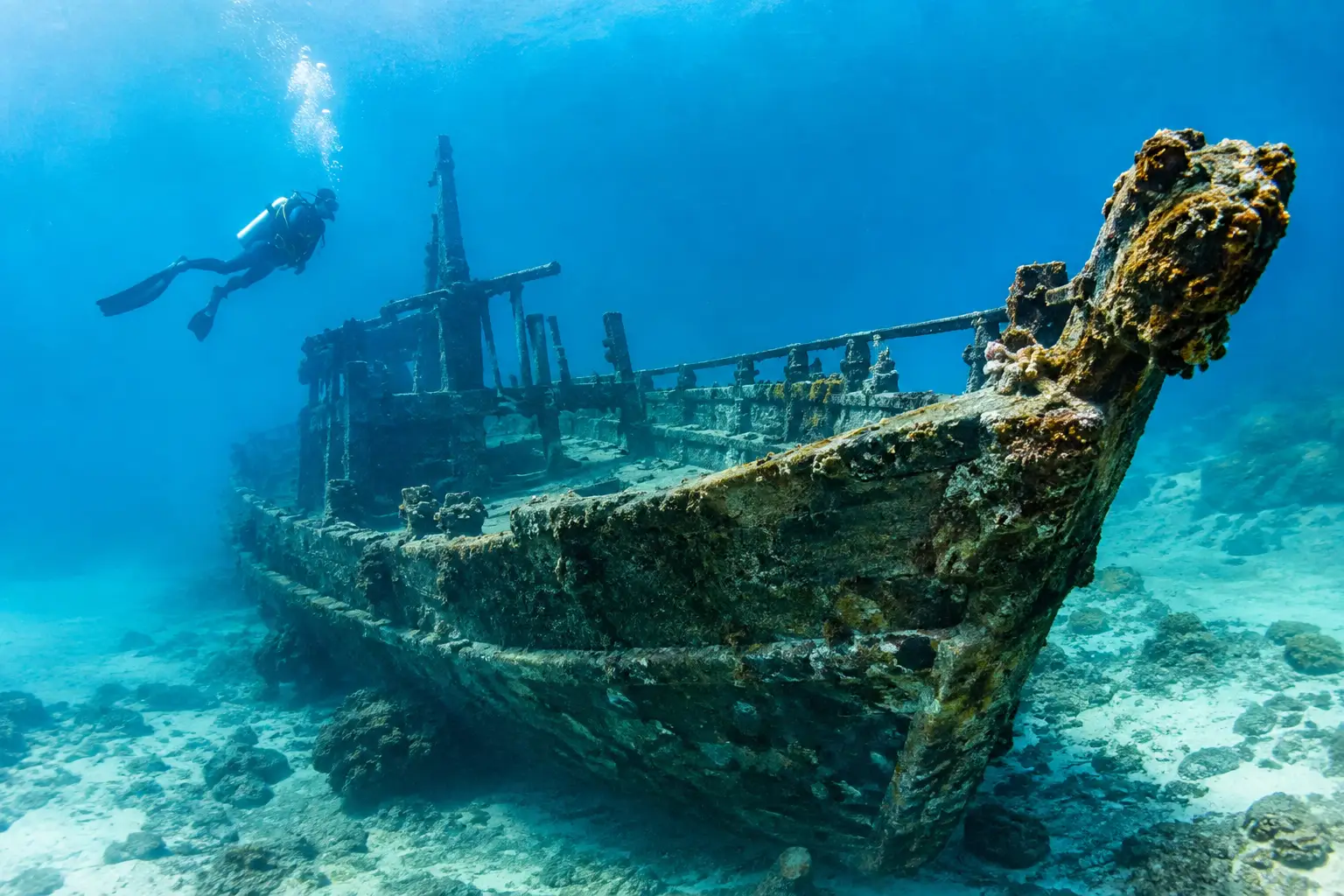

A porcelain bowl lifted from the sea is not simply an object recovered from the past. It may have spent centuries under sand, coral growth and shifting currents, its glaze protected in one place and weakened in another. The most compelling Asian shipwreck conservation examples show why recovery is only the beginning. The real work lies in stabilising fragile material, recording its context and deciding how a maritime story should be cared for and shared.
Across Southeast and East Asia, wrecks have revealed the scale and sophistication of historic sea routes. They carried Chinese ceramics, Southeast Asian stoneware, aromatic woods, metals and daily goods between ports that connected the Indian Ocean and the South China Sea. Their cargoes are visually captivating, but their value is far greater than their beauty. A shipwreck is a sealed, if imperfect, record of trade, technology, taste and human movement.
Why shipwreck conservation demands patience
Artefacts surviving underwater have reached an uneasy equilibrium with their environment. Once brought to the surface, that balance changes immediately. Salts held within ceramic pores can crystallise as an object dries, causing flaking or surface damage. Iron can corrode rapidly when exposed to oxygen. Organic materials such as timber, rope and lacquer may collapse or distort unless kept wet and treated with great care.
Conservation therefore begins at the site. Archaeologists map the wreck, photograph cargo concentrations and document the layers in which objects are found. A dish retrieved from a tightly packed stack can tell researchers about loading practice and trade volume; separated from that context, it becomes far less informative. Careful recording protects knowledge that cannot be replaced, even when the object itself survives.
Treatment is rarely quick. Ceramics may need prolonged desalination in controlled water baths before they can dry safely. Conservators assess each piece rather than applying one method to an entire cargo. A sturdy storage jar and a finely potted blue-and-white bowl may have faced very different conditions on the seabed.
This slower approach has a practical consequence for museums and visitors alike: not every object should be exhibited immediately, or at all. Responsible display balances public access with long-term preservation. Light levels, humidity, mounting materials and handling procedures all influence whether an artefact remains stable for future generations.
Asian shipwreck conservation examples in context
The Belitung wreck and the question of responsible recovery
The ninth-century Belitung wreck, discovered in Indonesian waters, is among the most significant maritime archaeological finds in Asia. Its cargo included a remarkable quantity of Tang-era ceramics, notably Changsha ware, alongside gold and silver objects. The vessel itself appears to have been constructed using an Arab or Indian Ocean shipbuilding tradition, making the wreck powerful evidence of a connected maritime world.
Its recovery also became an important case in debates about commercial salvage and archaeological standards. Large cargoes can generate intense market interest, particularly where beautifully preserved ceramics are concerned. Yet speed, selective recovery or inadequate documentation can compromise the historical record. The lesson is not that recovered cargoes should be hidden away. It is that excavation, conservation and public presentation must be planned together, with the wreck site treated as evidence rather than a source of collectables.
For visitors, the Belitung story offers a useful way to look beyond the individual bowl or ewer. Each object is part of a much larger voyage: one involving merchants, sailors, workshops, ports and consumers spread across continents.
The Vung Tau wreck and conservation at scale
Recovered off southern Vietnam, the late seventeenth-century Vung Tau wreck carried a major cargo of Chinese export porcelain. Such cargoes demonstrate an immediate challenge for conservation teams: scale. When thousands of objects have been underwater for centuries, treatment, cataloguing and storage require substantial specialist capacity.
At this scale, conservation is both scientific and organisational. Each object needs an identifying record, a condition assessment and an appropriate treatment pathway. Salt removal and cleaning must be monitored, while fragments need to be kept with their correct groups. Storage becomes a preservation issue in its own right. Crowded shelves, unsuitable packaging or unstable environmental conditions can undo years of patient work.
The Vung Tau material also encourages a more nuanced appreciation of export porcelain. These were not merely luxury pieces intended for display. Many were commercial goods made for particular overseas markets, carrying forms and decorative preferences shaped by long-distance demand. Conservation makes it possible to study those patterns without treating the cargo as an anonymous mass.
Hoi An and the value of meticulous documentation
The fifteenth-century Hoi An wreck, found off the central Vietnamese coast, contained large quantities of blue-and-white ceramics produced for export. Its excavation became well known for the importance placed on systematic recording. This matters because cargo arrangement can reveal how a vessel was loaded, where breakage occurred and which goods may have been stored together.
A museum label may identify a vessel by dynasty, kiln tradition or date, but the archaeological record can take interpretation further. Repeated shapes may point to an intended market. Repairs, firing flaws and cargo damage can reveal manufacturing realities. Marks on bases or packing residues may add further clues. Conservation supports this research by making fragile details visible and by preventing well-meaning cleaning from erasing them.
There is also a wider cultural benefit. Properly documented wreck assemblages allow scholars to compare objects across regions, helping to distinguish what was locally made, what travelled, and how artistic ideas moved with commerce.
The Nanhai No. 1 and conserving the ship itself
Ceramic cargoes often receive the greatest public attention, but the vessel can be equally valuable. China’s Southern Song dynasty Nanhai No. 1 is an outstanding example of conservation centred on an entire shipwreck. Rather than removing only selected finds, authorities raised a substantial section of the wreck and placed it within a purpose-built conservation environment.
The undertaking illustrates the difficulty of preserving waterlogged timber. Wood that has remained saturated for centuries cannot simply be exposed to air. Its cellular structure may have weakened, and uncontrolled drying can lead to cracking, shrinkage and loss of form. Conservators must manage water, temperature, biological growth and chemical deterioration over a prolonged period.
This kind of project is resource-intensive and is not a universal model. Raising a whole wreck can offer extraordinary research and display possibilities, but it demands infrastructure, funding and decades of commitment. In some cases, leaving a site in situ, protected and monitored underwater, may be the more responsible choice. Conservation is not defined by the most dramatic recovery, but by the method most likely to protect the evidence.
What ceramic cargoes can still tell us
Shipwreck ceramics are sometimes described as time capsules. The phrase is useful, provided it does not suggest that wrecks are untouched or simple. Currents move objects. Timber decays. Salvage history can alter a site. Even so, cargoes preserve associations that are rarely available from objects found on land.
A group of bowls may show how merchants ordered goods in quantity. A storage jar can speak to shipboard provisions or the transport of valuable commodities. A dish made in China and found on a vessel travelling through Southeast Asian waters reminds us that maritime history is never the story of one place alone.
This is why provenance matters. Knowing where an object was found, how it was recovered and what it was associated with strengthens its historical meaning. For collectors and museums, clear documentation is not a bureaucratic extra. It is part of the object’s authenticity and cultural value.
From seabed to gallery: the ethics of display
Displaying recovered ceramics gives the public an intimate encounter with maritime history, but it also creates responsibilities. Objects should not be presented as detached trophies from the sea. The strongest interpretation acknowledges the vessel, the crew, the trade networks and the conservation work that made display possible.
At Straits & Oriental Museum, shipwreck ceramics provide a tangible entry into the region’s maritime past. Collections associated with wrecks including the Wanli, Turiang, Royal Nanhai, Nanyang, Xuande and Desaru invite visitors to consider not only the splendour of porcelain, but also the long routes and skilled hands behind it. Seen together, they transform a gallery visit into a journey through the commercial and cultural exchanges that shaped Asian waters.
Good display also accepts uncertainty. Attributions can change as new research emerges. A date may be refined, a kiln identification reconsidered, or a trade route understood differently. This is not a weakness in the story. It is evidence that heritage remains alive to research, care and conversation.
The next time a shipwreck bowl catches the light in a gallery, look for more than its pattern. Consider the journey that carried it, the seabed that preserved it and the patient conservation that allows its story to continue.