
A small inscription beneath a porcelain bowl can feel like a message sent across centuries. Yet to identify Chinese porcelain marks accurately, one must read more than the blue characters or impressed seal. The mark is a valuable clue, but the body, glaze, decoration, firing, wear and history of the object must all speak together.
For collectors and curious visitors alike, this is part of porcelain’s enduring fascination. A dish may have travelled aboard a merchant vessel through the South China Sea, served at an imperial court, or been made centuries later in admiration of an earlier style. The difference is rarely settled by one detail alone.
Why Chinese porcelain marks can mislead
Chinese porcelain marks most often name a dynasty and reign, a workshop, a hall, a maker or an auspicious phrase. The best known are reign marks, usually written in four or six Chinese characters on the base. A six-character mark commonly follows the pattern Da Ming or Da Qing, meaning Great Ming or Great Qing, then the emperor’s reign title, followed by nian zhi, meaning made during the years of.
It is tempting to treat such a mark as a date. That is where many identifications go wrong. Chinese potters regularly copied admired forms and marks from earlier periods. A Qing dynasty vase may carry a Ming Xuande mark as an act of respect for a celebrated fifteenth-century model, rather than an attempt to claim it was made under the Xuande Emperor. Modern reproductions may carry the same mark, sometimes carefully painted and sometimes quite crudely.
A mark therefore identifies an intended reference before it confirms an age. It can be honest homage, a workshop convention, a later collector’s addition, or a deliberate deception. The question is not simply, What does this mark say? It is, Does every other feature of the piece support what the mark suggests?
How to identify Chinese porcelain marks: begin with the object
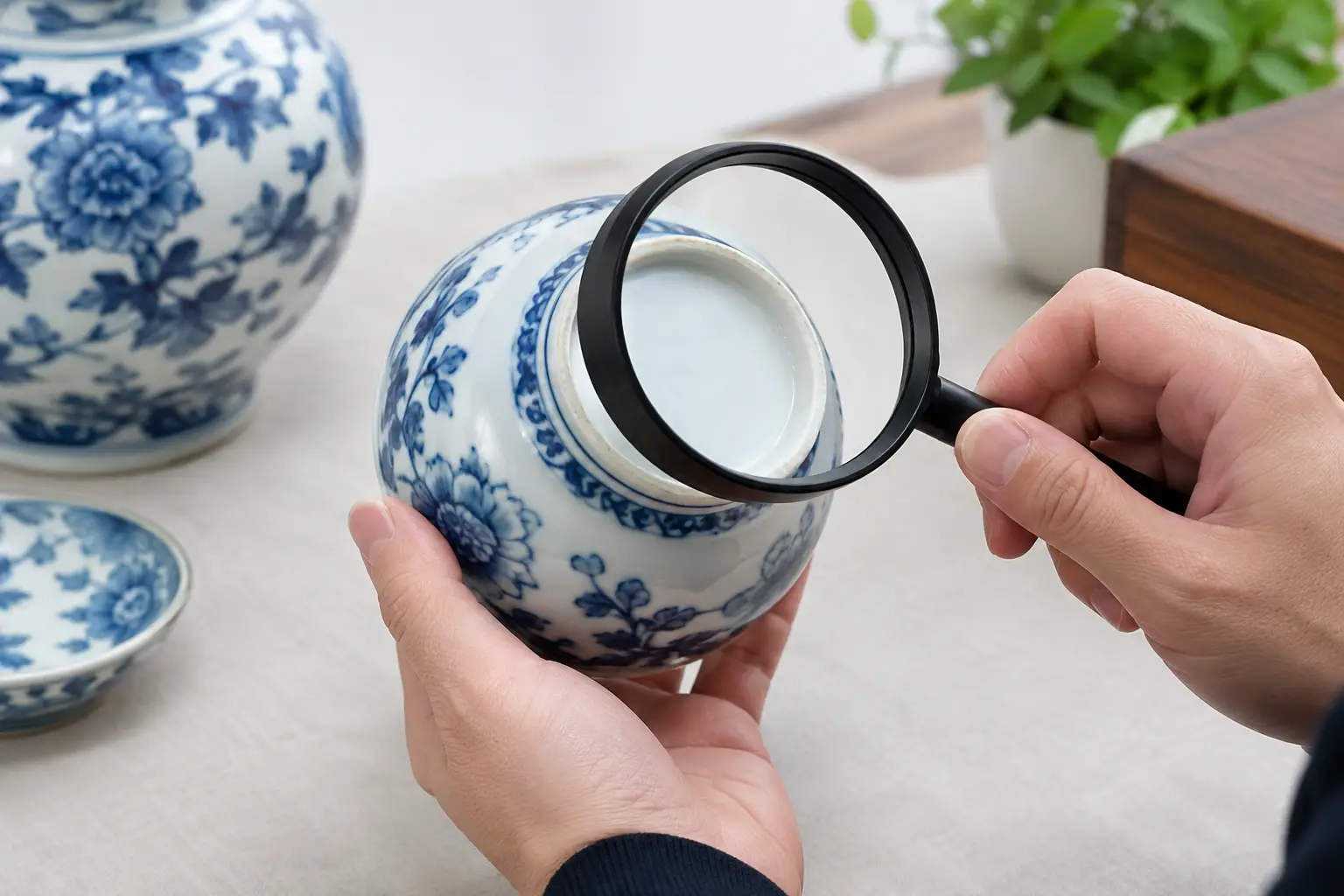
Turn the piece over, but do not begin by tracing the characters. First consider its proportions and purpose. A finely potted cup, a substantial storage jar and a shallow export plate were made for different markets, and their marks can follow different conventions. Note whether the base is glazed, unglazed or recessed; whether there is a neatly cut foot rim; and whether the paste looks dense and refined or coarse and chalky.
Glaze provides equally useful evidence. Early blue-and-white wares may show a soft, slightly pooled blue beneath a luminous glaze, while later pieces can have a clearer, brighter appearance. This is not a fixed rule. Kilns, firing conditions and restoration all affect colour. Still, a visually convincing reign mark on porcelain with an implausibly modern glaze should invite closer scrutiny.
Decoration should be studied as a whole. Look at the confidence of the brushwork, the spacing of motifs, the treatment of clouds, waves, flowers and dragons, and the relationship between the painted design and the vessel’s shape. Great porcelain is not merely decorative. It carries a rhythm born from the hand of the painter, the turning of the potter and the heat of the kiln.
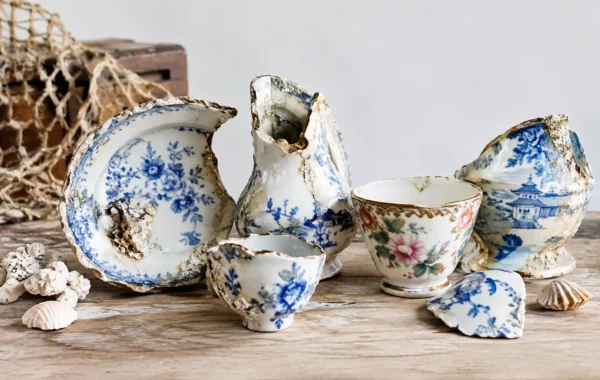
Wear is helpful when read with restraint. Genuine age may appear as rubbing to the foot rim, tiny firing imperfections, glaze contraction, scratches from use or a naturally softened surface. But artificial ageing is common. Dirt pressed into crevices, uniform abrasion and suspiciously dark staining can be created quickly. Conversely, a shipwreck ceramic may show marine accretions, staining or glaze changes from long burial underwater, rather than the wear expected from a cabinet-kept heirloom.
Read the format before the characters
Reign marks are often written in two vertical columns and read from top to bottom, beginning on the right. They may be painted in underglaze blue, written in overglaze red, incised, stamped, moulded or applied in gold. Some are enclosed within a double circle or square; others are left unframed.
The script itself can offer clues. Regular script is generally clear and formal, while seal script is more stylised and can be difficult for beginners to recognise. A six-character mark written with awkward spacing, uneven line weight or an unfamiliar character form may indicate a later copy. However, calligraphy varied between workshops and periods, so untidiness is not proof of forgery.
If you cannot read Chinese, compare the mark’s structure rather than guessing its meaning. Count the characters. Observe whether they are painted freely or look transferred. Notice the colour of the cobalt and whether it sits naturally beneath the glaze. A photograph taken square-on, in good daylight, is far more useful than an image captured at an angle.
Know the marks most often encountered
Ming and Qing reign marks dominate the collector’s imagination. Xuande marks are especially famous because porcelain of that reign is admired for its exceptional blue-and-white production. Chenghua marks are closely associated with refined small-scale wares, while Kangxi, Yongzheng and Qianlong marks appear across a vast and influential range of Qing ceramics.
But familiar names also attract imitation. A Qianlong mark may be found on a genuine nineteenth-century piece, a twentieth-century decorative object or a recent reproduction. Likewise, marks such as Made in China or Jingdezhen China are typically modern commercial marks, though they can still belong to appealing and well-made wares.
Not every significant piece is marked. Many export ceramics, provincial kiln products and earlier wares bear no reign inscription at all. Their dating depends more heavily on material, form and decoration. This is particularly relevant to maritime archaeology, where cargoes often contained practical trade ceramics made in quantity for distant ports rather than exclusively for elite domestic use.
Context gives a porcelain mark its meaning
Provenance is the record of where an object has been and who has owned it. A family history, old auction catalogue, collection label or archaeological record can transform how a mark is understood. It does not replace connoisseurship, but it can establish a chain of evidence that a base inscription alone cannot provide.
Shipwreck ceramics offer one of the clearest examples. An object recovered from a documented wreck can often be placed within a narrow trading period through the ship’s cargo, route and associated finds. The marine environment may alter its appearance, but it also gives the piece a compelling historical setting: porcelain not as an isolated treasure, but as evidence of exchange between Chinese kilns, Southeast Asian ports and households far beyond China.
At Straits & Oriental Museum, maritime collections encourage this wider way of looking. Porcelain recovered from historic shipwrecks is best appreciated not only for its painted surface, but for the voyage it survived and the networks of taste, trade and technology it represents.
When to seek an expert opinion
If a mark appears to indicate a rare early reign, professional assessment is sensible before any purchase, sale, insurance valuation or restoration. A reputable specialist will examine the porcelain in person, often under magnification, and compare it with published examples and known kiln characteristics. They may also assess repairs, replaced sections and altered marks, all of which affect value.
Scientific testing can help in selected cases, but it is not a shortcut to certainty. Thermoluminescence testing is mainly relevant to ceramic bodies and has limitations, particularly with porcelain and samples from repaired areas. Results need to be interpreted alongside visual examination and provenance.
Be wary of certificates that make sweeping claims without photographs, condition notes or the name of a recognised specialist. Equally, do not dismiss a piece merely because its mark is unfamiliar. Chinese ceramics encompass centuries of regional production, export trade and revivalist creativity. Certainty sometimes requires time.
The most rewarding habit is to let curiosity slow the process. Hold the object carefully, study its mark in relation to its making, and ask what journey it has taken before reaching you. That patient attention is often where porcelain begins to reveal its true story.