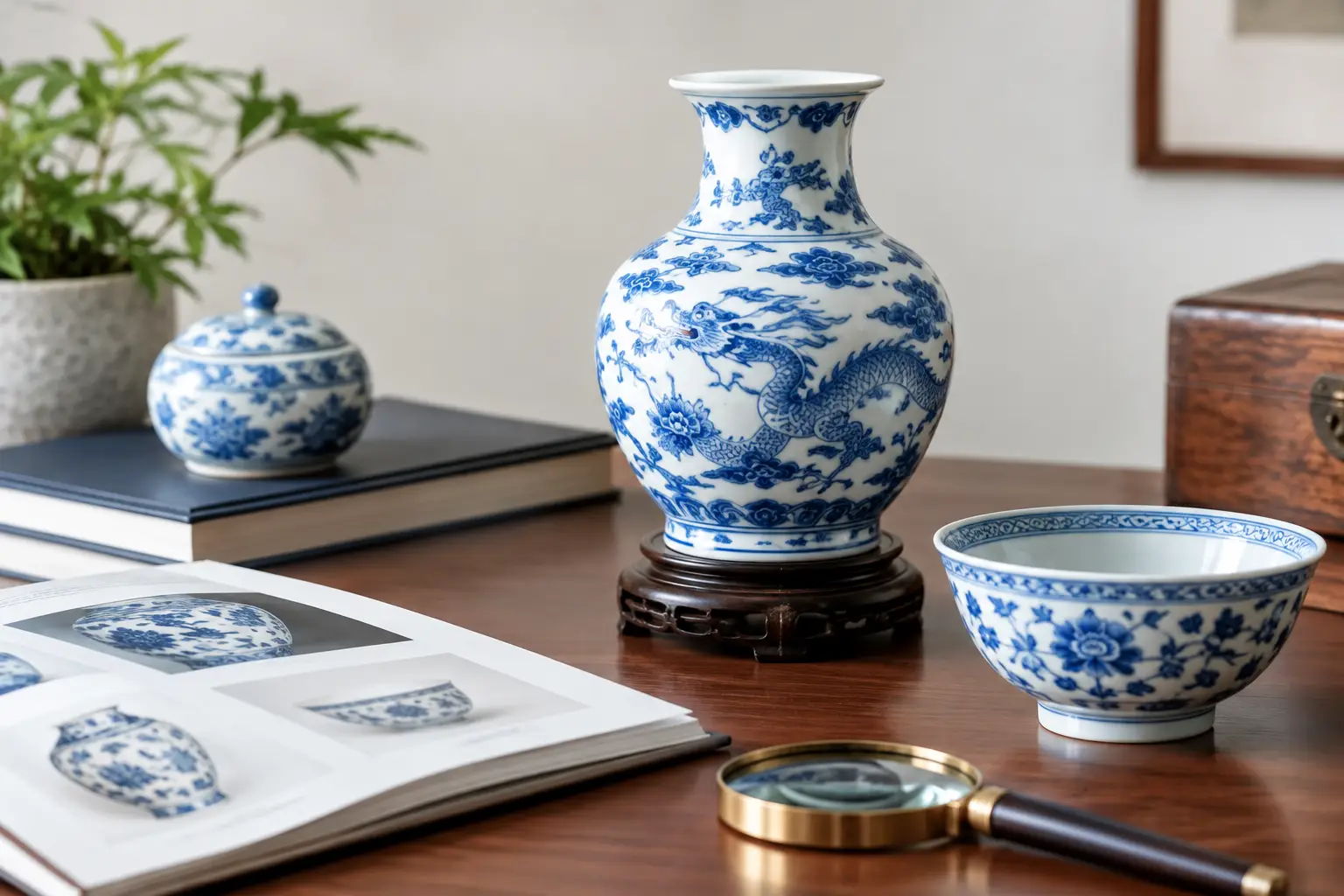

A Ming porcelain collecting guide should begin not with a purchase, but with a closer look. Turn a dish over and the story often gathers at its base: the texture of the unglazed footrim, the pooling of glaze, a kiln grit caught beneath it, or a collector’s label that hints at a journey across centuries. Ming porcelain rewards patience because its beauty is inseparable from the hands, kilns, trade routes and households that gave it purpose.
For a first acquisition, the aim is not to find the grandest blue-and-white vase in the room. It is to develop judgement: to recognise what you are seeing, understand what has happened to it, and decide whether its history, condition and price belong together.
Begin with the Ming period, not a single style
The Ming dynasty spans 1368 to 1644, a long period in which Chinese porcelain changed considerably. Treating every piece labelled “Ming” as though it shares one visual language is the quickest route to confusion. Imperial wares, domestic wares and export ceramics were made for very different markets, often by different levels of production.
Early Ming porcelain can appear restrained, with elegant forms and a clarity of design. The Xuande period is especially admired for its assured blue-and-white painting, rich cobalt and balanced shapes. Chenghua pieces are celebrated for delicacy, while the later Wanli period often presents more animated decoration, bolder composition and a broad range of wares made for local and overseas trade.
A collector does not need to memorise every reign before buying. It is more useful to learn a small number of visual anchors: how a dish sits, how a rim is shaped, whether a painted lotus feels composed or hurried, and how cobalt behaves beneath a clear glaze. Compare similar forms repeatedly. Over time, the eye becomes less dependent on labels.
Let purpose guide your collecting
The most satisfying collections have a point of view. You might be drawn to blue-and-white dishes made for Southeast Asian trade, the quiet warmth of blanc de Chine, ceremonial forms, or the material evidence of maritime exchange. A clear focus brings discipline, particularly when the market offers tempting objects from many periods and price levels.
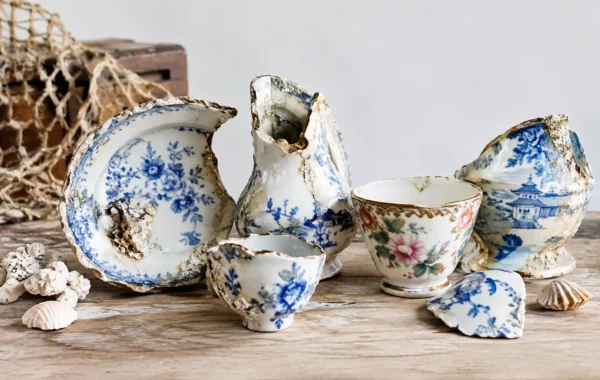
Shipwreck ceramics offer a compelling route into this history. A cargo of bowls, jars and dishes can reveal not only what a kiln produced, but also what merchants believed distant customers wanted. A piece recovered from the sea is therefore more than an antique. It is evidence of a voyage, commercial ambition and the intimate link between China and the ports of the Malay Archipelago.
That said, shipwreck provenance does not automatically make every object rare or valuable. Cargoes often carried large quantities of standardised trade wares. Their appeal may lie in archaeology, context and survival rather than individual refinement. Conversely, a land-excavated domestic piece may be more unusual, yet have little documented history. It depends on what matters most to you: aesthetic distinction, historical context, rarity or investment potential.
How to look at Ming porcelain before you buy
Photographs are useful, but porcelain should be viewed in person whenever possible. Hold the object carefully, support it with both hands, and look at it under natural or neutral light. The overall impression matters, but details decide whether a piece deserves further attention.
Start with the body. Ming porcelain is not uniformly thin or white. Clay, firing and intended function all affect its appearance. Look for a coherent relationship between the paste, glaze and form. The glaze may have tiny pinholes, soft pooling, a faint bluish cast or areas of wear consistent with age, but none of these traits proves authenticity in isolation.
Then study the footrim. It can show trimming marks, firing grit, kiln adhesion and use-related wear. Fresh-looking surfaces, artificially darkened grooves or suspiciously uniform abrasion deserve questions. A genuinely old foot is not a guarantee either, as fragments and old bases can be incorporated into later work. Judgement comes from the whole object, not one supposedly decisive feature.
Decoration should feel integrated with the form. On blue-and-white porcelain, notice the rhythm of brushwork, the variation in cobalt and the way motifs fill space. Later copies can be highly convincing, so avoid relying on a single familiar emblem such as dragons, lotus scrolls or a six-character reign mark. Marks were copied throughout Chinese ceramic history and were often used as homage rather than a literal date.
Condition is part of the object’s biography
Collectors sometimes hear that any restoration makes a piece undesirable. The reality is more measured. A museum-quality, rare object with sensitively disclosed restoration may remain deeply significant. A common bowl with extensive repair, however, may be difficult to live with or resell. Condition and rarity must be assessed together.
Examine rims, handles, spouts and the junction where a footring meets the body. Run a fingernail lightly around the edge to detect chips, and ask to inspect the piece under ultraviolet light where available. Look for hairlines, filled breaks, overpainting, spray restoration and areas where the glaze sheen changes abruptly. Request a condition report in writing, especially for a substantial purchase.
Shipwreck material requires its own caution. Marine encrustation, staining and surface alteration may be expected after centuries underwater. Heavy cleaning can remove valuable evidence, while unstable salts can continue to affect a ceramic object if conservation has been inadequate. Ask who conserved the piece, when the work was undertaken and whether any record accompanies it. Honest wear is part of an object’s maritime character; concealed intervention is another matter.
Provenance protects both value and trust
A beautiful object with a vague backstory can be a poor purchase. Provenance means the documented chain of ownership, collection history or recovery context associated with a piece. It helps establish legal standing, supports attribution and gives a collector confidence that an object has entered the market responsibly.
For Ming porcelain, ask for invoices, previous catalogue entries, published references, old collection labels, export documentation and any available excavation or shipwreck records. Documentation will vary. A modest trade dish may not have an extensive paper trail, while an important object should invite deeper scrutiny.
Be particularly careful with claims of imperial origin, named shipwreck recovery or association with a famous collection. Such claims should be supported by specific records, not merely repeated in sales descriptions. If a seller resists reasonable questions about condition, ownership history or legal export, walk away. There will always be another object, but trust is difficult to restore once lost.
Set a budget that includes learning
The entry point for Ming porcelain is broader than many newcomers expect. A damaged but honest example, a later Ming export dish, or a small piece with a well-documented maritime connection can offer real historical pleasure without competing for the highest tier of the market. Buying the best condition and provenance your budget allows is usually wiser than chasing a spectacular attribution with unanswered questions.
Reserve part of your budget for learning. Specialist catalogues, reputable auction previews, gallery visits and museum displays teach proportion, surface and context in ways that online browsing cannot. Handle authenticated examples whenever a supervised setting permits it. The more pieces you see, the easier it becomes to notice when an object feels inconsistent.
At Straits & Oriental Museum, shipwreck ceramics provide a particularly vivid way to study this wider story. Seeing groups of recovered wares together makes clear that porcelain was both a work of art and a working commodity, made to travel across dangerous seas towards new tables and new tastes.
Care for porcelain without erasing its past
Once acquired, display porcelain away from direct sunlight, strong heat, kitchen vapour and unstable shelves. Use secure stands suited to the form, and avoid adhesive museum wax unless professional advice supports its use. Lift vessels by their strongest area, never by a handle, finial or rim.
For routine care, a soft brush or clean microfibre cloth is generally enough. Do not soak old ceramics, use household bleach, or attempt to remove stains and deposits yourself. Water can enter cracks, and enthusiastic cleaning may destroy traces that help tell the object’s story. When in doubt, consult a qualified ceramics conservator.
A thoughtful collection grows slowly. Choose pieces that make you pause, ask better questions and look again. The most enduring reward is not merely owning Ming porcelain, but learning to recognise the human and maritime histories held within each fired surface.