
A seventeenth-century chart of the Malay Archipelago may show coastlines with startling confidence, then leave whole stretches of land uncertain or imaginatively embellished. That tension is the pleasure of antique map collecting: each sheet records not only a place, but also the knowledge, trade routes, ambitions and assumptions of the people who made it.
For collectors, a historic map can be an object of scholarship, a work of decorative art and a tangible fragment of a changing world. For travellers and museum visitors, it offers a different way to read familiar places. Penang, for example, belongs to a maritime region that was shaped by monsoon winds, port cities and the movement of goods long before modern borders settled into their present form.
What Antique Map Collecting Really Preserves
An antique map is rarely a neutral document. It may have been commissioned to guide a ship, support a colonial claim, educate a European household or advertise a newly understood world. The cartographer chose what to include, what to omit and what to make prominent. Decorative cartouches, sea monsters, royal coats of arms and sailing vessels were not merely ornament. They signalled authority, wealth and imagination.
This is why a map’s inaccuracies can be as revealing as its precision. An island drawn too large, an interior left blank or an old place name can tell us where knowledge was incomplete, contested or filtered through a distant publisher. Early maps of Southeast Asia are especially compelling because they capture a region at the crossroads of Chinese, Indian, Arab and European exchange.
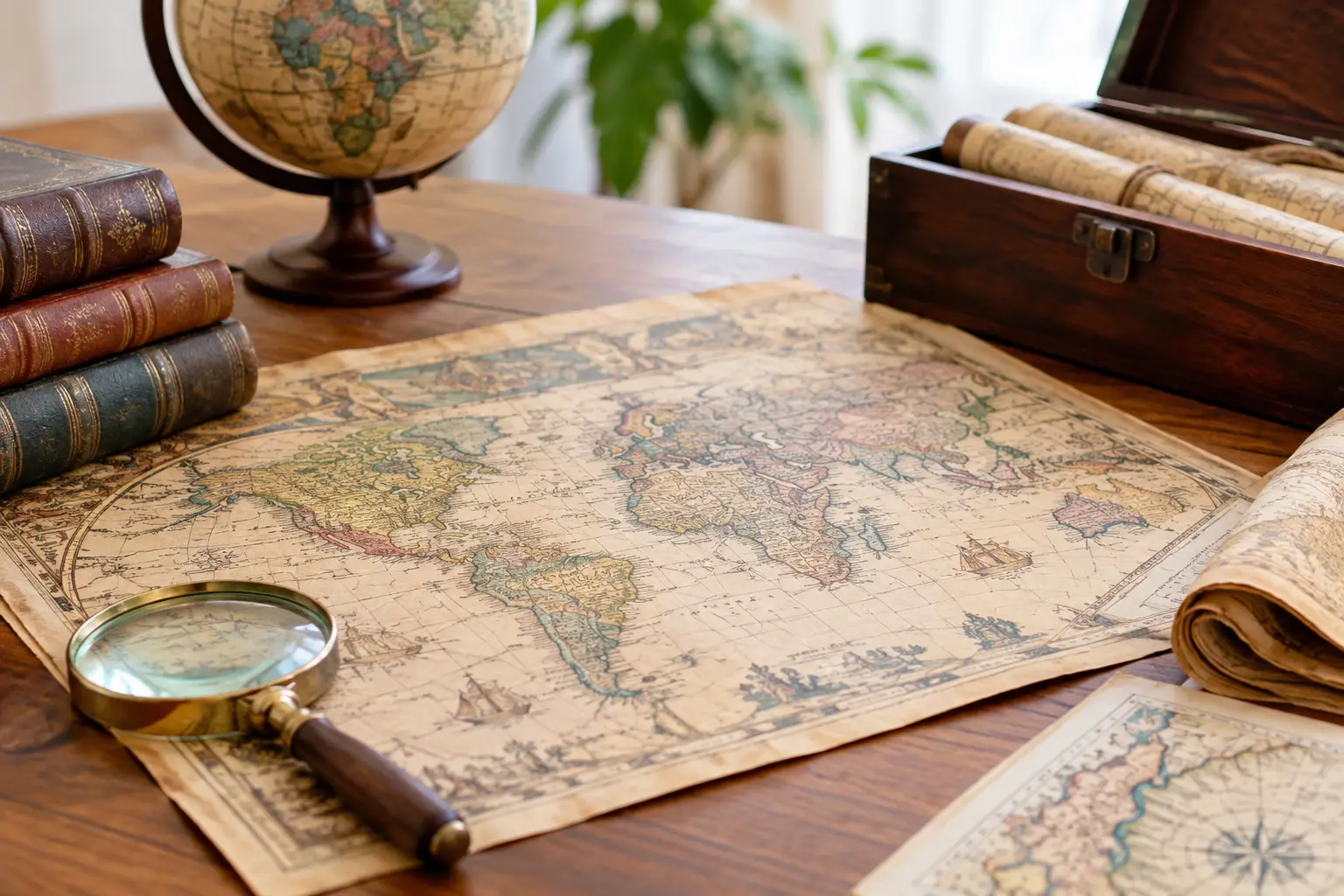
Maritime charts bring another layer of meaning. Soundings, rhumb lines, compass roses and coastal profiles speak directly to navigation and risk. They invite us to consider the same seaborne networks that carried porcelain, spices, textiles and people across the Indian Ocean and South China Sea. A chart need not show a famous shipwreck to illuminate the world in which such voyages took place.
How to Begin Antique Map Collecting with Judgement
The most satisfying collections begin with a question rather than a price point. You might collect maps of a family homeland, historic ports, former empires, botanical discoveries, railway expansion or the changing representation of an island. A focused theme gives a collection character and helps you recognise pieces that genuinely belong together.
It is wise to begin with examples that are well documented and attainable. Nineteenth-century printed maps can offer excellent engraving, strong visual appeal and a clear collecting field without the cost associated with scarce sixteenth- or seventeenth-century works. Original antique maps vary greatly in price. Rarity matters, but so do condition, desirability, subject matter, publisher and the strength of the impression.
Before purchasing, ask the seller direct questions. Is the item an original printed map, a later facsimile or a page removed from an atlas? Has it been coloured by hand at the time of publication, or coloured later? Are the dimensions of the paper or the image area being given? A reputable dealer should be comfortable discussing these points and providing clear photographs of both front and reverse.
Learn to Read the Physical Object
Paper tells a story. Earlier handmade sheets may show laid lines, chain lines or a watermark when held gently to light. Copperplate engraving often creates fine, crisp lines and may leave a faint plate mark around the image. Later lithographic maps have different visual qualities, sometimes with brighter printed colour and a softer, more varied line.
These observations are useful clues, not a substitute for expertise. A genuine old sheet may have been trimmed, repaired or mounted over its lifetime. Conversely, a convincing reproduction may imitate foxing and age. When a purchase is significant, consult a specialist dealer, conservator or established auction house rather than relying on a single visual detail.
Provenance deserves equal attention. A map with a reliable record of ownership, catalogue reference or publication source has greater scholarly and collecting confidence than one with an uncertain history. This is particularly important for material connected to colonial administration, conflict or vulnerable cultural heritage. Collect with curiosity, but also with care for lawful and ethical ownership.
Condition Is Part of the Story, Not the Whole Story
Collectors often worry about every mark on a map, yet condition is best judged in context. Light toning, a centre fold or modest signs of handling may be entirely consistent with a sheet that has survived for centuries. A rare chart with honest age may be more meaningful than a common example in pristine condition.
The greater concerns are structural. Look closely for tears that enter the image, brittle paper, extensive staining, losses at the margins, mould damage, heavy bleaching and repairs that obscure detail. Old backing, adhesive residue and aggressive restoration can affect both appearance and value. A map that has been washed or professionally conserved is not automatically undesirable, but the work should be disclosed and sensitively done.
Colour also requires judgement. Original hand colour may be subtle, sometimes uneven, and should sit naturally with the printing. Overly vivid washes can indicate later enhancement, though some later nineteenth-century maps were originally published in strong colour. It depends on the period, printer and intended market. The aim is not perfection, but honesty.
The Difference Between Decorative and Historical Value
A beautiful map can transform a room, but decoration and history do not always move together. A large, richly coloured world map may command attention above a dining table, while a small coastal chart may hold deeper importance for a specialist collector. Neither approach is wrong. The best choice is the one that gives you enduring pleasure and a reason to keep looking.
If display is your priority, consider scale, colour palette and how much natural light reaches the wall. If research is the priority, prioritise legibility, publication detail and comparability with other maps in your chosen field. Many collectors find a balance: a visually striking centrepiece accompanied by smaller sheets that build a more detailed narrative.
At Straits & Oriental Museum, objects associated with maritime exchange remind us that beauty and evidence often coexist. A ceramic vessel recovered from the sea can be admired for its glaze while also speaking to trade, technology and human movement. Historic maps deserve the same twofold attention. They are artful objects, but they also ask to be read.
Caring for Maps at Home
Paper is resilient when treated gently and unforgiving when neglected. Keep maps away from direct sunlight, damp walls, kitchens and spaces with dramatic changes in temperature or humidity. Sunlight fades pigments and weakens paper fibres; moisture can encourage mould and distortion.
For unframed maps, use archival-quality folders or mounts and store them flat where possible. Avoid ordinary adhesive tape, acidic card and plastic sleeves that may trap moisture. If framing, select acid-free materials and ultraviolet-filtering glazing, and ask a professional framer to use reversible mounting methods. A map should never be permanently glued to a backing merely for convenience.
Handle a map with clean, dry hands, supporting it fully rather than lifting it by one corner. Cotton gloves are not always necessary and can reduce dexterity, but food, drinks and hurried handling have no place near historic paper. If a sheet is fragile, rolled, mould-affected or badly torn, seek conservation advice before attempting to flatten or clean it yourself.
Build a Collection That Keeps Revealing Itself
The finest collections are not assembled in a rush. They develop through looking, comparing, reading catalogues and returning to the same questions over time. Keep a record of each acquisition: title, cartographer, date, publisher, dimensions, condition, purchase details and what first drew you to it. That small act of documentation turns possessions into a considered archive.
Visit exhibitions, study maps in libraries and speak with knowledgeable dealers whenever possible. Seeing original sheets in person teaches scale, texture and printing quality in a way that digital images cannot. It also sharpens your eye for the details that make one impression more compelling than another.
A map may begin as a beautiful object on a wall. Given time, it becomes a prompt to imagine a harbour at first light, a ship setting its course, or a place known by another name. That is the lasting reward of collecting: not owning the past, but keeping its journeys in view.