
George Town rewards visitors who slow down. The most Essential Penang heritage experiences are rarely found behind a single grand façade. They appear in the five-foot ways of weathered shophouses, in incense-scented temple halls, at a kopitiam table, and in the quiet evidence of centuries of trade carried across the Straits of Malacca.
This is a city shaped by movement: merchants, migrants, faiths, flavours, craft traditions and precious cargoes arriving by sea. A satisfying heritage day is therefore not about collecting landmarks. It is about noticing how these histories still live together, often on the same street.
Essential Penang Heritage Experiences for a Deeper Visit
1. Walk George Town’s historic streets with time to linger
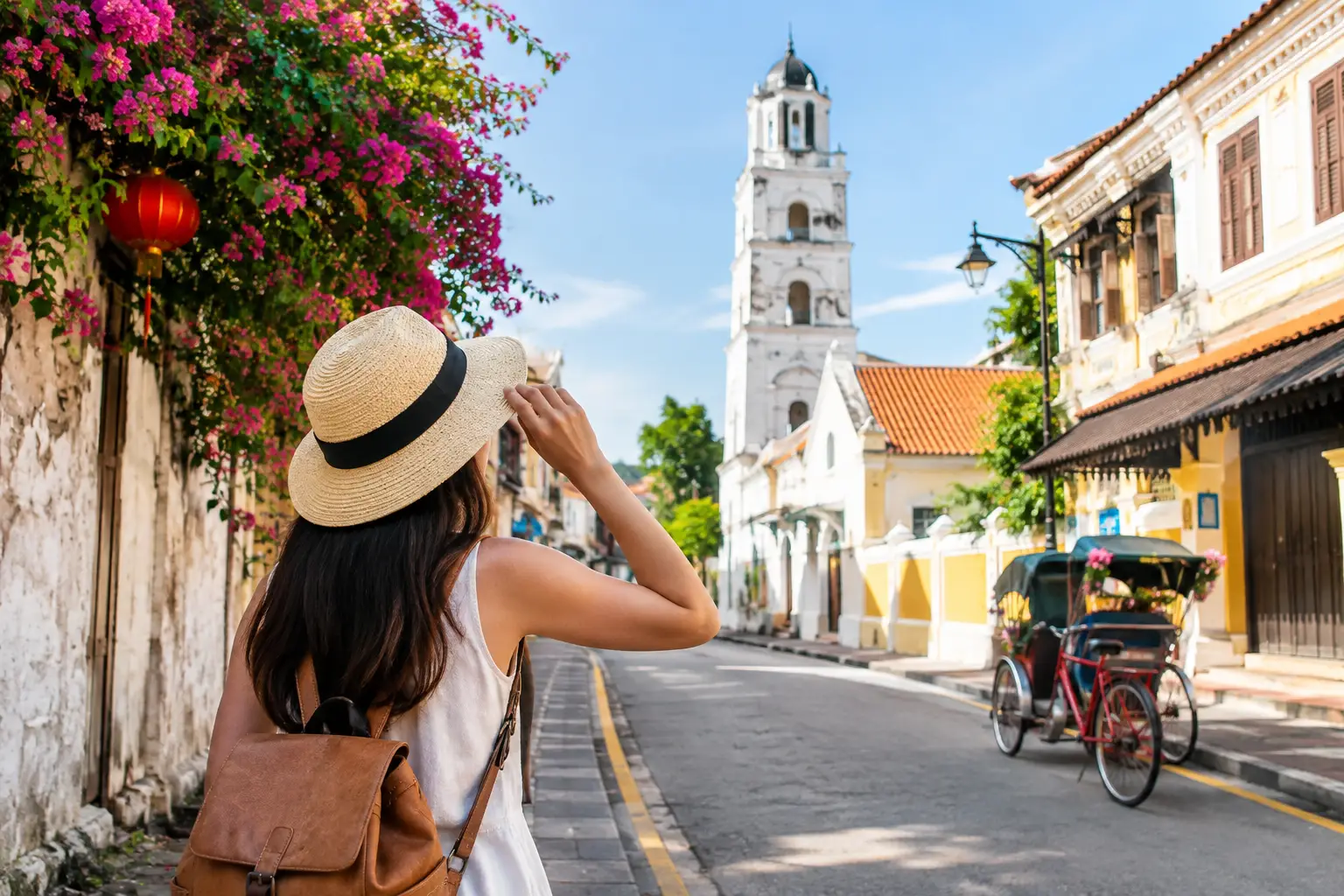
Start on foot, preferably early before the heat and crowds gather. George Town’s heritage core is best read at walking pace, where each row of shophouses reveals a different architectural language: Chinese carved timber doors, European shutters, Malay details and tiled façades influenced by generations of regional exchange.
Look beyond the most photographed corners. A signboard in several languages, a clan association tucked behind an unassuming entrance or an ageing five-foot way can tell a fuller story than a hurried itinerary. The five-foot way itself is a remarkable piece of living urban design: a covered pedestrian passage that offers shade, shelter and a shared threshold between home, trade and public life.
There is a trade-off here. A guided walk can provide useful context and point out details that are easy to miss, while independent wandering leaves more room for serendipity. For first-time visitors, a little of both often works best.
2. Visit a living clan house, not only a museum
Penang’s Chinese clan houses and associations are among its most distinctive cultural institutions. They were formed by communities linked through family name, district of origin or trade, offering newcomers support in a busy port city far from home.
Their elaborate halls were never merely decorative. Carved panels, ancestral tablets, courtyards and ceremonial spaces express ideas of lineage, duty and belonging. When visiting, take a moment to observe the craftsmanship as well as the symbolism. The dragons, phoenixes, peonies and calligraphy are part of a visual language that carries values across generations.
These are often active places of worship and remembrance, not frozen historic sets. Dress respectfully, keep voices low where appropriate and be mindful of ceremonies. That small courtesy changes the experience from sightseeing into genuine cultural encounter.
3. Step into Penang’s multi-faith streetscape
Few places make Penang’s plural heritage as visible as the streets around its historic houses of worship. Mosques, temples and churches stand within a short walk of one another, reflecting a trading settlement where different communities built lasting roots without losing their own traditions.
The value of this experience lies in attention rather than speed. Notice the architectural choices: a temple roofline, a mosque’s calligraphic detail, stained glass catching the tropical light, or the particular rhythm of a street becoming quieter near a sacred entrance. Each building has its own rules around dress, photography and visiting hours, so a flexible route is wiser than a rigid schedule.
Heritage is sometimes described as harmony in broad terms. Here, it is more interesting than that. It is a record of communities maintaining distinct identities while sharing a compact city, its commerce and its public spaces.
4. Taste the histories carried by Penang’s food
A heritage itinerary without food misses one of Penang’s most eloquent archives. Hawker dishes, kopitiam breakfasts and family-run restaurants preserve techniques, ingredients and culinary exchanges that developed through migration and trade.
Order with curiosity. Nyonya cooking reflects the meeting of Chinese and Malay foodways; Indian Muslim cooking speaks to long-established mercantile connections; noodle dishes and spice pastes reveal adaptation as much as continuity. The same dish may vary from stall to stall because heritage is not fixed. It is handed down, adjusted and argued over.
Choose busy, well-kept stalls and be prepared to queue at popular times. A polished restaurant meal can offer comfort and refinement, while a modest roadside table can offer immediate local character. Neither is inherently more authentic. What matters is the care behind the food and the story it allows you to taste.
5. Look closely at maritime history and shipwreck ceramics
Penang’s identity cannot be separated from the sea. Its position along historic maritime routes brought people, ideas and goods through the region, including the ceramics that travelled from Chinese kilns to distant markets across Asia and beyond.
Shipwreck artefacts offer an unusually tangible way to understand that world. A bowl, jar or blue-and-white porcelain dish recovered from the seabed is more than an attractive object. It is evidence of a journey interrupted, of patterns of trade, taste and diplomacy, and of the immense skill required to produce ceramics for an international market.
At Straits & Oriental Museum, authentic porcelain and ceramic artefacts from significant Asian shipwrecks place this maritime story at the centre of a wider cultural outing. The experience is especially rewarding for visitors who enjoy looking beyond surface beauty: examine a vessel’s form, its glaze, its decorative motifs and signs of use. These details document the splendour of porcelain while reminding us that even treasured objects were once cargo, packed for passage across uncertain waters.
6. Seek out the craft behind the façade
George Town’s built heritage is not simply about old buildings surviving. It is also about the skilled work that allows them to endure. Decorative tiles, lime plaster, timber joinery, sign painting and carved ornament all require knowledge that cannot be replaced by a quick cosmetic renovation.
When you encounter a restored shophouse, look for restraint. The most successful conservation usually keeps the building’s proportions, materials and imperfections legible, rather than smoothing every surface into a modern imitation of the past. A handsome restoration can make a space welcoming, but over-polishing risks turning heritage into scenery.
If a gallery, workshop or cultural venue offers a chance to meet makers or learn about traditional techniques, take it. Craft provides a useful corrective to the idea that heritage belongs only to grand collections. It lives in patient hands, practical materials and repeated acts of repair.
7. Make room for contemporary art and new interpretations
Heritage cities need not stand still to be respected. George Town’s galleries, exhibitions and creative spaces show how artists and curators continue to respond to questions of memory, identity and place.
This is where an itinerary gains depth. An exhibition of contemporary work may challenge sentimental ideas about the past, while a design-led space in a conserved building can demonstrate how old structures find useful new lives. Not every modern intervention will suit every visitor, and that is part of the conversation. The strongest ones acknowledge the building’s history rather than using it as a decorative backdrop.
For families, art spaces can also balance more formal heritage visits. Younger visitors may connect first with colour, objects and stories, then begin asking why a neighbourhood looks the way it does.
8. End the day where heritage meets hospitality
A meaningful heritage visit deserves time to settle. Choose a café, restaurant or bar in a historic setting and let the day’s impressions gather: the salt-trade routes suggested by a ceramic bowl, the scent of temple incense, the changing texture of shopfronts from one block to the next.
This is not an indulgence separate from cultural discovery. Hospitality has long been part of Penang’s social fabric, whether through a shared meal, coffee at a kopitiam or the welcome offered to travellers and trading partners. The setting matters, but so does the pace. Leave room to talk about what surprised you rather than rushing towards the next attraction.
How to Experience Heritage with Care
Penang’s heritage is both precious and lived in. Residents still work, worship, trade and raise families in the neighbourhoods visitors come to admire. Keep pathways clear, ask before photographing people or private interiors, and support businesses that show genuine regard for local culture rather than treating it as a costume.
It also helps to resist the urge to see everything in one day. A short visit can cover key sights, but two unhurried days allow room for repeat walks at different hours, a proper meal and the kind of unexpected discovery that makes George Town memorable.
The finest souvenir is not a rushed photograph or a checklist completed. It is the ability to recognise Penang as a port city with a living memory – one still being written in its streets, kitchens, sacred spaces and objects carried across the sea.