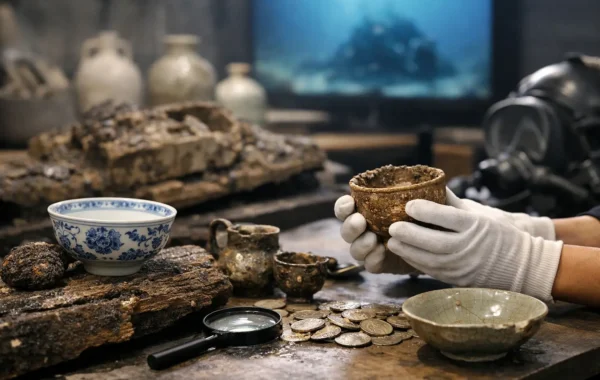

A bowl recovered from the seabed can reveal far more than a beautiful glaze. Its shape may point to a Ming dynasty kiln, its painted motifs may suggest its intended market, and the place where it was found may trace a trading route that once connected China with the Malay Archipelago. If you have asked, “where can I learn about Chinese porcelain in Malaysia?”, the most rewarding answer is to seek out places where the object, its journey and its historical setting are presented together.
Malaysia is exceptionally well placed for this kind of learning. For centuries, its ports sat along vital maritime routes linking China, Southeast Asia, India and beyond. Chinese ceramics did not arrive here as isolated artworks. They travelled as cargo, household goods, diplomatic gifts and treasured possessions. Learning to recognise them means following those routes as much as studying their surfaces.
Where can I learn about Chinese porcelain in Malaysia?
Begin with museums and heritage collections that place ceramics in a clear historical context. A well-curated display should do more than label an item as “blue and white” or “Ming”. It should help you see why a particular vessel was made, how it was used, where it was produced and what its presence in Southeast Asia tells us about trade, taste and exchange.
For visitors to Penang, Straits & Oriental Museum offers a particularly distinctive encounter with this history through authentic ceramics recovered from notable Asian shipwrecks. Its permanent collection includes artefacts associated with wrecks such as the Wanli, Turiang, Royal Nanhai, Nanyang, Xuande and Desaru. Here, porcelain is not simply displayed as a decorative achievement. It is presented as maritime evidence: a record of the merchants, vessels and sea lanes that shaped the region.
This approach is valuable for first-time learners because shipwreck ceramics retain an unusually powerful sense of context. A plate in a cabinet is beautiful; a plate understood as part of a cargo loaded for a distant market becomes part of a much larger story.
Start with the details that porcelain makes visible
Chinese porcelain can feel intimidating because there are so many dynasties, kilns, forms and decorative traditions. You do not need to memorise all of them before visiting a collection. Start by training your eye to notice a few meaningful details.
Look first at form. Is the object a small cup, a deep bowl, a storage jar, a dish or a ewer? Form often suggests function. A large, durable jar may have been made for storage or transport, while a finely painted dish may have held a more ceremonial or domestic role. Ceramics made for export were frequently shaped to suit customers in overseas markets, so familiar Chinese forms may sit alongside designs made with Southeast Asian, Islamic or European preferences in mind.
Then consider the body and glaze. Porcelain is prized for its hard, pale body and luminous finish, but not every Chinese ceramic is porcelain in the strictest sense. Stoneware and earthenware also travelled widely through Asian trade networks. A museum label may distinguish between them, and asking why that distinction matters is a useful way to deepen your understanding.
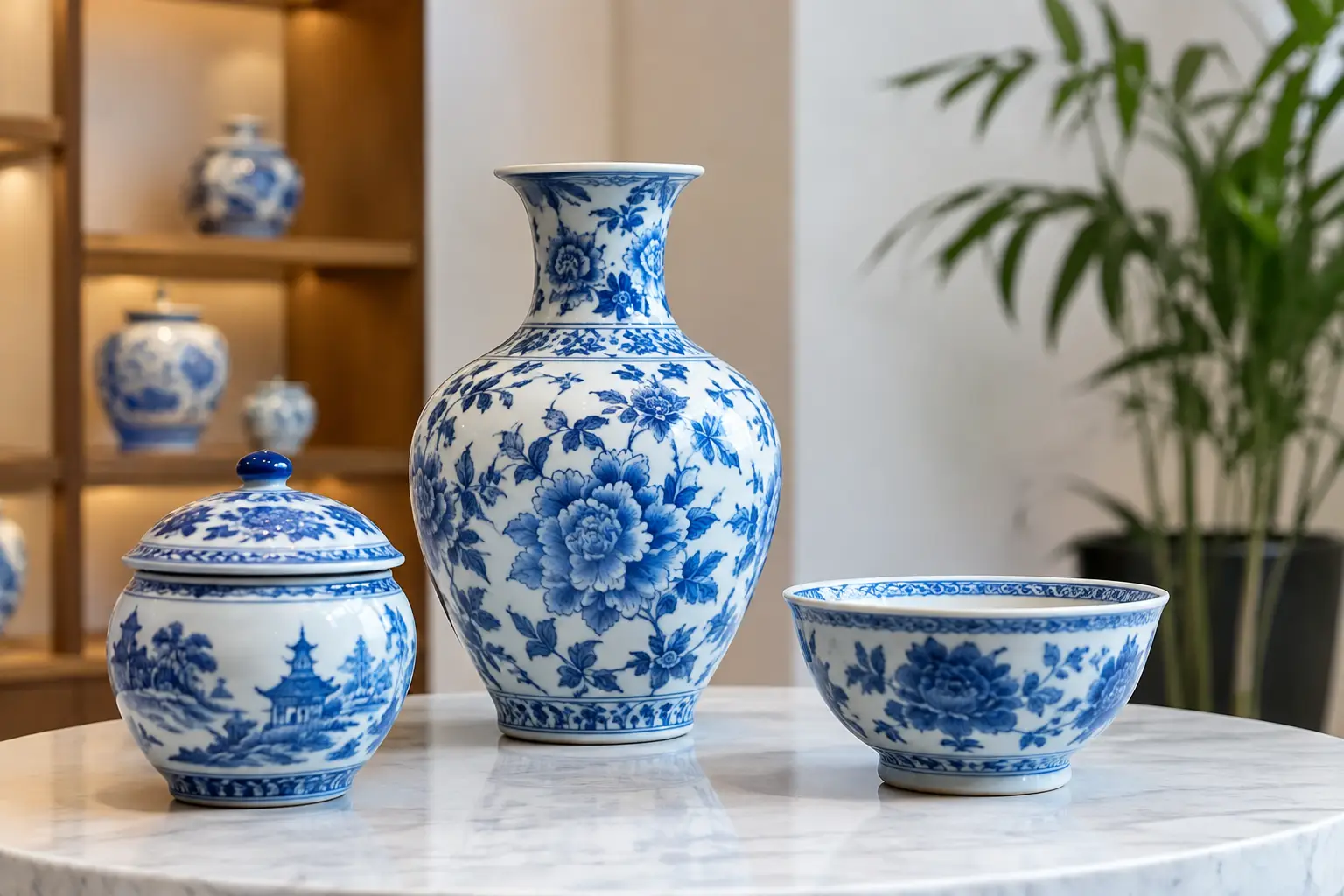
Decoration offers another entry point. Blue-and-white wares, painted with cobalt beneath a transparent glaze, are among the most recognisable. Yet colour alone is not a date. Look at the brushwork, the density of the pattern, the border designs and the motifs themselves. Peonies, lotus flowers, dragons, landscapes and auspicious symbols all carry visual traditions that changed across periods and markets.
Finally, turn the piece over when displays allow you to view its base. Foot rings, glaze colour, kiln grit and marks can be revealing, although they should never be treated as a shortcut to certainty. Marks can be copied, absent or misread. The strongest interpretation comes from looking at the whole object, not from relying on one detail.
Learn through maritime history, not just dynasty names
Many introductions to Chinese ceramics are arranged around imperial reigns. That is useful, particularly when learning the broad chronology of Song, Yuan, Ming and Qing production. In Malaysia, however, there is another route that often feels more immediate: learn through the sea.
A shipwreck collection allows you to see ceramics as cargo. You can ask what was travelling alongside it, who might have commissioned it and where it was headed. The answer may reveal that Chinese porcelain was part of a commercial language shared across ports from Fujian and Guangdong to Melaka, Penang and the wider archipelago.
This perspective also explains why objects found in Southeast Asia sometimes look different from pieces associated with imperial collections in China. Export ceramics were made for varied buyers. Some were modest everyday wares produced in volume; others were luxurious commissions. Neither category is inherently more meaningful. A simple bowl can be a remarkable witness to ordinary commerce and cultural exchange.
For families and casual visitors, this is often the best way to make the subject feel alive. Rather than asking a child to remember a date, ask them to imagine the vessel’s journey: where it was loaded, how it was packed, what storms it faced and whose table it might eventually have reached.
Combine museum visits with George Town’s living heritage
Chinese porcelain becomes more intelligible when seen alongside the communities and built environments that grew through trade. In George Town, historic streets, clan houses, temples and shopfronts offer a setting in which Chinese material culture is not remote from daily life. The city’s heritage is shaped by Malay, Chinese, Indian, Peranakan and European connections, and ceramics belong within that wider conversation.
Allow time after a museum visit to notice how decorative traditions continue in architectural tiles, altar wares, domestic objects and food culture. This is not the same as identifying antique porcelain, nor should every old-looking ceramic be assumed to be historic. It is simply a way to recognise that trade left enduring marks on visual life.
Those with a serious collecting interest may also encounter antiques through specialist dealers, galleries or auction settings. This can be educational, but it requires discernment. The commercial market is not a substitute for a documented museum collection. Condition, restoration, attribution and provenance all affect an object’s meaning and value, and confident claims should be supported by evidence rather than appearance.
Questions worth asking when you visit
The most memorable museum visit is rarely silent. Curators, guides and gallery teams can help turn an attractive object into a historical one, especially if your questions are specific.
Ask where the piece was made and whether its kiln or region can be identified. Ask how it was dated, whether it was produced for local use or export, and what the object was found with. If it came from a shipwreck, ask where the vessel was travelling and what that route reveals about the period.
It is equally worthwhile to ask about uncertainty. Archaeology does not always supply a complete answer. A fragment may be securely dated by its excavation context but impossible to attribute to one exact workshop. Another piece may resemble a known type but have an unclear original destination. Good interpretation makes room for this uncertainty rather than hiding it.
Build knowledge slowly, with the real object at the centre
Photographs and reference books are helpful, but porcelain rewards close looking. The scale of a bowl, the weight of a jar, the way cobalt pools under glaze, or the wear around a foot ring can be difficult to grasp on a screen. Repeated visits to museum collections develop visual memory in a more reliable way than chasing instant identification online.
Keep a small notebook, or use your mobile phone to record observations where photography is permitted. Note the period, material, decorative motif and the reason a piece caught your attention. Over time, patterns emerge: perhaps you are drawn to celadon’s quiet green surface, the energy of blue-and-white painting, or the practical elegance of export storage jars.
Leave room, too, for pleasure. Chinese porcelain is a field of scholarship, but it is also an art of extraordinary refinement and human connection. Stand before a vessel long enough to see its details, then imagine the hands that made it, packed it and carried it across the seas. That moment of attention is where a museum visit becomes a journey through time.