
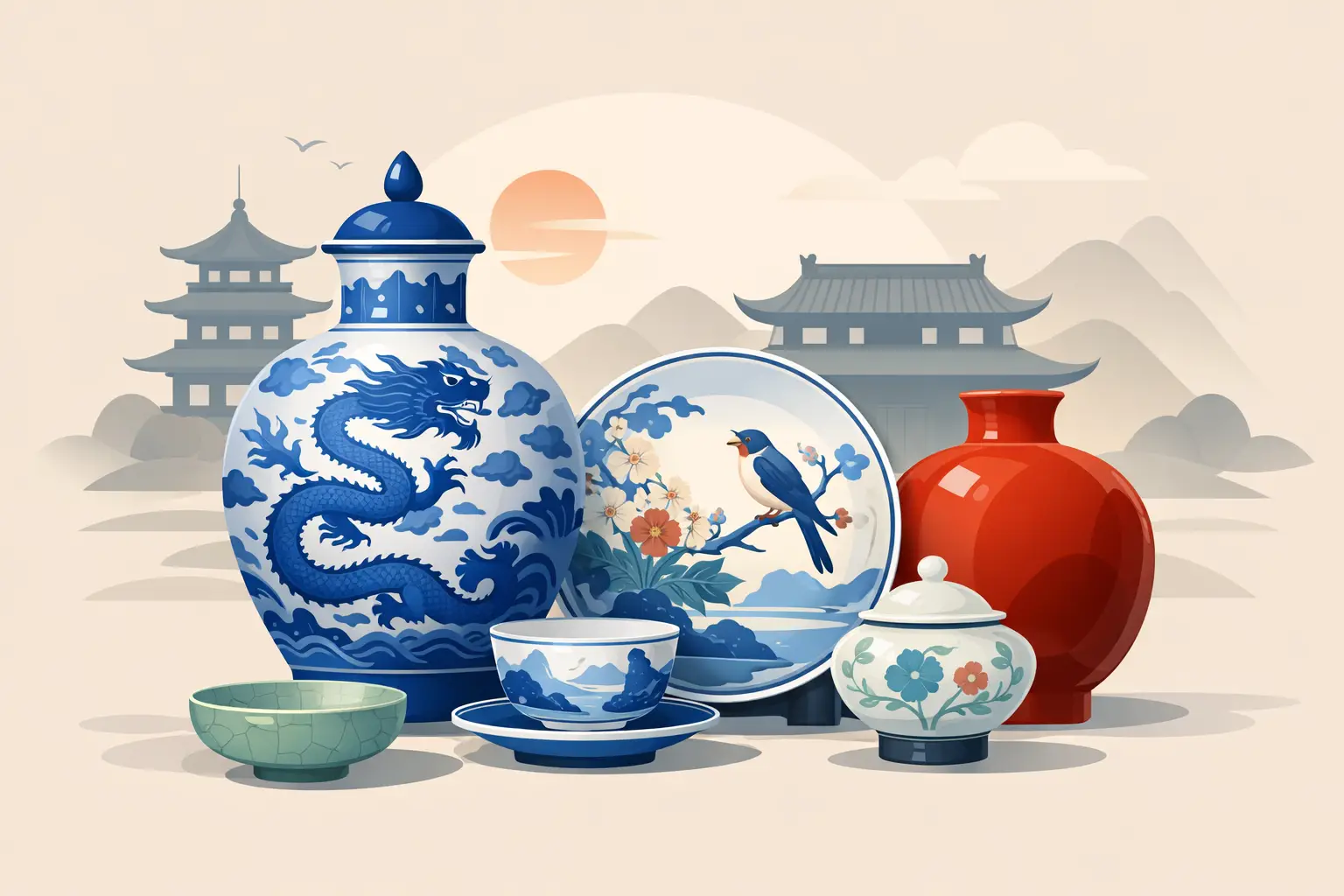

A shard of blue-and-white porcelain can hold an empire in miniature. For many visitors, collectors and history lovers, a guide to Ming dynasty ceramics begins with that first moment of recognition – the clear ring of porcelain, the confidence of cobalt brushwork, the balance between refinement and utility. Ming wares are admired for their beauty, certainly, but their lasting fascination comes from something larger: they were made for court ritual, domestic use, export trade and maritime exchange across Asia and beyond.
That breadth is what makes Ming ceramics so rewarding to understand. They are not one neat category but a vast family of objects shaped by imperial taste, technical innovation, kiln practice and global demand. Some were destined for palace tables, some for scholars’ desks, and some for ships crossing dangerous sea routes. Read well, a bowl or jar can tell you where it was made, who may have used it, and how far it travelled.
Why Ming ceramics matter
The Ming dynasty, which ruled from 1368 to 1644, presided over one of the great flowering periods in ceramic history. This was the era in which Jingdezhen became the pre-eminent centre of porcelain production, supplying the imperial court and producing wares that circulated across the world. When people picture Chinese porcelain, they often picture a Ming ideal – luminous white bodies, vivid underglaze blue, elegant proportions and decoration that feels both disciplined and alive.
Yet the appeal of Ming ceramics is not only aesthetic. They sit at the meeting point of art, commerce and seaborne history. Export porcelains carried Chinese forms and motifs into Southeast Asia, the Middle East and Europe, while overseas demand in turn shaped what was made. That is why shipwreck ceramics are so revealing. They preserve not merely objects, but evidence of taste, trade and risk on the maritime routes that linked ports, courts and marketplaces.
A practical guide to Ming dynasty ceramics by period
One of the most useful ways to read Ming ceramics is by reign period. Dates alone do not guarantee identification, and reign marks can mislead, but period style remains an essential starting point.
Early Ming
Early Ming wares, especially from the Hongwu and Yongle periods, often show restraint. Forms can feel solid and assured, with clean silhouettes and a certain calm authority. By the Xuande reign, blue-and-white porcelain had reached extraordinary sophistication. Cobalt painting appears rich and painterly, sometimes with soft tonal variation where the pigment has pooled or feathered slightly beneath the glaze.
Xuande pieces are especially prized, though that fame also means later copies are common. If a piece feels almost too eager to declare its importance, caution is wise. The best early Ming ceramics tend to project confidence without theatricality.
Middle Ming
The middle Ming period brought broader production and greater diversity. Decorative schemes became more abundant, and export demand increasingly influenced kiln output. Chenghua wares are celebrated for delicacy, especially in doucai decoration, while later fifteenth- and sixteenth-century pieces may show more energetic patterning and a wider range of forms.
This is where context matters. A bowl made for domestic elite use and a dish intended for overseas trade may emerge from the same broad period but speak very different visual languages. Neither is inherently lesser. They simply answered different needs.
Late Ming
Late Ming ceramics, particularly from the Wanli period, are central to many maritime collections because they travelled widely in commercial cargoes. These wares can be lively, ambitious and sometimes less exacting in finish than earlier imperial standards. That does not diminish their historical value. In fact, their very scale of production helps explain the intensity of regional trade.
Wanli blue-and-white often features dense decoration, kraak-style panelled designs for export markets, and forms that were made to move in quantity. In a museum setting, such pieces are especially compelling because they connect the workshop directly to the shipping lane.
What to look for in Ming porcelain
A good guide to Ming dynasty ceramics should teach the eye before it teaches terminology. The first thing to study is form. Ming potters understood proportion at a remarkably high level, whether in the swelling body of a jar, the measured curve of a dish or the poised foot of a cup. Even when decoration is elaborate, the shape usually does a great deal of the work.
Next comes the body and glaze. True porcelain from Jingdezhen typically has a fine, hard white body and a glaze that appears clear, smooth and well integrated with the surface beneath. Wear is normal on authentic old pieces, but it should make sense. Artificial ageing often looks indiscriminate, as if damage has been applied rather than lived.
Decoration repays close attention. Underglaze blue is the signature most people know, yet within that category there is enormous variation. Early cobalt may appear deep and slightly uneven in ways that specialists value. Later blue can look brighter or more controlled, depending on material and firing. Overglaze enamels, doucai and wucai palettes also appear in the Ming world, each with its own technical and visual character.
Then consider the footrim and base. These areas can reveal trimming marks, firing grit, glaze termination and other practical clues. Reign marks attract attention, but they should never be read in isolation. Many later wares bear apocryphal marks honouring earlier periods. A convincing mark on an unconvincing body proves very little.
Imperial wares and export wares
One of the most common misunderstandings is to assume that all Ming ceramics aspired to imperial perfection. In reality, Ming production ranged from court-controlled masterpieces to commercial wares made for broad distribution. The distinction matters because it affects how a piece should be judged.
Imperial wares were made to exacting standards and often reflect the taste of a particular reign. Their materials, decoration and finishing can be exceptionally refined. Export wares, by contrast, were often designed around volume, transport and foreign demand. They may show stacking marks, kiln flaws or brisker brushwork, yet they are among the most eloquent witnesses to global exchange.
For a public audience, export ceramics are often the most immediate. They make visible the maritime networks that carried porcelain into homes, markets and royal courts far from China. Seen this way, a cargo bowl is not a lesser cousin of an imperial dish. It is a different kind of historical document.
Why shipwreck finds change the story
Shipwreck ceramics bring Ming history closer because they preserve objects within the drama of movement. Instead of viewing porcelain only as a finished art object, we encounter it as cargo – packed, traded, handled and sometimes lost at sea. This context sharpens our understanding of quantity, destination and demand.
Marine recovery also introduces complexity. Saltwater burial, encrustation and conservation can alter appearance. A shipwreck piece may not have the polished surface condition of an item preserved in a palace collection, but it often possesses something equally valuable: undeniable archaeological context. That context can speak with unusual authority about dating, trade patterns and the circulation of particular forms.
For institutions that foreground maritime archaeology, Ming ceramics become part of a larger regional story. They are not isolated treasures behind glass but survivors of the routes that once connected China with Southeast Asia and the wider world. At places such as Straits & Oriental Museum, this perspective adds a rare dimension, inviting visitors to see porcelain not only as art but as evidence of the sea’s long memory.
Collecting and interpreting with care
For new collectors, enthusiasm should be paired with patience. The Ming field is rich, but it is also full of later copies, restored pieces and objects described too confidently. Provenance, condition and expertise all matter. Hairlines, chips and restoration do not automatically ruin a piece, but they do affect value and should be honestly assessed.
It also helps to decide what kind of collector you want to be. Some people pursue imperial-quality porcelain, others are drawn to export wares, kiln variation or shipwreck material. A focused eye usually leads to better decisions than a purely status-driven one. The strongest collections are often built around curiosity rather than prestige alone.
For non-collectors, the same principle applies in the gallery. Looking slowly is more rewarding than trying to memorise dynastic facts. Notice the thickness of a rim, the looseness or control of brushwork, the way a motif fills space, the relationship between function and ornament. Ming ceramics reveal themselves in stages.
The pleasure of learning to see
To learn Ming ceramics is to learn a language of form, fire and exchange. Some pieces impress instantly with brilliance and symmetry. Others grow in stature as you recognise what they have survived, where they may have travelled, and how they fit into the larger movement of goods and ideas across the seas.
The finest guide to Ming dynasty ceramics does not ask you to admire porcelain from a distance. It invites you to look closely, ask better questions and enjoy the object as both artwork and witness. Once that habit of seeing takes hold, even a single bowl can open out into a remarkably wide world.