
A large jar with broad shoulders, painted in a blue so vivid it still feels fresh after seven centuries, rarely needs an introduction. Yuan dynasty porcelain characteristics announce themselves with confidence – scale, drama, and a new visual language that would shape ceramic history far beyond China.
For visitors drawn to maritime collections and the long story of trade across Asia, Yuan porcelain is especially compelling. It belongs to a moment when ceramics were no longer made only for local taste or courtly use, but increasingly for movement – across ports, seas, and cultures. That is part of what gives these wares their distinct presence today.
What makes Yuan dynasty porcelain characteristics so recognisable?
The Yuan dynasty, which lasted from 1271 to 1368, sits at a turning point in ceramic production. Earlier Chinese ceramics could be exquisitely refined, but Yuan porcelain often feels more assertive. The bodies are typically thicker, the forms larger, and the painted decoration more expansive. Rather than whispering elegance, many pieces project it.
One of the clearest Yuan dynasty porcelain characteristics is the rise of underglaze blue and white porcelain on a grand scale. Cobalt pigment, painted beneath a transparent glaze, allowed potters to create strong motifs with striking contrast. This was not entirely without precedent, but in the Yuan period it matured into a major artistic and commercial force.
There is also a practical reason these wares stand out. Many were made for circulation across regional and international markets. A dish intended for export, a jar made for storage, or a vessel shaped to suit foreign demand might prioritise impact and durability as much as delicacy. That does not lessen their artistry. If anything, it reveals how closely beauty and trade were intertwined.
The hallmark features of Yuan porcelain
Bold blue-and-white decoration
When people think of Yuan porcelain, they usually picture blue-and-white ware first, and with good reason. The cobalt blue is often deep, rich, and slightly uneven in a way collectors find especially appealing. In some pieces it appears almost heaped or blurred at the edges, where the pigment has pooled during firing. That softness is not necessarily a flaw. It can be one of the clues to period character.
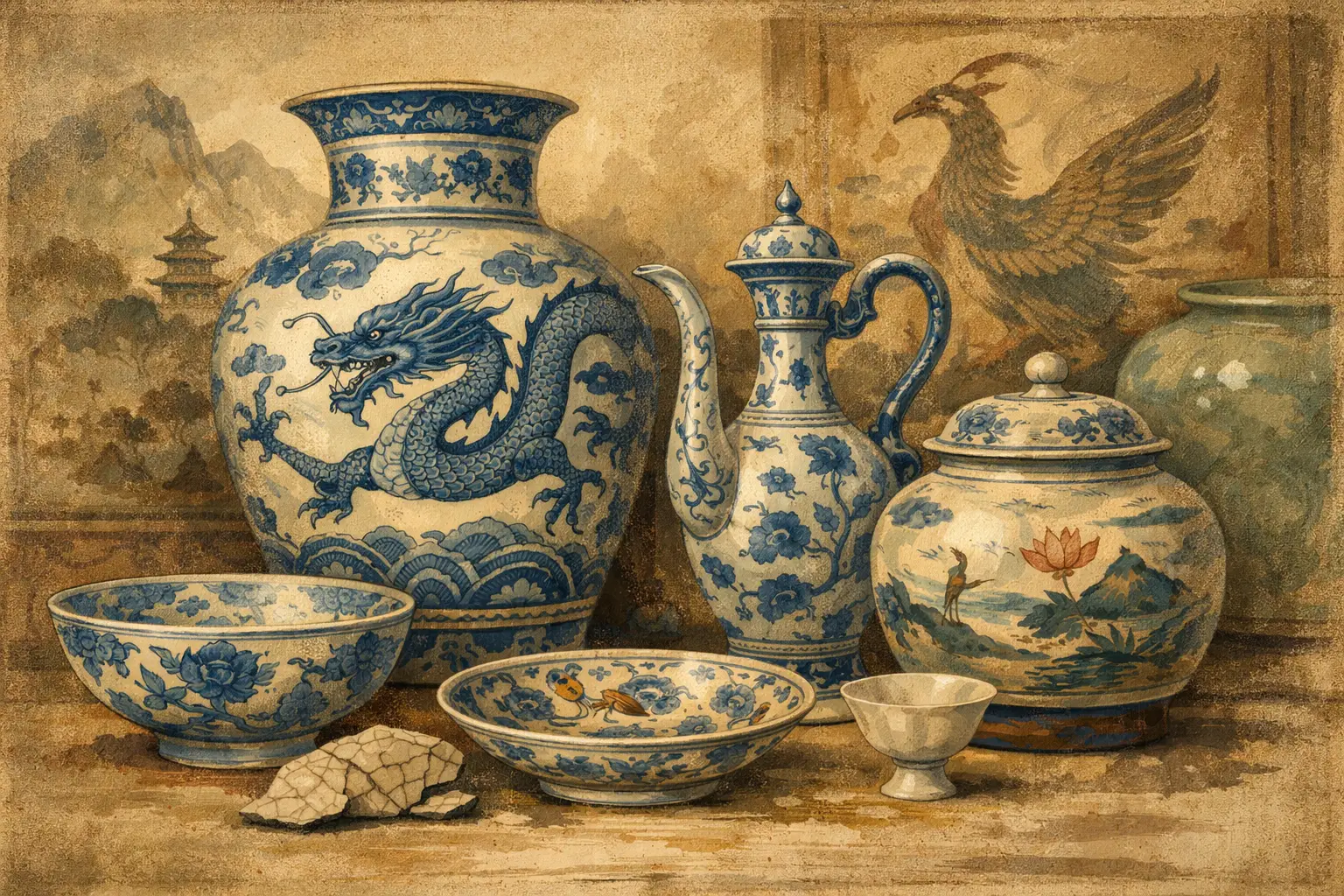
Decoration tends to be energetic rather than restrained. Floral scrolls, lotus panels, peonies, waves, phoenixes, dragons, and narrative scenes are arranged in bands or framed zones. Many Yuan painters filled the available surface with assurance. Empty space was used differently from later Ming porcelain, which often looks more controlled and technically polished.
Large and commanding shapes
Scale matters. Yuan porcelain is known for substantial jars, meiping vases, dishes, stem cups, and storage vessels that carry real physical weight. Broad shoulders, powerful silhouettes, and tall proportions are common. Even when a form is familiar, it may appear more muscular than comparable wares from later periods.
This preference for larger objects reflects both aesthetic taste and trade reality. Bigger jars and dishes had practical uses, and they also made a visual impression in elite and mercantile settings. For a modern viewer, these proportions are one of the fastest ways to sense a Yuan piece, even before studying glaze or painted detail.
Strong potting and thicker bodies
Another of the key Yuan dynasty porcelain characteristics is the structure of the vessel itself. Many pieces have thicker porcelain bodies than those of the finest later imperial wares. Foot rims can be substantial, and the potting may feel sturdy rather than ultra-refined.
That sturdiness should be read carefully. It does not mean the work is crude. Rather, it reflects a stage in technological and stylistic development when potters were pushing porcelain into new markets and new formats. The best examples combine force with surprising balance.
Decorative zoning and layered surface design
Yuan porcelain often uses clearly divided decorative bands. A jar might carry one motif at the shoulder, another around the body, and a different pattern near the foot. This layered approach gives the surface rhythm and structure.
The effect can feel lavish, especially on larger pieces. Yet it also helps scholars and collectors identify period habits. Later porcelain sometimes simplifies or standardises these arrangements, whereas Yuan wares often preserve a slightly freer, more exploratory spirit.
Materials, kilns, and the importance of cobalt
Much of the most celebrated Yuan porcelain was produced at Jingdezhen, the great kiln centre that would later dominate imperial porcelain production. During the Yuan period, Jingdezhen expanded its importance dramatically, refining porcelain bodies and glazes while responding to rising demand.
Cobalt was central to this transformation. Imported cobalt, probably from West Asia, gave Yuan blue-and-white its distinctive intensity. This matters because the maritime story is built into the object itself. The blue on a Chinese vessel may already speak of exchange before the finished piece ever left the kiln.
Not every Yuan porcelain piece is blue and white, of course. There are also underglaze red wares and other ceramic types from the period. Still, blue and white remains the most iconic because it so perfectly captures the era’s technical ambition and international outlook.
Why export mattered to Yuan porcelain
The Yuan period was deeply connected to wider trade networks, and porcelain was one of the clearest expressions of that reach. Sea routes linked Chinese kilns to Southeast Asia, South Asia, the Middle East, and beyond. As a result, some Yuan wares were made with external tastes in mind.
This is where interpretation becomes especially interesting. A motif may be Chinese in origin, but the shape of a vessel, the density of decoration, or the durability of its body may reflect export demand. In other words, Yuan porcelain characteristics are not only artistic features. They are evidence of movement, commerce, and cultural conversation.
For museums that interpret shipwreck ceramics, this adds another dimension. A recovered shard or intact vessel is not simply a decorative object. It is a witness to the maritime routes that carried taste, technology, and prestige across the region. At Straits & Oriental Museum, that broader context helps porcelain feel vividly alive rather than locked behind chronology.
How Yuan porcelain differs from Ming porcelain
This is where nuance matters, because the two are often confused. Early Ming blue-and-white porcelain inherited much from the Yuan period, especially in form and decorative language. At a glance, the overlap can be considerable.
Even so, Yuan pieces often show a bolder, less regulated energy. Their shapes can be heavier. The painted designs may feel more spontaneous, with stronger brush movement and less uniformity. The cobalt can appear darker or more uneven, sometimes with spots of bleeding where the pigment reacted under the glaze.
Ming porcelain, especially in well-known imperial phases, often moves towards greater precision and finish. That does not make it better. It simply reflects different priorities. Some collectors are drawn to Yuan ware precisely because it retains a certain immediacy – a sense of invention before the grammar of blue-and-white became more fixed.
What to look for when viewing Yuan pieces in person
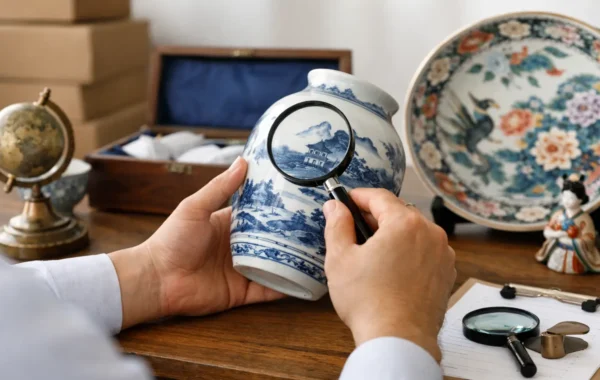
Seeing a photograph is useful, but Yuan porcelain rewards close looking. Start with the silhouette. Does the vessel have breadth, height, and a confident outline? Then study the painted decoration. Look for brushwork that feels alive rather than mechanical, and for cobalt tones that shift from intense blue to softer, slightly blurred edges.
Next, look at how the design is organised. Many authentic period examples use decorative bands with clear transitions from neck to shoulder to body. Finally, notice the material presence of the object. Yuan porcelain often has an authority that comes from weight, scale, and a slightly less polished finish than later court-centred wares.
Of course, attribution is rarely simple. Later copies exist, and some are highly convincing. Condition, excavation context, kiln analysis, and specialist comparison all matter. A single visual clue is never enough on its own.
Why these characteristics still matter
Yuan porcelain changed the global story of ceramics. It helped establish blue-and-white as one of the most enduring visual formats in world art, and it did so through a mixture of technical innovation and commercial ambition. That combination remains fascinating because it feels modern in spirit, even while rooted in medieval trade.
For travellers, collectors, and museum visitors, the appeal is not merely academic. These objects hold the drama of long-distance exchange. They carry traces of kiln fire, painterly confidence, and ocean passage. Their beauty is inseparable from the routes that moved them.
To spend time with Yuan porcelain is to encounter an era when ceramics became truly international without losing their place of origin. The next time you stand before one of these bold blue vessels, look past the surface brilliance for a moment – you may be looking at the shape of maritime history itself.