
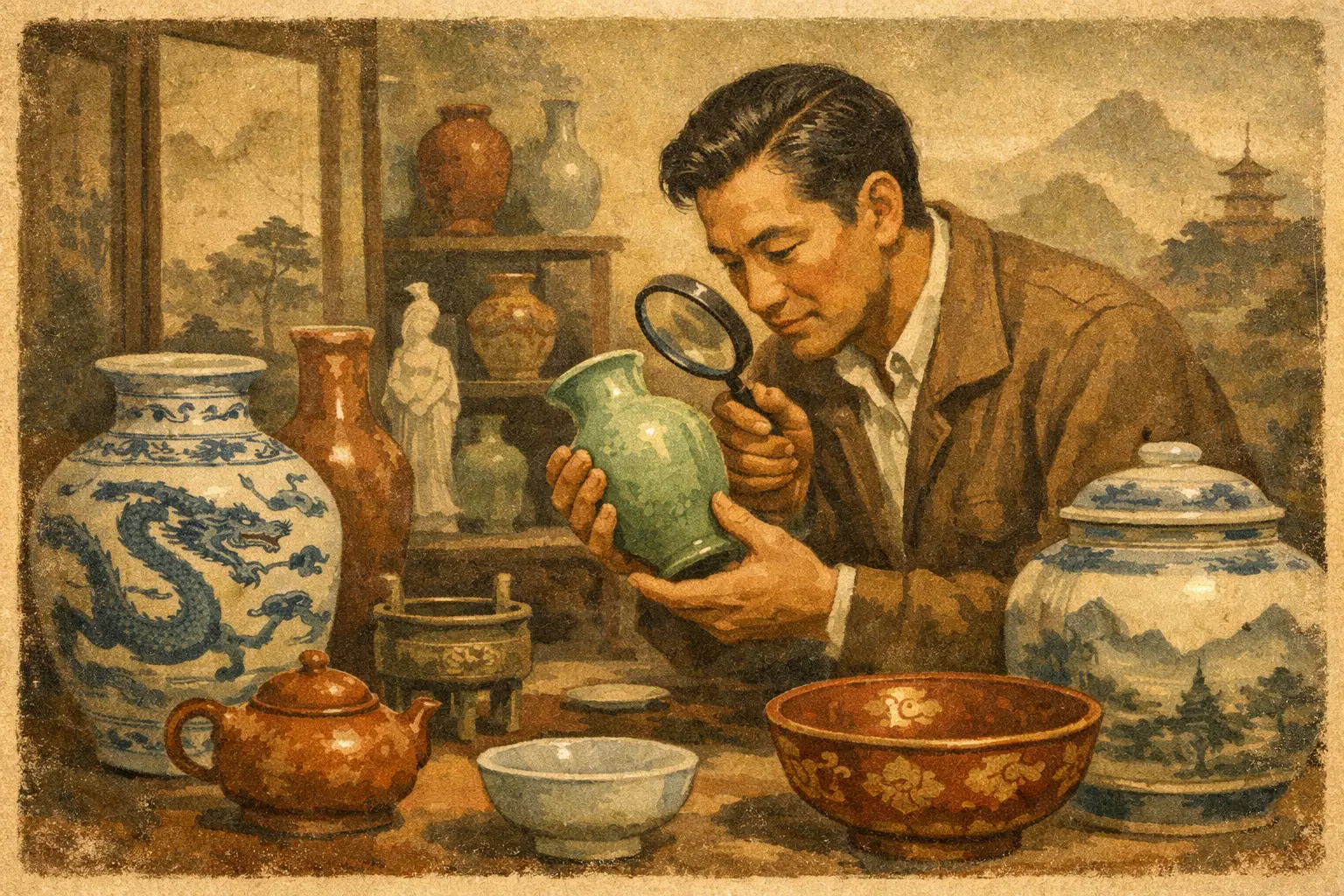

A Chinese ceramics collecting guide begins not with the question, ‘What is it worth?’, but with a closer one: ‘What story does it carry?’ A tea bowl’s unassuming glaze, a blue-and-white dish’s painted border, or a storage jar lifted from a maritime wreck can each reveal changing tastes, trading routes and centuries of skilled workmanship. The most rewarding collections are built slowly, with the eye trained by looking as much as buying.
Chinese ceramics are an especially rich field because they were made over more than two millennia for imperial courts, domestic households and overseas markets alike. That breadth can feel daunting at first. It is also the pleasure of collecting: there is always another kiln, form, period or journey to understand.
Begin with a collecting point of view
No collector can sensibly pursue everything called ‘Chinese ceramics’. Choose a focus that gives your collection shape. You may be drawn to the quiet strength of Song stoneware, the painted drama of Ming blue-and-white porcelain, famille rose wares of the Qing dynasty, or export ceramics made for Southeast Asian and European tables.
A narrower interest does not make a collection smaller in spirit. It makes each acquisition more meaningful. A group of modest 18th-century bowls made for regional trade, for example, can tell a more coherent story than a cabinet of unrelated objects bought simply because they appeared old.
For collectors in Penang and across the Straits, maritime ceramics offer a particularly compelling starting point. Cargoes carried through the South China Sea connected Chinese kilns with port cities, merchants and households across Asia. A recovered shard or complete vessel is not only a ceramic object: it is evidence of a voyage interrupted, preserved beneath the sea and rediscovered centuries later.
Learn the language of material and making
The terms earthenware, stoneware and porcelain are not interchangeable. Earthenware is generally fired at lower temperatures and remains relatively porous. Stoneware is fired hotter, producing a harder body. Porcelain is made from a refined clay body and fired at high temperatures, often with a translucent quality at thin points. Chinese potters achieved extraordinary variety within these categories, and the material itself is one of the first clues to a piece’s identity.
Glaze also rewards close attention. Celadon is valued for its jade-like green tones, which can range from misty olive to a clearer blue-green. A white glaze may appear warm and creamy, cool and bluish, or finely crackled. Blue-and-white decoration is painted in cobalt beneath a transparent glaze, while overglaze enamels are applied and fired afterwards. These distinctions help collectors describe what they see accurately, rather than relying on broad labels.
Form can be as revealing as decoration
Look at a vessel’s purpose before becoming absorbed by its pattern. Was it made as a bowl, kendy, jar, ewer, dish, cup or altar vessel? The shape can indicate its market and use. A kendy, with its round body, spout and no handle, was widely used in Southeast Asia and appears frequently in regional trade ceramics.
Decoration should feel at home on the form. A well-painted floral scroll follows the curve of a bowl with confidence; a border sits naturally at the rim; a foot is neatly finished. None of these details alone proves age or quality, but together they build a persuasive visual argument.
Period is a question, not a shortcut
Collectors often encounter labels such as ‘Ming’, ‘Qing’ or ‘Song’ used as though each were a single style. In reality, dynasties covered long periods, with changing court preferences, kiln technologies and export demand. A Ming piece might date from the early 15th century or the 17th, and those worlds are very different.
Marks can be useful, particularly reign marks on the base of porcelain. Yet they should never be treated as a verdict. Marks were copied, revived and sometimes added later to make a piece more saleable. A six-character mark must be considered alongside the body, glaze, foot rim, painting, wear and documented history.
The same caution applies to descriptions such as ‘imperial’ or ‘rare’. Both can be meaningful in the right context, but neither should substitute for evidence. Ask what makes the object rare, how its date has been established and whether comparable pieces are known in museum collections, auction records or published references.
Provenance is part of the object
For a serious collector, provenance is not a decorative extra. It is the chain of ownership and documentation that supports an object’s history. A clear provenance may include an old collection label, catalogue entry, receipt, previous sale record, expert report or, in the case of shipwreck material, recognised excavation and recovery documentation.
This matters for confidence, legality and cultural responsibility. The market contains reproductions, altered objects and pieces with incomplete histories. It also contains material that may have been removed from archaeological contexts without proper permission. A reputable seller should be willing to discuss where an object came from, when it was acquired and what paperwork accompanies it.
Shipwreck ceramics need particular care. Marine encrustation, surface wear and firing flaws can be authentic features, but they are not automatic proof of wreck provenance. Seek credible documentation from established salvage operations or recognised collections. At Straits & Oriental Museum, shipwreck ceramics are best appreciated not as isolated curiosities but as witnesses to the maritime networks that shaped the region.
Condition: look closely, then look again
A small rim chip may be acceptable on a centuries-old export bowl; a restored crack across a rare and finely painted dish may affect its value substantially. Condition is always relative to age, scarcity, form and collector purpose. The key is to know exactly what you are accepting.
Inspect a piece in natural, angled light where possible. Turn it over and examine the base as carefully as the front. Ask directly about restoration, including hairline cracks, filled chips, retouching, reattached sections and resurfacing. A seller’s description should distinguish clearly between original firing characteristics and later damage.
When assessing an object, pay attention to four areas:
- the rim, where chips and restoration are common;
- the foot rim, which may show genuine wear but can also reveal modern finishing;
- the glaze, for scratching, staining, crazing and concealed repairs; and
- the sound, used cautiously, as a clear ring can be reassuring but does not confirm authenticity.
Do not reject every imperfect piece. Honest wear can deepen an object’s character, especially where it reflects use or a long journey through trade. What matters is that the condition is priced fairly and disclosed plainly.
Buy with patience, not pressure
The most expensive purchase is often the one made in haste. Before committing, compare several examples of the same type. Notice proportions, painting quality, glaze tone and the feel of the foot rim. Read catalogues, visit exhibitions and handle ceramics whenever a knowledgeable specialist permits it. Your eye develops through repetition.
Set a budget that leaves room for research, professional advice, insurance and proper display. A lesser-known kiln or export form can offer greater historical interest per pound than a fashionable name attached to an uncertain object. Conversely, paying more for an exceptional, well-documented piece may be wiser than buying several inexpensive examples with unresolved questions.
A trusted dealer or auction specialist can be valuable, but their expertise does not remove the need for your own judgement. Ask for condition reports in writing and retain every invoice, photograph and conversation relating to an acquisition. This record becomes part of your collection’s future provenance.
Care for the collection you are building
Ceramics are durable until they are not. Display them away from direct sunlight, unstable shelves and crowded surfaces. Use secure mounts or museum wax where appropriate, and never lift a vessel by its rim, handle, spout or lid. Support it with both hands from beneath.
Avoid aggressive cleaning. Dust gently with a soft brush or dry microfibre cloth. Do not soak, bleach or attempt to remove old deposits without specialist advice, particularly on excavated or shipwreck pieces. What looks like dirt may be evidence of age, use or marine context.
Collecting Chinese ceramics is ultimately an education in attention. Let each object earn its place through quality, history and the pleasure it gives on repeated viewing. The finest collection is not the one that announces itself most loudly, but the one whose objects continue to speak – of kiln fires, sea passages and the hands that treasured them before yours.