
A blue-and-white bowl recovered from the seabed can tell a more revealing story than a map. Its glaze, kiln marks and cargo companions speak of merchants, monsoon winds, changing tastes and the ports that connected them. That is the living appeal of straits settlement history: it is not simply a record of colonial administration, but the story of a maritime world in constant motion.
For Penang, the sea was never a distant backdrop. It was the route by which people arrived, goods circulated and communities built a cosmopolitan town. To understand George Town’s heritage properly, one must look beyond its shophouses and streets towards the narrow waters of the Malay Peninsula – and the vessels that made this coast one of Asia’s great commercial crossroads.
What were the Straits Settlements?
The Straits Settlements were a British colonial administrative grouping comprising Penang, Malacca and Singapore. Penang was established as a British settlement in 1786, Singapore followed in 1819, and Malacca was transferred to British control in 1824. In 1826, the three were brought together under the Straits Settlements, initially administered from British India.
The grouping became a Crown Colony in 1867, governed directly from London. Its formal life ended in 1946, after the Second World War, when changing political circumstances reshaped the region’s administration. Yet its influence remains visible in the architecture, institutions, languages, foodways and trading cultures of the places once joined under its name.
The term can be misleading if it suggests that Penang, Malacca and Singapore had identical experiences. Each had its own geography, population and commercial strengths. Penang’s position at the northern entrance to the Strait of Malacca gave it a particular role: a place where ships travelling between the Indian Ocean, the Bay of Bengal, the Malay Archipelago and the South China Sea could provision, trade and gather intelligence before continuing their journeys.
Straits settlement history began with older sea routes
British rule did not create the maritime networks that made Penang valuable. Long before 1786, the Strait of Malacca was among the world’s most consequential waterways. It linked the markets of China with India, the Middle East and Europe, while connecting the ports and producing regions of Southeast Asia with one another.
Ceramics travelled on these routes in remarkable quantities. Chinese porcelain was prized for its beauty, durability and status, but it was also part of everyday commerce. Bowls, jars, dishes and storage vessels moved alongside spices, textiles, metals, forest products and foodstuffs. They passed through hands that were Malay, Chinese, Indian, Arab, European and many more besides.
This matters because the history of the Straits is not only a narrative of empires directing trade from above. It is also a record of sailors, artisans, brokers, labourers, interpreters and families whose work made trade possible. Ports thrived because people could negotiate difference – through shared commercial practices, mixed languages and practical forms of trust.
Penang joined this established maritime landscape as a new colonial port, rather than an empty frontier. Its success depended on its ability to draw existing networks towards a harbour that offered opportunity, relative security and access to wider markets.
Penang and the making of a free port
When Francis Light took possession of Penang Island for the English East India Company, the settlement was intended to serve strategic and commercial interests. It could support British shipping, offer a base near vital sea lanes and compete with other regional ports. Its early designation as a free port proved particularly significant.
A free port reduced the burden of customs duties and encouraged merchants to bring their goods, capital and connections to the island. Penang became a meeting place for traders from across the region. New arrivals included Chinese merchants and labourers, Indian communities, Malay traders, Eurasian families, Armenian commercial figures and Europeans engaged in administration and enterprise.
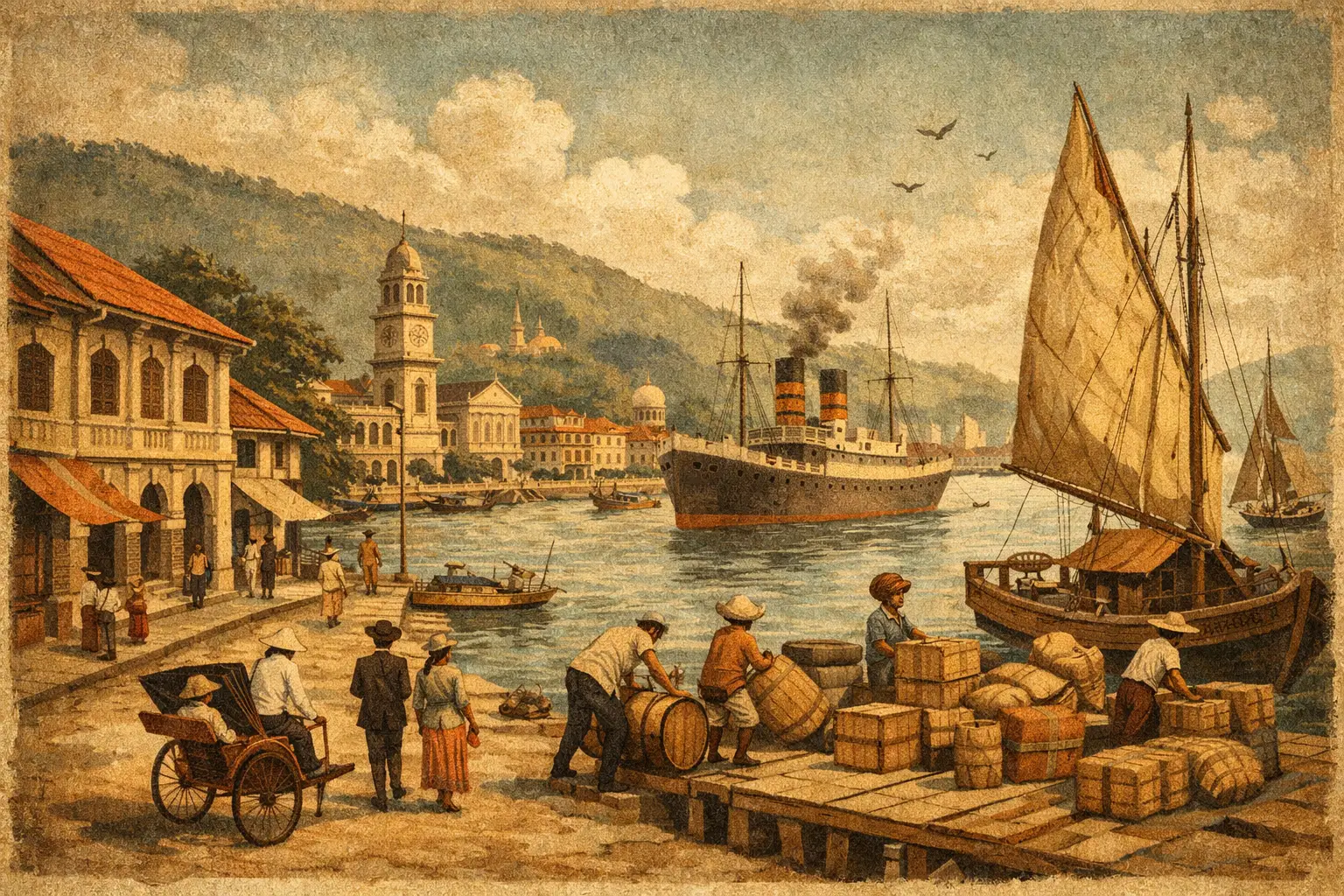
The town that emerged was commercially ambitious and culturally layered. Temples, mosques, churches, clan houses, markets and godowns developed close to one another because trade and daily life were deeply intertwined. A port was not merely a place of departure. It was a place where news was exchanged, debts settled, food prepared, languages adapted and identities continually remade.
There were, however, costs behind the prosperity. Colonial port economies were shaped by unequal power, land pressures and systems of labour that did not benefit everyone equally. British control over trade routes and territory served imperial interests first. A heritage story worthy of Penang should hold both truths together: the extraordinary cultural richness created by connection, and the uneven conditions under which that connection was often organised.
Why shipwreck ceramics matter to this history
Written records tend to preserve the voices of officials, major merchants and institutions. Shipwreck ceramics offer a different kind of evidence. A cargo scattered across the seabed can reveal what was being bought, where it was produced, how goods were packed and which routes were commercially active at a particular moment.
A single vessel may carry porcelain intended for elite tables alongside more practical wares for households and regional markets. Its cargo can show that Asian trade was not a simple line from China to Europe. It was a dense web of exchanges in which goods were redistributed through Southeast Asian ports, adapted to local preferences and valued in many different social settings.
The dates and styles of ceramics also give material shape to long periods of change. Pieces from the Ming dynasty, for example, belong to centuries when Chinese kilns supplied markets across maritime Asia. Later wares tell of evolving production centres, new consumers and shifting trading relationships. Their survival makes history tactile. The fine crackle of a glaze or the curve of a storage jar can bring an oceanic world into close view.
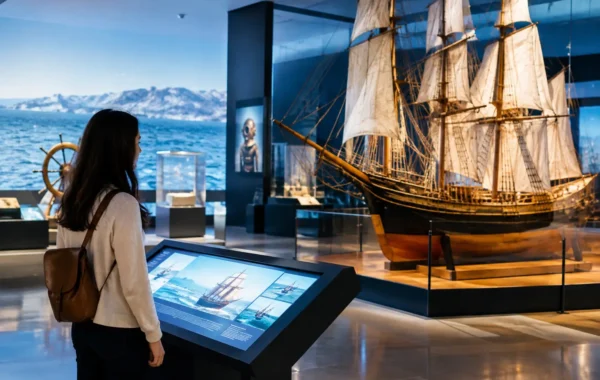
At Straits & Oriental Museum, authentic ceramics recovered from shipwrecks including the Wanli, Turiang, Royal Nanhai, Nanyang, Xuande and Desaru make these connections visible. They invite visitors to see porcelain not as a decorative object alone, but as evidence of journeys, risk and exchange across the seas.
The changing fortunes of a connected region
The nineteenth century brought new technologies and stronger imperial systems to the Straits. Steamships altered the rhythm of travel. The opening of the Suez Canal in 1869 shortened sea passages between Europe and Asia, while telegraph lines transformed the speed at which commercial information travelled. Tin and rubber expanded the economic importance of the Malay Peninsula, and Penang remained a significant entrepôt within a wider colonial network.
Yet no port stands still. Singapore’s deep harbour and position on major shipping routes gave it an increasing advantage, while Penang developed according to its own regional relationships and commercial specialisms. This is a useful corrective to the idea that history moves in one upward line. Ports rise, adapt and sometimes lose ground according to technology, politics, hinterlands and the decisions of people far beyond their shores.
The Japanese occupation during the Second World War disrupted the old colonial order with devastating consequences. After the war, the Straits Settlements were dissolved, and the political map of Malaya entered a new era. Independence did not erase Penang’s maritime inheritance. It changed the framework through which that inheritance would be understood.
Reading George Town through the harbour
For visitors, straits settlement history offers a richer way to experience George Town. Look at its streets and one sees buildings, but look through the harbour and one sees the forces that brought those buildings into being. The facades, faiths, cuisines and commercial traditions of the city were shaped by arrivals from across the sea and by the local communities that made a home from exchange.
This perspective also changes how we regard museum objects. A porcelain dish is not only an object of refinement. It may be a trace of a ship’s cargo, a merchant’s calculation, a household’s aspiration or a route that linked distant makers and buyers. Its beauty becomes more compelling when its journey is part of the view.
The next time you stand near Penang’s waterfront, imagine the harbour as a historical archive without walls. The vessels are gone, but their stories remain in the city’s streets, its collections and the enduring conversation between the Straits and the wider world.