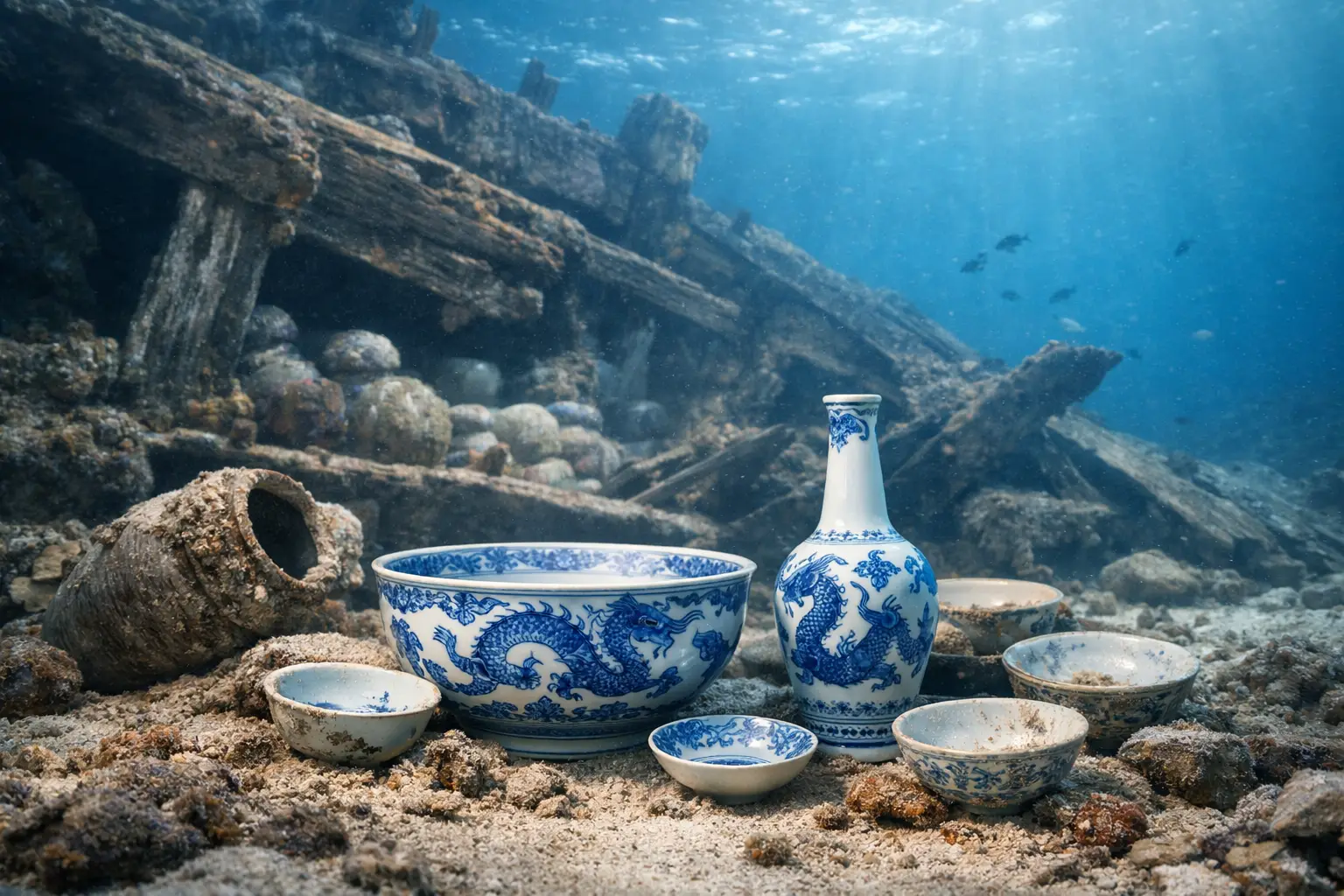

A porcelain bowl recovered from the sea is more than a beautiful object. Its glaze, shape and painted motifs can preserve evidence of what people wanted to buy, where merchants expected to sell it, and how Asian ports were connected. The Xuande shipwreck trade example offers a particularly vivid way to read this history: through cargo made for movement, taste and exchange rather than for an imperial palace alone.
Dating to the Xuande reign of the Ming dynasty, from 1426 to 1435, material associated with this period sits at a compelling point in the history of Chinese export ceramics. Blue-and-white porcelain was becoming one of the most recognisable luxury goods circulating across maritime Asia. A wreck cargo allows visitors to encounter that commerce not as an abstract route on a map, but as hundreds of individual vessels once packed into the hold of a working ship.
Why the Xuande shipwreck trade example matters
The sea route between China and Southeast Asia was not a single, direct line. It was a busy web of coastal passages, seasonal monsoon crossings, island entrepôts and port communities. Ships carried ceramics alongside other goods, while merchants gathered cargoes from several producers and supplied buyers with different incomes, customs and dining traditions.
The Xuande-period ceramics found in shipwreck contexts demonstrate the commercial reach of Jingdezhen porcelain and related Chinese production centres. They also show that export was never simply a matter of China sending finished wares to a passive market. Demand shaped production. Merchants selected forms that travelled well, appealed to customers and could be sold in quantity through established trading relationships.
A bowl, dish or jar may have been refined in appearance, yet it was also practical merchandise. It could be nested with similar pieces, packed with protective material and counted as part of a larger consignment. The survival of such cargoes beneath the sea gives maritime archaeology an unusual advantage: the assemblage may retain the relationships between objects that are often lost when ceramics enter private collections or are excavated from settlements centuries later.
A cargo designed for many buyers
Xuande blue-and-white porcelain is admired for its luminous cobalt decoration, balanced forms and confident painting. In a shipwreck cargo, however, visual splendour is only part of the story. Repeated shapes and patterns suggest that merchants were dealing in recognisable, saleable categories rather than isolated masterpieces.
Some wares were likely intended for elite households, religious settings or ceremonial gifting. Others were made for prosperous urban consumers who wanted durable, fashionable tableware with the prestige of Chinese manufacture. A cargo can therefore reveal several tiers of the market at once. Its variation matters as much as its finest object.
This is why shipwreck ceramics should not be judged only by rarity. A group of similar dishes can tell us about volume, standardisation and commercial confidence. A less elaborate vessel may be just as historically revealing as an exceptional blue-and-white piece, because it speaks to the wider market that made long-distance trade viable.
Reading trade through porcelain
Ceramic evidence can answer questions that written records leave open. A ship’s cargo may indicate where merchants expected demand, but it does not automatically identify the final destination. A vessel could have been travelling to a major port, calling at several smaller settlements, or carrying goods that would be redistributed by local traders after arrival.
That distinction is essential. The place where a ship sank is not always the place where its cargo was meant to be sold. Maritime trade depended on intermediaries: captains, brokers, warehouse keepers, financiers, translators and local merchants. Ports across Southeast Asia were active commercial centres, not merely stopping points between larger powers.
The forms in a Xuande-period assemblage can nevertheless offer clues. Covered boxes, dishes, bowls, kendis and storage vessels suited different uses and cultural settings. Their presence points to the adaptability of ceramic commerce. Chinese kilns produced goods that could be appreciated in homes, courts and trading communities far beyond the place of manufacture.
Decoration also travelled with meaning. Floral scrolls, lotus motifs, cloud forms and familiar blue-and-white palettes carried associations of refinement, auspiciousness and status. Yet consumers in different regions did not necessarily interpret them in exactly the same way. Trade succeeds when goods can be welcomed into local lives, not when they remain fixed to the intentions of their makers.
Dating a wreck requires care
The term “Xuande shipwreck” can sound more precise than the evidence always permits. Archaeologists establish a wreck’s date by bringing together several kinds of information: ceramic typology, inscriptions, coins, ship construction, associated finds and the wider historical record. A ceramic made in the Xuande period may remain in circulation for years, while styles can overlap from one reign to another.
For that reason, responsible interpretation avoids treating a cargo as a perfect time capsule. It is a powerful record, but it is also a working shipment shaped by stock availability, reuse and the realities of sea travel. What matters is the combined pattern of evidence, not one decorative detail considered in isolation.
This measured approach makes the story more compelling, not less. It reminds us that maritime archaeology is an active conversation between objects, places and evidence. Each recovered piece adds to the picture while also raising new questions about routes, ownership and intended markets.
Southeast Asia was central, not peripheral
The Xuande shipwreck trade example is especially valuable for understanding Southeast Asia’s place in the fifteenth-century maritime world. The region connected the South China Sea, the Java Sea, the Indian Ocean and beyond. Its ports offered provisions, repair facilities, market access and local knowledge of winds and waterways. Their merchants were instrumental in directing the circulation of ceramics.
Monsoon rhythms governed much of this movement. Sailors did not simply depart whenever they pleased. They planned journeys around predictable wind systems, waiting in port when conditions were unfavourable and using seasonal changes to cross open water. A shipwreck captures the risk within that otherwise highly skilled system. Trade created wealth and cultural exchange, but every voyage carried the possibility of storm, reef, fire, collision or navigational error.
The objects that survive also complicate any simple notion of luxury. Porcelain was precious, certainly, but it was also used. Once unloaded, it entered homes, dining spaces, rituals and gift exchanges. It could be treasured for generations, broken and discarded, or placed in graves and sacred contexts. The route did not end at the port.
What a museum encounter can reveal
Seeing shipwreck ceramics in person changes the scale of the story. The fine blue painting invites close attention, while the repetition across a cargo brings the commercial reality into view. Visitors can consider both the individual hand that painted a motif and the organised system that moved large quantities of fragile wares across dangerous seas.
At Straits & Oriental Museum, shipwreck artefacts provide a tangible route into this regional history. They invite a slower look at the objects themselves: the foot rim worn by firing, the pooling of cobalt beneath glaze, the proportion of a dish designed to be held and used. These details connect connoisseurship with the lives of makers, sailors, merchants and buyers.
There is also a useful lesson for collectors and enthusiasts. Provenance matters. Objects with documented archaeological contexts can tell a richer story than ceramics detached from their findspot and cargo companions. Context gives an artefact its commercial, social and maritime voice.
A Xuande-period bowl may first draw the eye because it is beautiful. Stay with it a little longer, and it becomes evidence of a voyage, a market and a vast community of exchange. That is the enduring pleasure of shipwreck ceramics: they make the history of the sea feel close enough to hold.