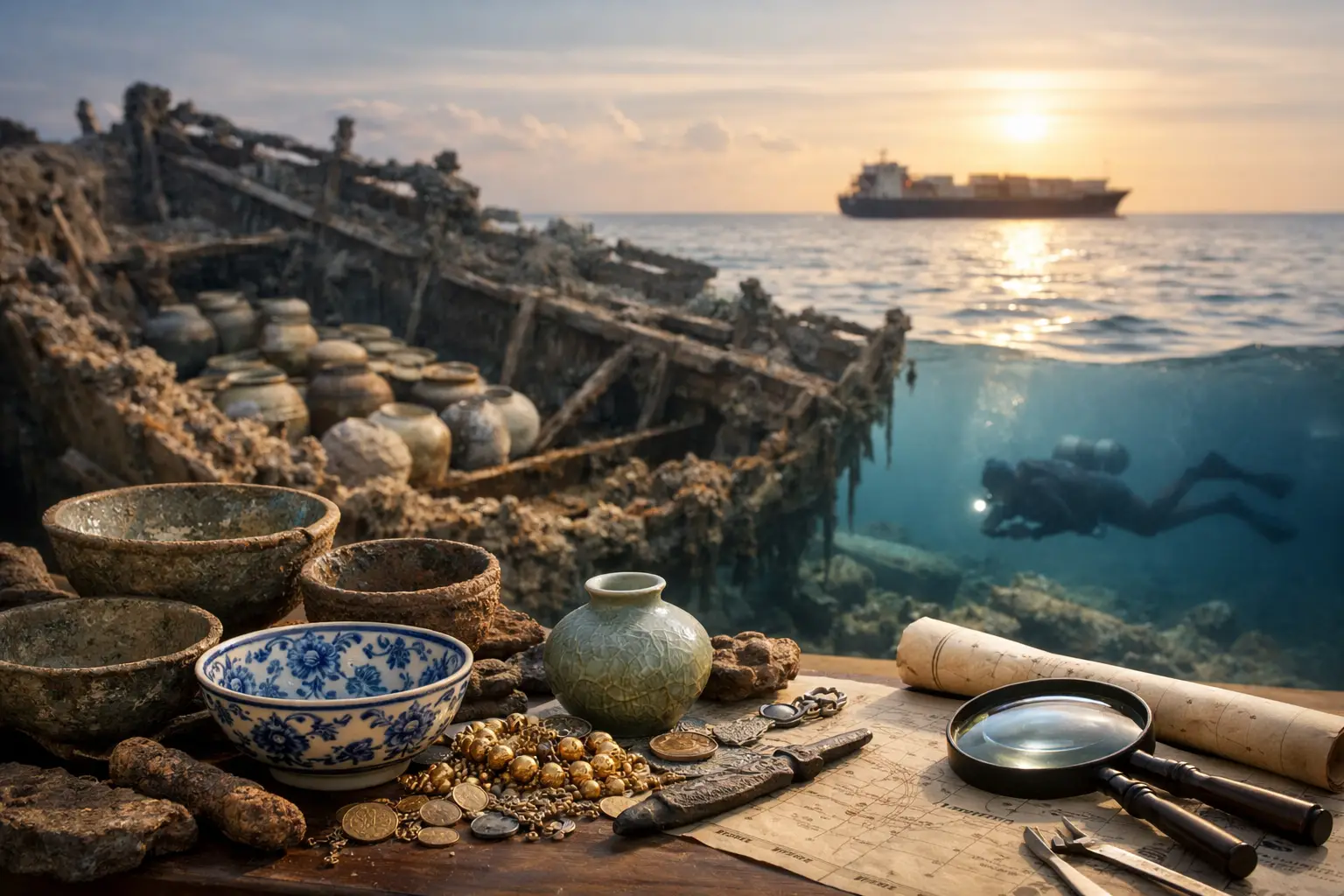

A ceramic bowl lifted from the seabed can appear beautifully self-contained: a fine glaze, a familiar form, perhaps a small firing flaw preserved for centuries. Yet on the Turiang wreck, each vessel was also part of a far larger arrangement of cargo, commerce and human ambition. Turiang shipwreck cargo analysis asks us to look beyond individual objects and read the hold of a lost vessel as evidence of a trading world in motion.
Commonly associated with the late fourteenth century, the Turiang wreck offers an unusually vivid view of maritime Southeast Asia at a time when regional ports, workshops and merchant networks were closely connected. Its cargo was not assembled for a modern display case. It was packed to travel, to be exchanged, used, gifted and treasured across communities linked by the sea.
Why the Turiang cargo matters
Shipwreck cargoes are time capsules, but not simple ones. They record a particular commercial decision at a particular moment: what a merchant believed buyers wanted, what workshops could supply, which route was worth taking and how fragile the journey could be.
The Turiang assemblage is especially compelling because it brings together ceramics of differing forms, origins and levels of refinement. Rather than treating every piece as a rare treasure in isolation, cargo analysis considers their relationship to one another. A group of bowls may indicate household demand; jars and storage vessels may point to transport, provisioning or local use; finely made wares may suggest gifts, status or an affluent market. The story lies in the combination.
For visitors, this changes the experience of looking at shipwreck ceramics. Repetition is no longer repetition. A row of similar dishes becomes evidence of scale. Variations in glaze, shape and decoration become clues to production, choice and destination.
Turiang shipwreck cargo analysis begins with context
The first task is to establish what was aboard and how it was arranged. Archaeologists and conservators document object types, materials, measurements, condition and, where recorded, their position within the wreck. This work is methodical because a vessel found beside another is not necessarily from the same shipment, and an object damaged by the sea may not have looked that way when it left the kiln.
Ceramics are often central to this process because they survive underwater remarkably well. Their durability, however, can be misleading. Salt deposits, marine growth, breakage and movement on the seabed may obscure surfaces or separate objects from their original packing. Careful cleaning and conservation are therefore not merely cosmetic. They make marks, glazes and manufacturing details visible again.
Comparative study then connects the cargo to known ceramic traditions. The clay body, glaze colour, foot ring, decorative technique and firing characteristics can help distinguish between wares made in different production centres. A pale celadon surface, a painted motif or a particular vessel profile may reveal links to workshops in China, Thailand, Vietnam or other parts of the region, depending on the object and the available evidence.
This is where restraint matters. Attribution is often a matter of probability rather than certainty. Kilns shared techniques, copied successful forms and produced for export markets. A persuasive reading weighs several features together instead of resting on a single visual resemblance.
Quantity is evidence, not a footnote
Numbers help reveal the commercial logic of a cargo. When a particular form appears in significant quantity, it suggests that the ship carried a consignment rather than a handful of personal possessions. A broad range of forms, by contrast, may indicate that the merchant was serving several kinds of customer or making calls at more than one port.
Quantities also expose the difference between modern collecting and historic trade. Today, collectors may prize the exceptional bowl or the most finely painted dish. Medieval consumers needed functional objects as well: vessels for serving food, storing ingredients, presenting offerings or marking a household occasion. The cargo reminds us that ceramics travelled as part of daily life, not only as luxury goods.
The value of ordinary forms
A plain jar can be as historically revealing as a decorated plate. Storage forms speak of movement and use. Their size, mouths, handles and surfaces can indicate whether they were suited to liquids, dry goods or repeated handling. Some may have been commodities in their own right; others may have supported life aboard the ship.
This distinction cannot always be resolved with certainty. An empty jar recovered from a wreck does not automatically prove that it was sold empty, nor does a vessel’s placement alone explain its original purpose. But when form, number and distribution are considered together, more credible interpretations emerge.
A map of maritime Southeast Asia in ceramic form
The Turiang cargo belongs to a period when the seas connecting East Asia and the Malay Archipelago were not margins between civilisations. They were thoroughfares. Merchants, sailors, interpreters, craftsmen and port communities moved ideas as readily as material goods.
Ceramics were ideal participants in this trade. They were useful, visually attractive and recognisable across cultural boundaries. A successful form could be ordered in volume, adapted to different tastes and carried to distant markets. Glazes and decoration were not simply aesthetic choices; they were part of how a product announced quality, origin and desirability.
The cargo also complicates the idea of a one-way trade route. A ship might carry wares associated with several places, sail under a particular maritime tradition and serve markets far from both its departure point and intended destination. Port cities were places of negotiation, where cargoes were consolidated, repacked and redirected. The Turiang wreck preserves one interrupted moment within that wider system.
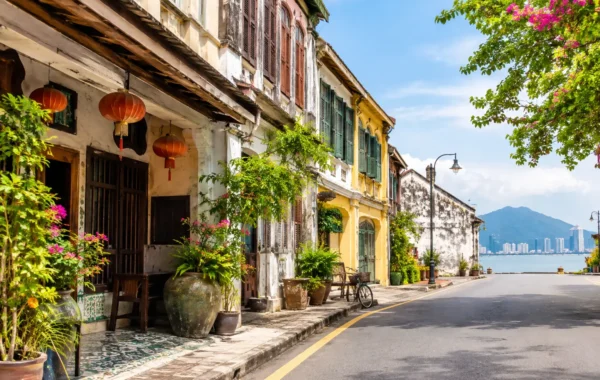
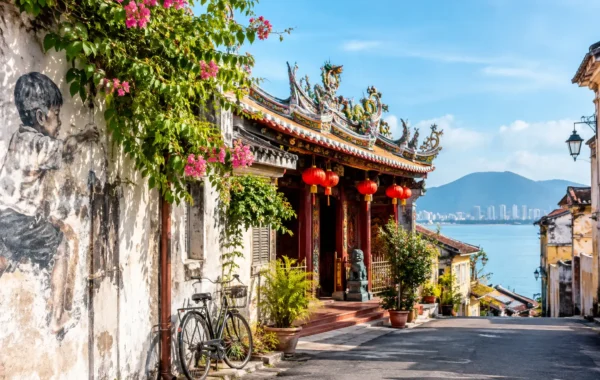
For Penang, a historic meeting point for peoples and goods, such material offers a resonant way to encounter the region’s maritime inheritance. It shows that the Strait was shaped not only by celebrated voyages and imperial ambitions, but by ordinary acts of exchange repeated across generations.
What the cargo cannot tell us on its own
A shipwreck is powerful evidence, but it has limits. It represents one vessel, one loss and one surviving selection of materials. Perishable cargoes such as textiles, foodstuffs, timber and paper may have disappeared almost entirely. Metals may corrode, and objects of value may have been removed before or after the wrecking event.
Nor should the cargo be treated as a perfect inventory of a single market. Goods could have been loaded at different ports, acquired at different times or intended for onward trade. The ship’s final destination may remain uncertain. Even the cause of loss can be difficult to establish without enough surviving hull, environmental evidence and excavation records.
These uncertainties do not weaken the Turiang story. They make it more honest and more interesting. Maritime archaeology works through fragments, asking what the material can support while leaving room for new findings. The finest interpretation is not the most dramatic one. It is the one that lets evidence, comparison and informed curiosity work together.
Seeing the cargo as a human story
The real achievement of cargo analysis is that it restores people to objects. Behind every ceramic vessel were potters who prepared clay and tended kilns, traders who judged demand, crews who loaded fragile goods, and households waiting to use them. The wreck did not end those relationships. It preserved their material trace.
At Straits & Oriental Museum, the Turiang collection can be encountered not as a set of isolated antiques but as part of a regional conversation about craft, movement and taste. The beauty of these pieces remains immediate, yet their greatest distinction may be what they reveal together: a fourteenth-century trading network with room for refinement, practicality, risk and exchange.
The next time you pause before a shipwreck bowl, look for more than its surface. Consider the vessels beside it, the journey beneath it and the unseen hands that believed it was worth carrying across the sea.