

King Street Georgetown attraction is a useful search term, but it scarcely captures the pleasure of arriving in one of George Town’s most characterful heritage quarters with time to linger. Here, a visit need not be reduced to a quick photograph outside a handsome shophouse. It can become an encounter with the trade routes, craftsmanship and human stories that made Penang a meeting point for the wider world.
For travellers drawn to places with substance, King Street offers a compelling pause within a day of wandering George Town. Its historic streetscape invites close attention: worn thresholds, layered façades and the everyday rhythm of a living city. The most rewarding way to experience it is to pair that atmosphere with a cultural destination that reveals what moved through these waters centuries ago – and why it still matters.
Why King Street Deserves More Than a Walk-Through
George Town’s heritage appeal is often described in terms of architecture, food and street art. All are worth seeking out, yet the city’s deeper identity has always been maritime. Penang was shaped by arrivals and departures: merchants, sailors, migrants, spices, textiles, ceramics and ideas crossing the Straits of Malacca.
King Street carries that wider story quietly. It is best approached at an unhurried pace, when there is room to notice the scale of the shophouses and to imagine the commercial life that once filled them. The buildings are not merely a backdrop to a heritage holiday. They are part of the evidence, framing a district created through exchange between communities and ports.
That is why a cultural stop here can feel more resonant than another item ticked off an itinerary. It places objects of trade beside the streets that grew prosperous through trade, connecting the visible fabric of George Town with the sea lanes beyond it.
A King Street Georgetown Attraction With a Maritime Story
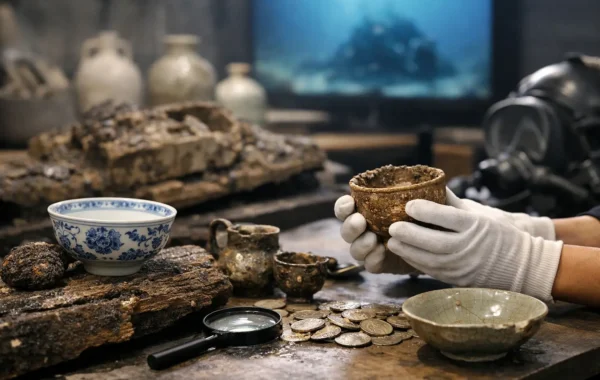
At Straits & Oriental Museum, the story becomes tangible through authentic porcelain and ceramic artefacts recovered from important Asian shipwrecks. Rather than presenting maritime history as an abstract timeline, the collection brings visitors face to face with objects that travelled across oceans, survived catastrophe and re-emerged centuries later.
The permanent displays include ceramics associated with shipwrecks such as the Wanli, Turiang, Royal Nanhai, Nanyang, Xuande and Desaru. Their value lies not only in their rarity or decorative beauty. Each vessel offers a snapshot of regional commerce: what was being made, what was being carried, who might have desired it, and how far it was expected to travel.
A blue-and-white bowl, a finely decorated plate or a humble storage vessel can alter the pace of a visit. Look closely and questions begin to surface. Was this made for an elite household, a merchant’s stock or a distant market? What hands packed it into a ship’s hold? What did its pattern signify to the people who first bought it? Maritime archaeology does not always provide a complete answer, but that uncertainty is part of its fascination.
Porcelain as Evidence of a Connected Asia
Porcelain is often admired for its finish, colour and delicacy. Within a shipwreck collection, it also becomes evidence. A single cargo can reveal changing tastes, production centres and commercial ambitions across Asia. Its survival under water gives it a particular gravity: these are not modern reproductions designed to resemble the past, but material witnesses to it.
For collectors and design-minded visitors, the displays offer an opportunity to appreciate form and craftsmanship at close range. For families, they provide a more immediate route into history than a textbook can offer. Children may be captivated by the idea of a lost ship beneath the sea, while adults can follow the larger story of trade and cultural exchange.
The experience rewards different levels of attention. A brief visit can be visually rich; a longer one allows time to compare shapes, glazes and decorative traditions across periods. Those with a serious interest in Asian ceramics may wish to study the collection slowly, while first-time museum visitors can simply allow the objects to lead the way.
From Heritage Visit to a Well-Spent Afternoon
The distinction of a strong cultural destination is not only what it displays, but how it makes visitors feel while they are there. A museum visit need not be hushed, distant or overly formal to be meaningful. In a city known for hospitality, food and conversation, heritage can sit naturally alongside the pleasures of a considered afternoon.
As Malaysia’s first integrated heritage and lifestyle museum, Straits & Oriental Museum brings together museum galleries, exhibitions, art, dining, drinks and a gift house in one destination. This makes it especially suitable for travellers who want cultural depth without dividing their day into separate, disconnected stops.
There is a trade-off worth recognising. Visitors seeking a purely academic museum may prefer to focus entirely on the artefacts and their historical context. Those looking for a fuller outing can extend the visit with a meal, a coffee or time spent browsing objects that carry the spirit of the place beyond the gallery. Neither approach is more correct. The pleasure lies in choosing the rhythm that suits your day.
For couples, the setting offers a refined alternative to a hurried route through the city. For families, it gives everyone a reason to stay engaged, whether through the drama of shipwreck discovery, visual detail in the ceramics or a pause for refreshments afterwards. International visitors may find it particularly helpful as an introduction to the maritime networks that linked Penang with China, Southeast Asia and the wider trading world.
How to Make Time for the Details
The most satisfying visits begin with a little restraint. Do not try to see every corner of George Town in a single afternoon. Arrive with enough time to look at the first gallery without checking the clock, then let the collection determine your pace.
Notice the differences between pieces made for display and those made for use. Consider the journey implied by a vessel’s form and decoration. If a particular object holds your attention, stay with it. Heritage becomes memorable not when every fact is retained, but when one detail – a cobalt motif, a crack from the seabed, an elegant rim – creates a lasting connection.
It is also worth leaving space after the galleries. The transition from historical discovery to a table, a drink or a browse through curated gifts helps the experience settle. Rather than rushing back into the heat and noise of the street, visitors can reflect on how maritime history continues to shape Penang’s cultural identity.
A Better Lens for Seeing George Town
Seeing shipwreck ceramics on King Street changes the way the surrounding city reads. The shophouse districts become more than attractive examples of built heritage; they become part of a port city’s long commercial memory. The flavours found at lunch, the goods displayed in old trading premises and the mix of languages heard on the pavement all gain a broader context.
This is particularly valuable for visitors who have already enjoyed George Town’s more familiar attractions and are looking for an experience with greater historical texture. Street art may draw you into the lanes, but maritime heritage can explain why a place like this existed at all. It reveals the connections beneath the surface: the sea, the cargoes, the markets and the communities formed around them.
A visit also invites a more thoughtful form of tourism. Historic neighbourhoods thrive when guests do more than pass through them. Spending time with authentic collections, supporting cultural programming and choosing experiences rooted in place helps keep heritage active rather than ornamental.
King Street is at its best when treated not as a shortcut between sights, but as a setting for curiosity. Step inside, look closely at what the sea has returned, and let the story of porcelain carry you far beyond the street itself.