
A dish resting quietly in a display case can hold the record of an extraordinary journey. Yuan porcelain trade links connected kiln towns in China with merchants, rulers, households and ports across Southeast Asia, the Indian Ocean and beyond. These ceramics were not simply beautiful exports. They were durable evidence of a maritime world in which ideas, materials, skills and tastes travelled with the monsoon winds.
For visitors encountering shipwreck ceramics, this changes the question from “Where was this made?” to “How did it arrive here, and who wanted it?” The answer leads from the workshops of Jingdezhen and other Chinese production centres to busy entrepôts, coastal settlements and the holds of trading vessels. It is a story of ambition, risk and remarkable cultural exchange.
What Yuan Porcelain Trade Links Reveal
The Yuan dynasty, which ruled China from 1271 to 1368, presided over a period of profound connection. The Mongol empire linked vast territories over land, while Asian maritime routes carried goods through a different but equally consequential network. Chinese ceramics moved south through coastal ports and the South China Sea, then west towards the Malay Archipelago, the Bay of Bengal, India, Sri Lanka, the Persian Gulf and the east coast of Africa.
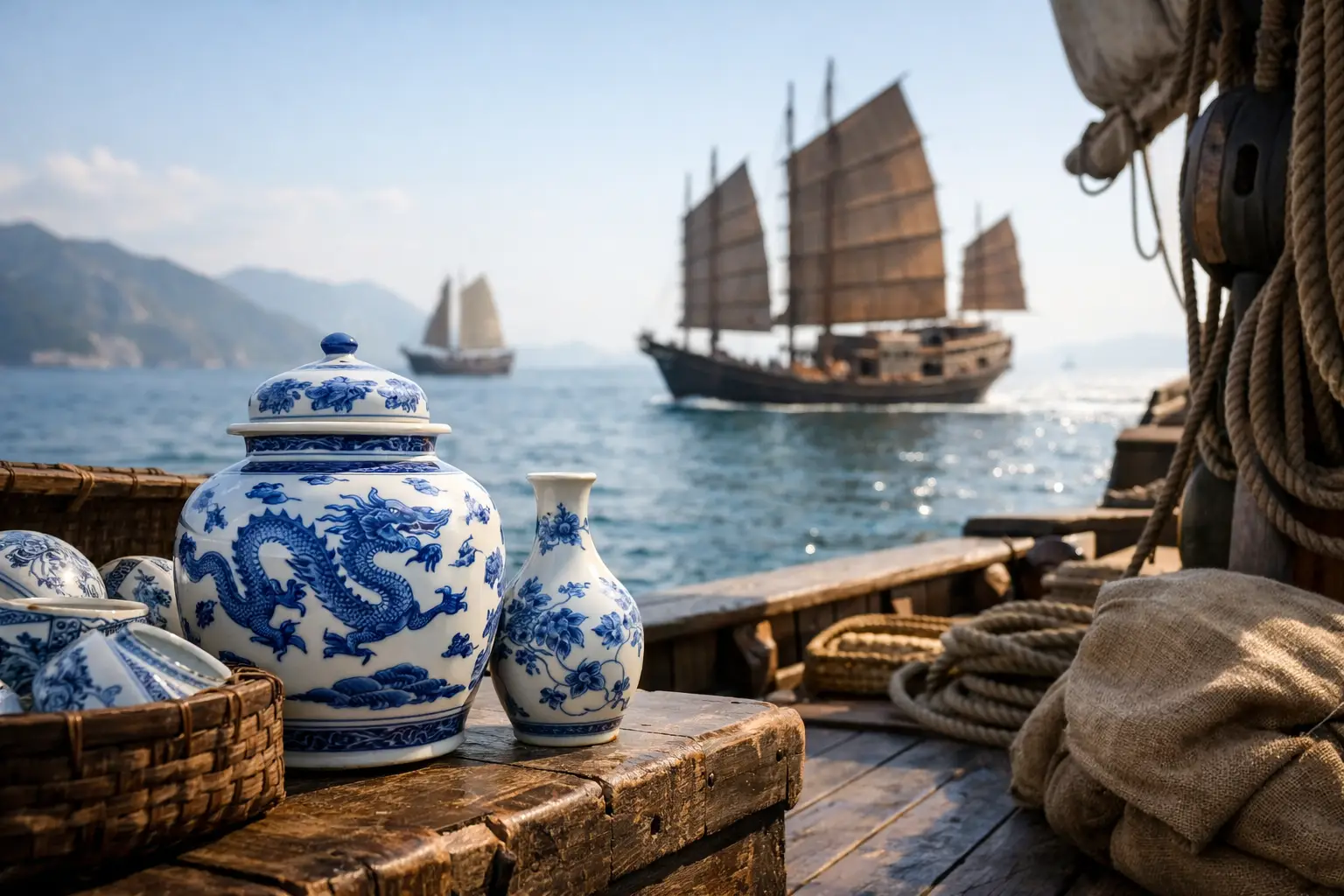
Porcelain was particularly well suited to this commerce. It was precious enough to reward long-distance transport, yet practical enough to be used at a table or given as a diplomatic gift. Bowls, dishes, jars and ewers could be packed in quantity, often nested together to make efficient use of a ship’s cargo space. Their forms travelled widely, but their meanings changed from one destination to another.
A blue-and-white dish, for example, represented a technical triumph as well as a decorative object. The cobalt used for its vivid blue could be sourced through western Asian trade, then painted onto a Chinese body and fired at great heat. In one object, materials and expertise from different regions became something distinctly Chinese, before being sent back into the wider world. This is why porcelain is such a compelling record of exchange: it preserves global connections in its clay, pigment, form and decoration.
From Kiln to Harbour
The journey began well before a vessel left port. Producing porcelain required access to suitable clay, fuel, water, skilled labour and sophisticated kilns. Jingdezhen became renowned for its porcelain production, but it was part of a broader landscape of specialised workshops. Potters, painters, kiln workers, packers and merchants all contributed to an object that might eventually travel thousands of miles.
Once fired, wares entered commercial networks that were highly organised, though never entirely predictable. Inland transport brought ceramics to major ports, where merchants assembled cargoes alongside silk, metalware, spices, forest products and luxury goods. A vessel’s departure had to take account of monsoon patterns. The winds that made long-distance sailing possible also imposed a rhythm on trade, requiring crews and merchants to wait, bargain and plan at seasonal ports.
Southeast Asia was not merely a passage between China and the Indian Ocean. It was a vital marketplace in its own right. Ports throughout the region supplied resins, aromatic woods, tin, spices and other valuable goods, while local communities purchased and adapted imported ceramics for everyday use, elite display and ritual practice. The sea did not separate these places. It made their relationship possible.
Ports Were Meeting Places, Not Just Stops
It is tempting to picture maritime trade as a straight line from producer to buyer. In reality, porcelain often changed hands several times. A merchant might buy a cargo in southern China, sell part of it at a Southeast Asian harbour, then use the proceeds to acquire local goods for another market. Some pieces remained close to where they first arrived; others continued across the ocean in smaller, regional trading networks.
This helps explain why similar ceramic forms appear in places with very different cultures. A Chinese bowl could become part of a household in the Malay world, a prized possession in an Indian Ocean port or an object incorporated into local ceremonial traditions. Trade created shared visual languages, but it did not erase local preference.
Reading Taste Through Ceramic Cargoes
The objects selected for export tell us that buyers were discerning. Merchants did not simply send whatever a kiln produced. Shapes, motifs and quantities reflected demand, price and practical considerations. A cargo rich in bowls and dishes suggests the importance of dining and domestic use; large storage jars point towards the movement and preservation of foodstuffs, liquids or valuable commodities.
Decoration also mattered. Floral scrolls, birds, waves and auspicious motifs could appeal across cultures, while some forms may have been commissioned or favoured for particular markets. Yet interpretation requires care. A pattern found in a coastal settlement does not automatically prove a direct commercial relationship with one Chinese port. Ceramics can circulate for generations, move through secondary markets and be copied by workshops elsewhere.
That uncertainty is part of their fascination. Maritime archaeology rarely offers a complete ledger of every transaction. Instead, it provides fragments: a cargo sealed beneath the sea, a cluster of sherds at an excavation, an object preserved in a family collection. When these fragments are compared with kiln evidence, historical records and other finds, a richer picture emerges.
Shipwrecks Preserve a Moment in Trade
Shipwrecks are among the most vivid sources for understanding the porcelain trade. A wreck can preserve a cargo at a particular point in time, revealing what was being carried together and, sometimes, the route a vessel may have intended to take. Unlike a single heirloom or an isolated sherd, a shipwreck assemblage can show the scale of trade and the commercial logic behind it.
It also reminds us that maritime success was never guaranteed. Ships faced reefs, storms, shifting currents, fire, structural failure and piracy. Each wreck represents a journey interrupted, but its loss can become an unexpected archive centuries later. Ceramics often survive where wood, textiles and foodstuffs do not, making porcelain one of the clearest surviving voices from the vessel.
The condition of a recovered piece can reveal much. Marine encrustation may conceal a surface that remained remarkably intact beneath the seabed. Stacking marks, firing flaws and traces of packing offer clues to manufacture and transport. Even broken pieces matter, because they can help archaeologists identify types, dates and connections between cargoes found in different places.
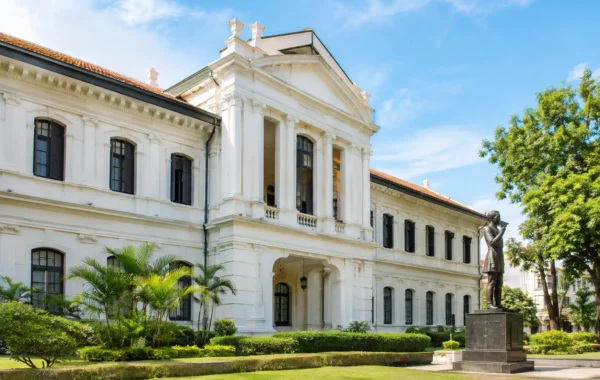
At Straits & Oriental Museum, shipwreck ceramics offer a tangible way to encounter these histories. They bring the great networks of Asian maritime exchange into human scale: a cup held in a hand, a jar once secured in a ship’s hold, a bowl whose painted surface still carries the confidence of an accomplished kiln.
Why Provenance Matters
For collectors and museum visitors alike, the appeal of ancient porcelain should be matched by respect for provenance. A beautiful object gains historical depth when its origin, collection history and archaeological context are responsibly documented. Context can tell us whether a vessel carried ordinary trade goods or exceptional wares, whether a form was common or unusual, and how objects were used after reaching their destination.
This is also where caution serves appreciation. Dating Yuan ceramics can be complex. Styles overlap, revival pieces exist, and a later object may deliberately echo an earlier form. Attributions are strongest when specialists can compare clay, glaze, decoration, firing technique and archaeological parallels. A confident label should rest on evidence, not simply on the romance of age.
The trade-offs are real. An object with a documented wreck provenance may be especially valuable for scholarship, while a finely preserved piece without a clear history may still be visually impressive but harder to interpret. Museums make these distinctions meaningful by placing individual works within the broader story of production, trade and cultural encounter.
A Maritime Story Still Felt in Penang
George Town belongs to a later chapter of the region’s port history, yet its streets and waterfront still make the logic of maritime exchange easy to feel. Penang grew through the movement of people, goods, languages and food across the Straits. Looking at Yuan porcelain in this setting is a reminder that Southeast Asia has long been central to international commerce, not peripheral to it.
The next time you stand before an ancient bowl or jar, linger over more than its colour and craftsmanship. Consider the hands that shaped it, the merchants who priced it, the sailors who carried it and the households that made it part of their lives. That small act of attention lets the porcelain do what it has always done best: connect distant shores through a good story.