
A bowl recovered from the sea is never merely a bowl. Its glaze may still carry a quiet brilliance, but its greater value lies in the questions it preserves: who made it, who selected it for cargo, where it was bound, and why it never arrived. The Royal Nanhai excavation findings offer precisely this kind of encounter – a rare, material record of the maritime networks that connected China and Southeast Asia during the Ming period.
For visitors and collectors alike, these objects make history unusually immediate. They were once commercial goods, packed tightly below deck for a market beyond the horizon. Centuries later, they emerge as witnesses to craftsmanship, trade and the unpredictability of life at sea.
What the Royal Nanhai excavation revealed
The Royal Nanhai was a Chinese trading vessel carrying a substantial ceramic cargo when it was lost in the South China Sea. Its recovery brought to light a remarkable range of Chinese export wares, particularly blue-and-white porcelain alongside other ceramic forms made for circulation beyond China’s domestic market.
The significance of the find does not rest on one spectacular object. It is in the cargo’s collective evidence. A shipwreck preserves ceramics in the company they kept: stacked bowls, storage jars, dishes, cups and other vessels selected in quantity. On land, such pieces often survive as isolated heirlooms or fragments. In a wreck assemblage, they can be read as part of a commercial decision – a consignment shaped by price, demand, packing and the practical limits of a ship’s hold.
This is why shipwreck archaeology changes the way porcelain is understood. A finely painted dish may be admired for its design, but its place within a larger cargo tells us that beauty and commerce were closely entwined. These wares were desirable not only as works of skill, but as useful, portable and recognisable objects for households across the region.
Ceramics made for a maritime market
The Royal Nanhai cargo helps illustrate the international character of Ming ceramic production. Chinese kilns were capable of producing vast quantities of wares, from accomplished porcelain with carefully painted decoration to more restrained everyday vessels. Export did not mean inferior. Rather, it meant that makers and merchants understood the preferences of customers living far from the workshops where the ceramics began.
Forms were often practical as well as elegant. Bowls travelled well, nested efficiently and suited daily dining. Jars could serve storage needs. Dishes offered broad surfaces for decoration and display. Within such choices is an early picture of market awareness: goods designed for use, exchange and status in port communities around maritime Asia.
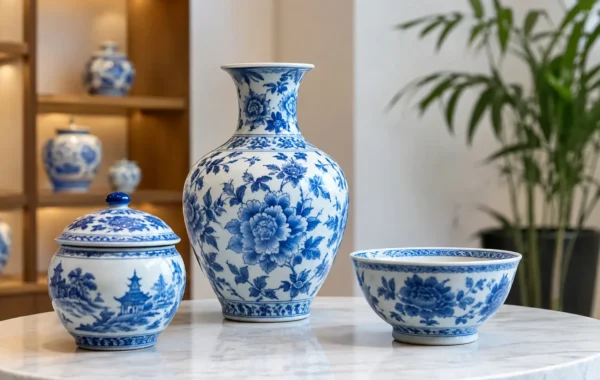
Blue-and-white porcelain remains especially compelling because its visual language travelled so successfully. The contrast of cobalt blue against a white ground was legible in many cultural settings. Floral sprays, scrolling motifs, geometric borders and familiar vessel shapes could satisfy a broad market while retaining the authority of Chinese manufacture.
Why the Royal Nanhai findings matter beyond the sea bed
A wreck is a frozen moment, not a complete account. It cannot tell us every port the vessel visited, the names of its crew or the exact intentions of every merchant involved. Marine archaeology requires interpretation, and conclusions can evolve as ceramics are compared with kiln material, historical records and other excavated cargoes.
Even so, the Royal Nanhai excavation findings are powerful because they bring together forms of evidence that are rarely found intact. The vessel, cargo and marine environment provide context that individual antiques usually lack. This allows specialists to consider chronology, trade routes and consumer taste with greater care.
The cargo also complicates the old notion that cultural exchange moved in one direction. Chinese ceramics were exported from Chinese ports, certainly, but their designs, forms and commercial success were shaped by a wider world of buyers. Southeast Asian port cities were not passive destinations. They were lively centres of exchange, where merchants assessed goods, negotiated value and carried styles onwards through regional networks.
For Penang, a historic gateway between the Straits of Malacca and the wider world, this maritime perspective has particular resonance. The island’s own heritage was formed by movement: of people, spices, textiles, ceramics, languages and ideas. Shipwreck ceramics make that long history tangible, placing a small porcelain vessel within a much larger story of the sea.
The sea changed every object
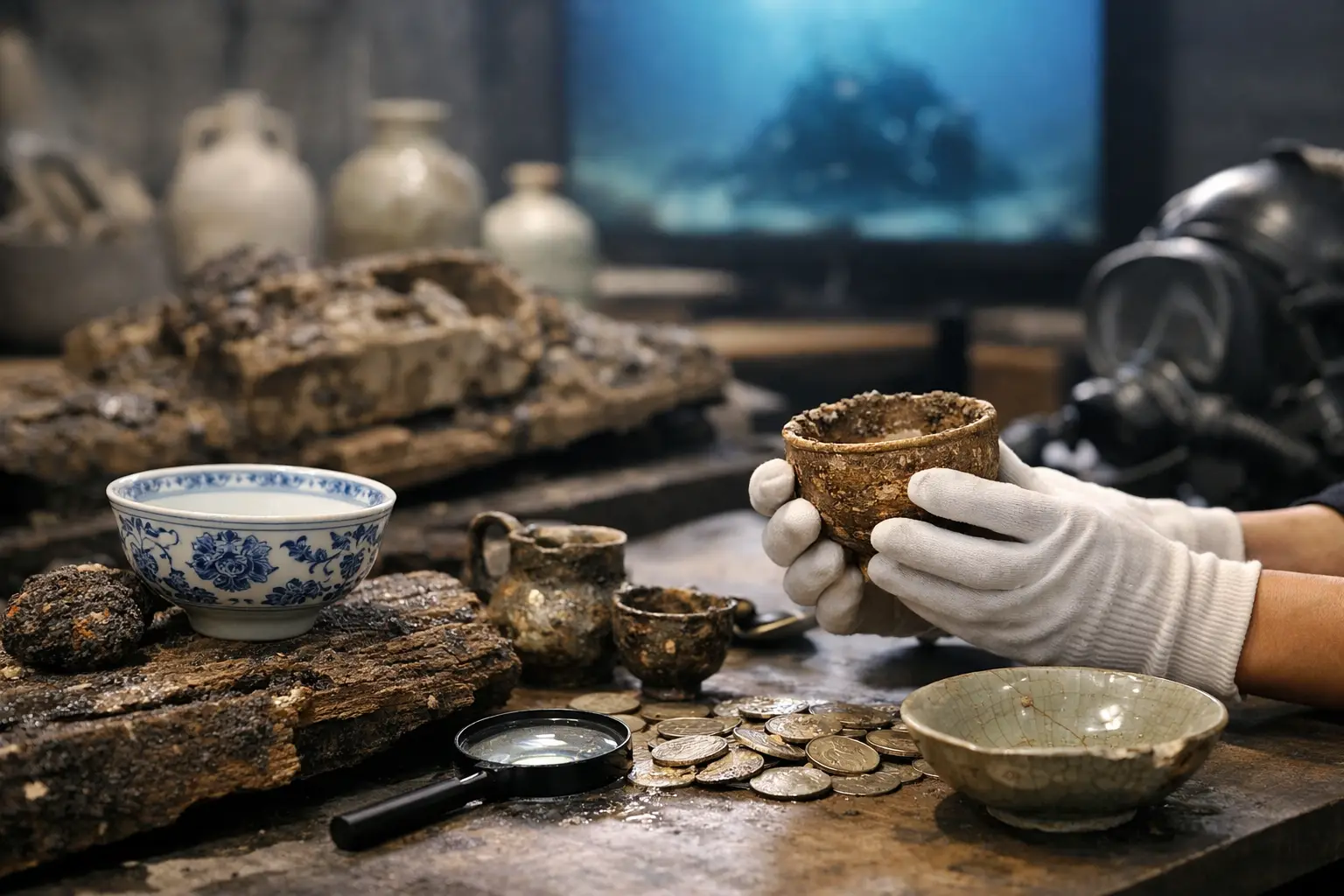
Marine burial gives shipwreck ceramics a character unlike that of objects kept in a cabinet for centuries. Some surfaces may be softened by encrustation, staining or abrasion. Other pieces may have survived in astonishing condition, protected by sediment and the way the cargo settled after the wreck.
These marks should not automatically be treated as defects. They are evidence of an object’s second life beneath the water. A collector may prefer a pristine surface, while an archaeologist may value a piece with sea accretions for what it reveals about burial conditions and recovery. Neither response is wrong, but they answer different questions.
Condition also affects interpretation. A chipped bowl may still be crucial if it helps establish a cargo type or packing pattern. Conversely, an immaculate piece without secure provenance can be less informative historically than a more weathered excavated example. The distinction is worth remembering whenever shipwreck ceramics are viewed, bought or discussed.
How to look closely at Royal Nanhai ceramics
The most rewarding way to view these artefacts is to move beyond the first impression of colour and decoration. Begin with the vessel’s form. Is it a bowl intended for repeated daily use, a dish for serving, or a jar made for storage? Form can suggest how an object functioned before it became an archaeological find.
Then study the decoration. Notice whether a motif is carefully composed around the centre, confined to a border or allowed to flow across the surface. Look for the confidence of the painted line, the depth of cobalt and the balance between ornament and empty space. These details speak to both workshop practice and the aesthetic expectations of the intended market.
Finally, consider the object as cargo. It was not carried alone. Imagine the labour behind it: clay prepared, vessels shaped, glazed, fired, sorted, packed and loaded. Each piece represents an extraordinary chain of hands and decisions, ending not at its planned destination but on the sea bed.
At Straits & Oriental Museum, shipwreck ceramics can be encountered within a broader journey through Asian maritime history. The experience is not simply about seeing porcelain behind glass. It is about recognising the human ambition behind every recovered object, and the astonishing distances that such fragile things were made to travel.
A caution for collectors and curious visitors
The appeal of shipwreck ceramics has encouraged strong interest among collectors, but provenance should always be central to appreciation. Responsible ownership begins with clear documentation, lawful recovery and an understanding that archaeological objects carry cultural responsibilities as well as aesthetic appeal.
It is also wise to resist easy labels. Not every blue-and-white ceramic was made at the same kiln, for the same buyer or to the same standard. Dating can be complex, and attribution often depends on close comparison of form, paste, glaze and painted style. A persuasive story is not a substitute for sound evidence.
For the curious visitor, this complexity is part of the pleasure. The Royal Nanhai does not offer a neat tale of treasure recovered from the deep. It offers a more interesting one: a commercial voyage interrupted, a cargo transformed by the sea, and a collection of objects that still connect makers, merchants and modern audiences across centuries.
Next time a shipwreck bowl catches your eye, pause over its modest scale. It may fit in two hands, yet it carries the imprint of kilns, ports, monsoon routes and lives lived far beyond the shore.