
A porcelain bowl can be hundreds of years old and still be relatively familiar. Another, made in the same century, may be among the few surviving examples of a kiln, a trade route or a lost cargo. That distinction lies at the heart of what makes ancient porcelain rare: age matters, but it is only the beginning of the story.
For collectors, historians and curious visitors alike, ancient porcelain offers a remarkably tangible connection to Asia’s artistic and maritime past. Its surfaces carry the ambitions of imperial courts, the skill of kiln communities, the tastes of distant markets and, in some cases, the drama of a ship that never reached its destination. True rarity is created where these stories converge.
What Makes Ancient Porcelain Rare?
Rarity is not a single quality that can be judged at a glance. It is a balance of survival, craftsmanship, historical importance, condition and evidence. A piece becomes especially compelling when it is scarce in the surviving record and can be firmly connected to a particular place, period or journey.
Porcelain itself was a technical achievement. Its hard, luminous body required carefully selected materials, high firing temperatures and close control within the kiln. In China, where porcelain production reached extraordinary sophistication over many centuries, individual kilns developed distinct palettes, forms, glazes and decorative languages. Yet not every old ceramic was made to be exceptional. Vast quantities were produced for domestic use and export, while only certain wares were reserved for elite patrons, imperial courts or highly particular overseas markets.
The rarest pieces are therefore often those that sit at an intersection: a limited production, a difficult technique, a short-lived design, a known historical context and unusually good survival.
Age Is Meaningful, But It Is Not Enough
It is tempting to assume that the oldest porcelain is automatically the rarest. In practice, age must be viewed alongside production volume and survival rate. Some ceramics were made in enormous numbers and traded across Asia, the Middle East and Europe. Their age gives them historical interest, but surviving examples may still be comparatively accessible.
Conversely, a later piece can be much rarer if it came from a kiln with limited output, used a brief experimental glaze, or belonged to a service commissioned for a specific household or market. A vessel decorated in a pattern known from only a handful of examples may command far greater attention than a more common object of greater age.
Dating also needs care. Ceramic styles were frequently revived, copied and reinterpreted, sometimes within a generation and sometimes centuries later. Specialists look beyond a broad date such as “Ming” or “Qing”, examining the foot rim, paste, glaze, brushwork, shape and firing characteristics to establish where an object belongs in the long history of porcelain.
The Kiln, Craft and Design Matter
A rare porcelain object often reveals a demanding process. Certain glazes required exact mineral mixtures and precise kiln atmospheres. A change of only a few degrees, or an excess of oxygen during firing, could alter the result. Copper-red decoration, for instance, was notoriously difficult to control, while finely painted cobalt-blue designs required both an experienced hand and a successful firing.
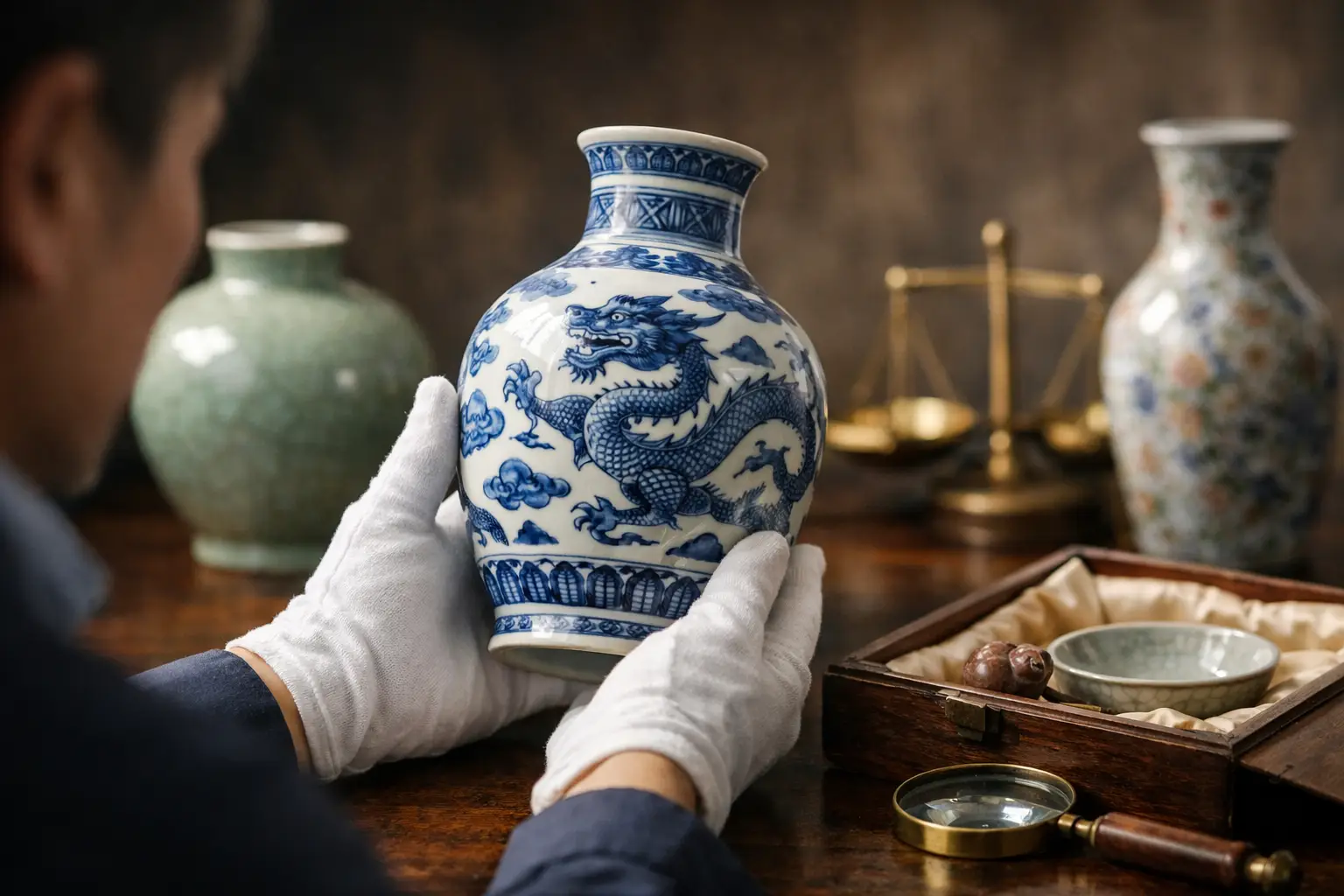
The quality of the decoration matters too. Confident brushwork, balanced composition and a clear understanding of form can distinguish an accomplished workshop from routine production. On a finely painted dish, a dragon may seem to move around the surface; on a celadon bowl, the glaze may pool gently in carved lines, bringing a quiet design to life. These are not merely decorative details. They are evidence of mastery.
Imperial and courtly wares may be rare because they were produced under strict supervision, sometimes in limited runs, for use rather than widespread commerce. However, an imperial association should never be accepted on appearance alone. Marks can be copied, and not all wares carrying a reign mark were made during that reign. The object’s material and workmanship must support the claim.
Survival Changes the Odds
Porcelain is hard, yet it is far from indestructible. It breaks in homes, ships, markets and burial sites. It can be damaged by poor storage, repaired in later centuries or discarded when fashions change. Every intact vessel has survived a sequence of risks that most of its contemporaries did not.
Condition therefore has a powerful effect on rarity and desirability. An untouched piece with a clean rim, original glaze and no restoration is often far scarcer than one with chips, hairline cracks or heavily concealed repairs. That said, condition is not an absolute rule. A fragment bearing a rare inscription, an exceptional motif or secure archaeological context may be profoundly significant despite its incompleteness.
Collectors should regard restoration as part of an object’s biography, not simply a flaw to hide. Professional conservation can stabilise a piece and make it suitable for display, but it should be clearly disclosed. Over-restoration may erase useful evidence and can diminish both historical integrity and confidence in the object.
Shipwreck Porcelain Has a Different Kind of Rarity
Shipwreck ceramics bring an additional layer of meaning. They are not simply objects recovered from the sea. They are part of a sealed moment in maritime history, carrying evidence of what merchants were exporting, who might have bought it and how trade linked distant ports.
A wreck cargo can contain hundreds or thousands of pieces, which means an individual bowl type may not be rare in the usual numerical sense. Its importance may instead come from context. A group recovered together can establish a reliable date for a form, reveal a previously under-documented export pattern, or show how cargoes were packed for long sea voyages. Saltwater, sediment and centuries underwater can also preserve objects in surprising ways, although marine encrustation, staining and surface wear are common.
The most significant shipwreck porcelain is accompanied by careful archaeological recording. Its location, depth, cargo arrangement and associated finds all help tell the story. Without that documentation, an object may be attractive, but its historical voice is quieter. Provenanced wreck material provides a rare opportunity to see ceramics not as isolated antiques, but as participants in the great maritime networks that shaped Southeast Asia.
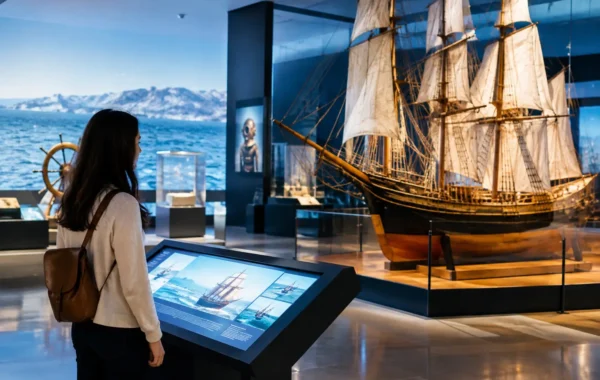
At Straits & Oriental Museum in George Town, shipwreck ceramics allow visitors to encounter this history at human scale: a storage jar, a blue-and-white dish or a small cup becomes evidence of an ocean crossing, a commercial decision and a world of exchange.
Provenance Is the Evidence Behind the Story
Provenance means the documented ownership and history of an object. For ancient porcelain, it can be as valuable as the object’s visual appeal. A continuous record linking a piece to a respected collection, excavation, old inventory or published exhibition offers reassurance about authenticity and establishes context.
This is particularly important because the market has long attracted reproductions and deliberate forgeries. Some copies are honest commemorations of earlier styles; others are made to mislead. A convincing imitation may reproduce a mark or decorative motif, but it often struggles to replicate every aspect of age, clay, glaze, wear and craftsmanship.
Good provenance does not remove the need for expert examination, and a lack of paperwork does not automatically prove that a piece is false. It does, however, affect the level of confidence. The strongest assessment combines material knowledge with transparent records and, where appropriate, scientific analysis.
Rarity Also Depends on Whose Story Is Being Told
Ancient porcelain was made for different audiences. A refined cup for a courtly setting, a robust storage vessel for a ship’s hold and a dish designed for an overseas dining table all speak to distinct histories. Their rarity cannot be measured solely by auction interest or decorative appeal.
A common export form can be invaluable to researchers if it helps map the trading relationships between Chinese kilns, Malay ports and consumers across the region. A humble shard can provide a date for an archaeological layer. A rare shape may reveal a custom order for a distant market. Cultural value and market value often overlap, but they are not identical.
This is why the most rewarding way to view porcelain is to look slowly. Turn your attention from the painted scene to the foot rim, from the glaze to the vessel’s purpose, and from the object itself to the route it may have travelled. The questions become richer than “How old is it?” or “What is it worth?”
Ancient porcelain becomes rare when it preserves something that would otherwise be lost: an exceptional act of making, a fragile survival, a documented journey or a precise glimpse of the past. Seen with care, each piece offers more than beauty. It offers a reason to pause, and a story that has crossed centuries to be heard.