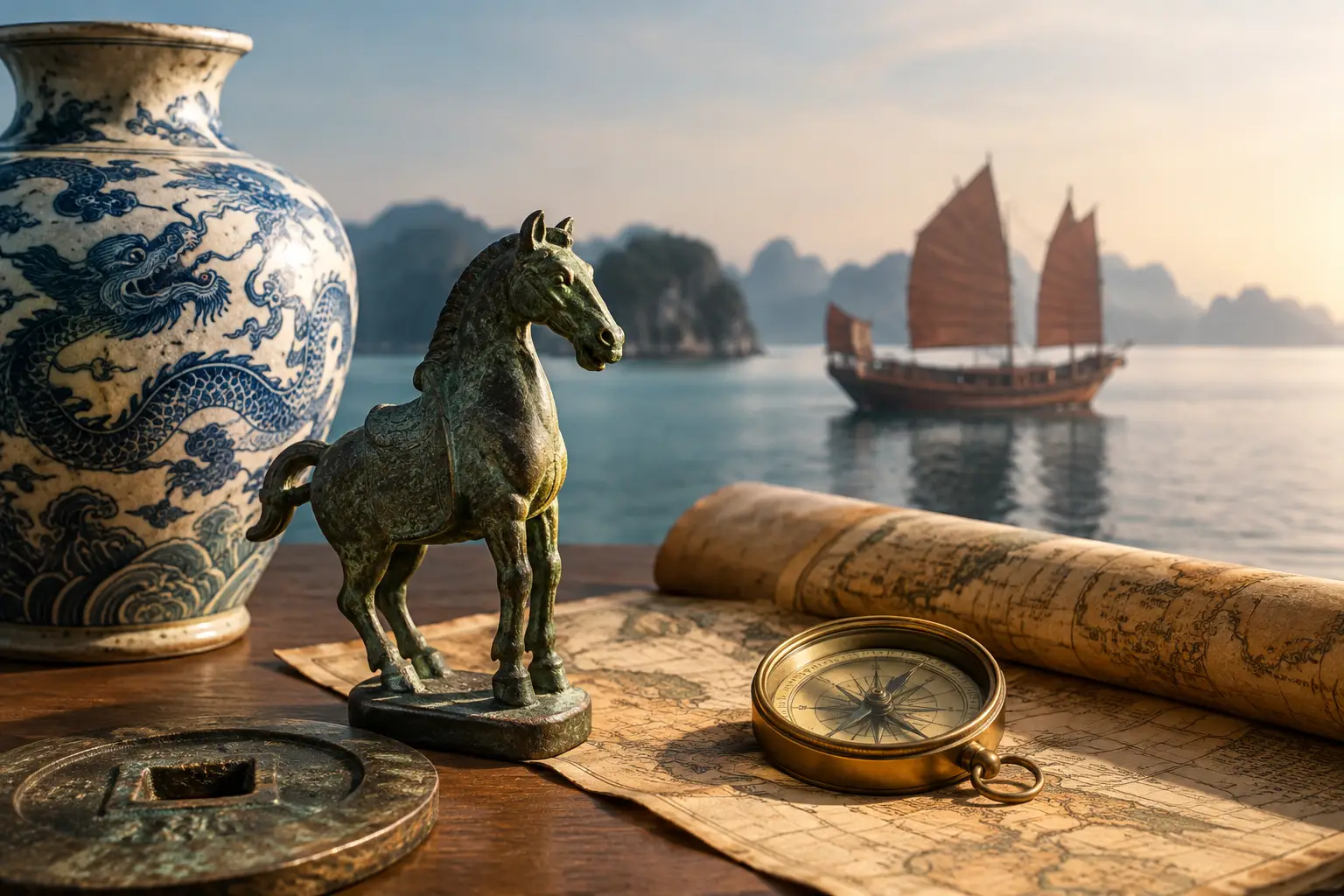

A porcelain bowl raised from the seabed can carry the quiet evidence of an extraordinary journey: shaped at a Chinese kiln, packed among hundreds of companions, loaded aboard a trading vessel, and lost or delivered somewhere along Asia’s maritime crossroads. Chinese antiquities are not simply beautiful objects from the past. They are records of taste, technology, commerce and the human desire to carry fine things across great distances.
For visitors and collectors alike, their appeal lies in this double life. A dish may be admired for the rhythm of its cobalt-blue painting or the translucence of its glaze, yet its form also tells us who might have ordered it, where it was intended to travel, and how China became central to one of the world’s most enduring networks of exchange.
Why Chinese Antiquities Continue to Captivate
Chinese ceramic traditions developed across many centuries, with each period bringing its own technical advances, decorative language and collecting legacy. Porcelain in particular became prized because it was both refined and remarkably durable. Its hard, vitrified body, luminous surface and capacity for intricate decoration set it apart from many ceramics made elsewhere.
The finest examples were never merely domestic wares. They could signal status at an imperial court, grace a merchant household or serve as diplomatic gifts. At the same time, large quantities of practical bowls, jars and dishes were made for export. This combination of exceptional artistry and broad circulation is why Chinese ceramics can be encountered in palaces, private collections and archaeological sites far beyond China.
Their value should not be measured only by age or rarity. A modest export bowl with a lively floral motif can be historically significant if it reveals how a particular community ate, traded or entertained. A finely painted dish may reward close looking with references to gardens, auspicious creatures, poetry or seasonal ritual. Each object asks the viewer to slow down and recognise that decoration was often a language, not simply an embellishment.
Chinese Antiquities at Sea
The sea is essential to the story. From the ports of southern China, cargoes of ceramics travelled through the South China Sea and the Strait of Malacca towards Southeast Asia, the Indian Ocean and beyond. These waters connected producers, sailors, merchants, courts and consumers from vastly different cultures.
Shipwreck discoveries offer a rare, concentrated view of that movement. Unlike a single heirloom preserved in a family home, a wreck can preserve a commercial moment: the range of goods selected for a market, the forms packed together and, occasionally, the traces of the ship’s final voyage. Ceramics survive particularly well underwater, making them among the most evocative witnesses to maritime history.
A cargo might include elegant covered boxes, storage jars, bowls for daily use and ceremonial-looking dishes. The mixture is revealing. It suggests that maritime trade was not confined to elite collectors. Fine ceramics travelled alongside useful household wares, meeting the needs of varied communities in port cities and inland settlements.
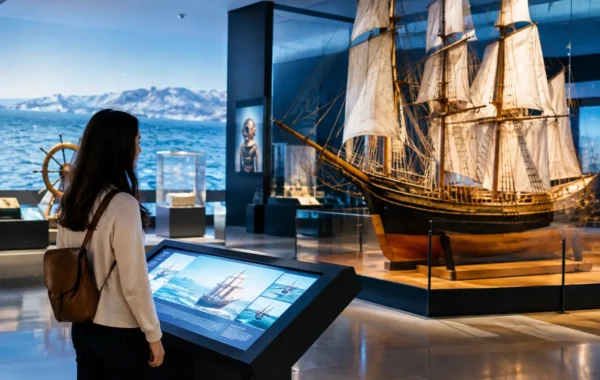
There is, however, an important distinction between a beautiful object and a fully documented archaeological artefact. Context matters. Knowing where an item was recovered, what it was found with and how it has been conserved can add considerably to our understanding. Responsible museum display gives these objects back their setting, allowing visitors to see more than a decorative fragment of the past.
Reading the Marks of Time
Chinese ceramics are often introduced through dynasties, and this can be useful, but it is only one way to look. The Ming period, for example, is celebrated for the international reach of blue-and-white porcelain, while later Qing ceramics are admired for technical virtuosity and a wide palette of enamels. Yet a visitor does not need to memorise every reign mark to begin seeing the difference between objects.
Start with the material. Is the body pale and fine, or heavier and more stoneware-like? Then look at the glaze: does it appear glassy, softly crackled, celadon-green or brilliant white? Decoration provides further clues. Cobalt-blue painting beneath a clear glaze often evokes the long history of blue-and-white ware, while iron-red, famille rose and other enamelled palettes point to different firing methods and aesthetic preferences.
Shape is equally informative. A large jar was made to store or transport. A small cup shaped for the hand suggests another kind of ritual or sociability. A dish with a broad, open well created a canvas for painted scenes. Even the foot ring beneath a vessel can reveal practical details about manufacture and firing.
It is worth resisting the temptation to treat every old-looking piece as rare. Condition, provenance, workmanship, period and historical context all affect significance. Repairs, chips and marine encrustation may reduce commercial value in some cases, but they can also form part of an object’s story. For a shipwreck ceramic, the marks of a journey can be as compelling as pristine perfection.
A Shared Visual Language Across Asia
Chinese ceramics were exported widely, but they were not simply received unchanged. In Southeast Asia, local rulers, merchants and households incorporated them into their own traditions. They were used at meals, exchanged as gifts, placed in graves, displayed as prestige goods and, in some places, adapted as architectural decoration.
This circulation also encouraged creativity. Potters in Vietnam, Thailand and other centres responded to the popularity of Chinese forms and motifs, sometimes making close alternatives and sometimes developing distinctive regional interpretations. The result is not a story of one culture acting upon another, but of dialogue across ports, workshops and households.
Penang is a particularly fitting place to encounter this history. Its position within the Straits of Malacca places it within the wider geography of maritime exchange that shaped the region for centuries. At Straits & Oriental Museum, shipwreck ceramics provide a direct encounter with these routes, bringing the splendour of porcelain into conversation with the vessels, traders and coastal communities that made its movement possible.
Looking Closely Changes the Experience
Museum encounters with Chinese antiquities are most rewarding when they move beyond the question, “How old is it?” Consider instead what an object was made to do. Was it created for an imperial patron, a household table or an overseas market? Who would have handled it before it reached its destination? What does its decoration suggest about the values or hopes of its intended owner?
A dragon may represent authority and auspicious power. Peonies can evoke prosperity and honour. Lotus scrolls may carry associations of purity and renewal. These meanings were not fixed in a simplistic way, and motifs could be selected for beauty as well as symbolism. Still, recognising them gives the surface of a vessel greater depth.
Scale can also surprise. A tiny box or cup requires intimate attention, while a storage jar reminds us of the practical logistics behind luxury trade. One was perhaps treasured in the hand; the other may have been packed tightly in a ship’s hold. Both belong to the same vast commercial world.
Collecting with Care and Curiosity
For those considering Chinese antiquities as a collecting interest, informed curiosity is the best starting point. Buy from reputable sources, ask for clear provenance and condition information, and learn to appreciate scholarship as much as visual impact. A confident attribution should be supported by more than an appealing label.
There are trade-offs. A museum-quality piece with strong documentation may command a premium, while a less perfect object can offer charm and educational value at a more approachable level. Personal taste matters, but it should be guided by authenticity, ethical collecting and an understanding of what has been restored or altered.
Above all, allow the object to remain larger than its price or decorative appeal. Chinese antiquities endure because they hold many stories at once: the knowledge of a kiln worker, the confidence of a merchant, the preferences of a distant buyer and the unpredictable force of the sea. To stand before one is to meet a small, resilient survivor of Asia’s shared history – and to let its journey continue in the imagination.