
George Town rewards the traveller who slows down. Along the Georgetown heritage trail, a Chinese shophouse, an Indian Muslim mosque, a clan temple and a weathered godown can stand only minutes apart, each holding a chapter of Penang’s long conversation with the world. This is not a place best understood through a hurried collection of photographs. It is a port city whose streets still reveal how merchants, migrants, artisans and sailors shaped a remarkable cultural crossroads.
A meaningful heritage walk is less about seeing every landmark than learning to notice connections: the five-foot ways that shelter passers-by from tropical rain, the façades that blend European proportion with local craft, and the names of streets that preserve the memory of trades once conducted there. Set aside the better part of a day, keep the route flexible, and leave room for a thoughtful pause indoors when the heat rises.
Begin the Georgetown Heritage Trail at the Waterfront
The sea is the right place to begin because George Town’s heritage was built on maritime exchange. From the late eighteenth century onwards, Penang became a strategically placed entrepôt linking the Malay Archipelago, China, India and Europe. Ships arrived with textiles, spices, tea, metalware and ceramics; they departed carrying the goods, tastes and ambitions of a growing port.
At the waterfront, the scale of this history becomes easier to imagine. Fort Cornwallis recalls the colonial administration that established the settlement, while the nearby streets point towards the commercial life that quickly grew beyond it. Look beyond the formal monuments. Warehouses, loading spaces and older shop premises offer a more human sense of the port: goods moving from boat to shore, workers speaking many languages, and families finding a future in a new trading town.
The Clan Jetties, reached further along the waterfront, bring this relationship with the sea into sharper focus. These timber settlements are living communities, not a stage set. Walk with consideration, keep noise low and remember that the narrow passages are home as well as heritage. Their survival speaks to the resilience of migrant communities whose livelihoods were tied to the harbour.
Read the Streets, Not Just the Landmarks
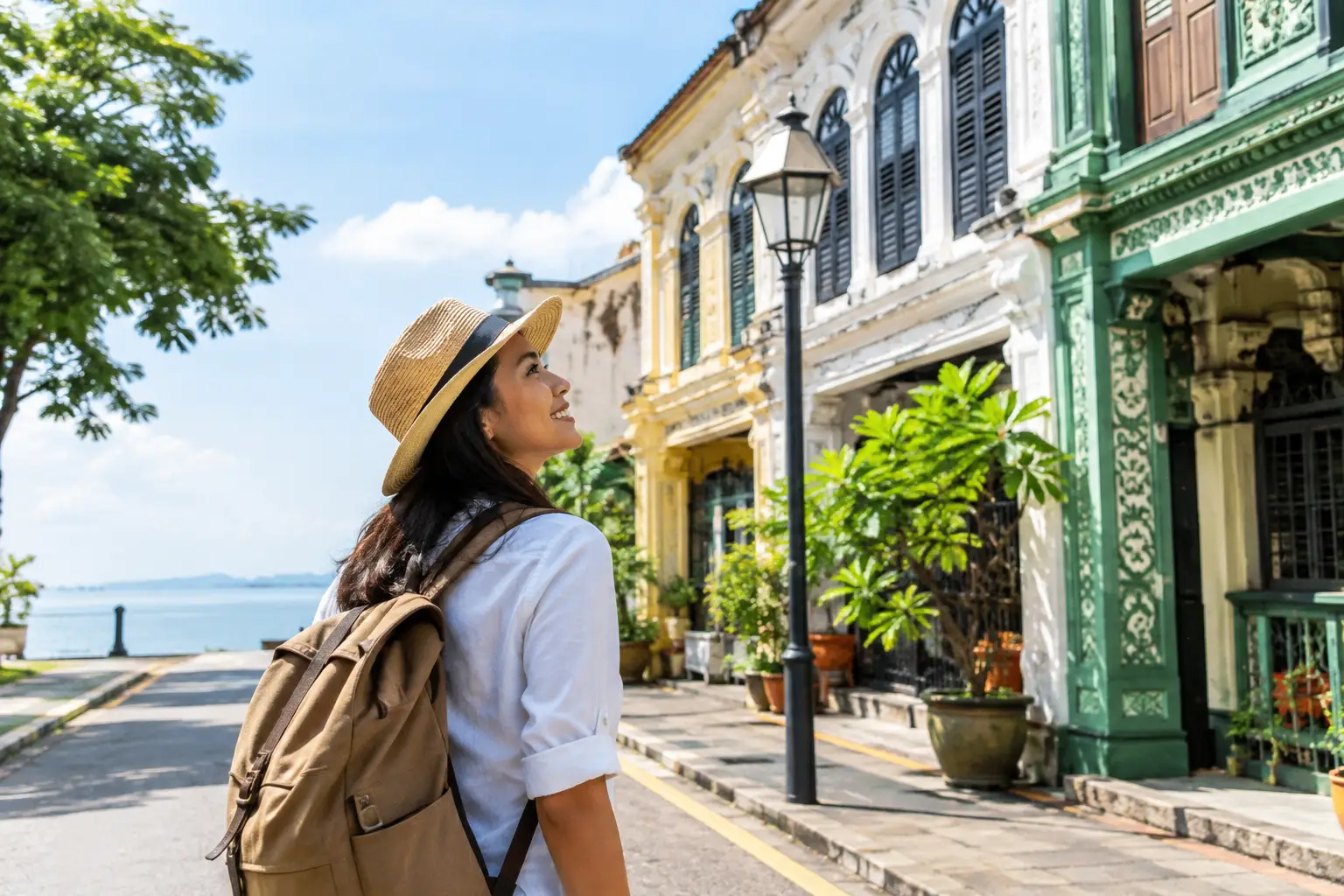
From the waterfront, move inland towards the older commercial quarters. George Town’s celebrated shophouses deserve more than a quick glance at their colourful fronts. Their architecture was designed for both work and domestic life: trade on the ground floor, family life above, and a covered walkway at street level that connects one building to the next.
Notice the details. Timber louvres encourage air movement in the humid climate. Ventilation openings, ornate tiles and carved doors tell of changing fashions and the confidence of successful households. Some façades are restrained, while others display an exuberant mix of Chinese, Malay, Indian and European motifs. That visual layering is one of the city’s great pleasures.
Armenian Street is often busy, and it can be tempting to treat it as the entire experience. It is better approached as one lively thread within a larger urban fabric. Turn down a quieter side street where possible. The pace changes quickly, and the city begins to reveal less polished but equally telling signs of daily life: a traditional tradesman at work, incense drifting from a shrine, or a family-run business opening for the morning.
The Architecture of Exchange
George Town was never culturally static. Its built environment records adaptation. Peranakan households developed distinctive decorative languages; religious communities built places of worship that reflected both inherited traditions and local materials; merchants commissioned premises that conveyed prosperity to customers and neighbours alike.
This is why a heritage trail should not be treated as a list of separate attractions. A temple, mosque, church and clan house are not simply stops on a map. Together, they show how different communities negotiated proximity, commerce and belonging in a dense port city. The short distances between them are part of the story.
Follow Faith, Community and Craft
The area around Jalan Masjid Kapitan Keling offers one of the clearest introductions to George Town’s plural heritage. Here, religious architecture does not sit at the margins. It forms the heart of neighbourhood life, reflecting the presence of Muslim, Hindu, Buddhist and Christian communities whose histories are intertwined with trade and migration.
Enter respectfully, dress appropriately and be prepared for restricted access at certain times. A place of worship is most rewarding when approached with curiosity and restraint. Listen for the rhythms of the neighbourhood rather than looking only for its most photographed angle.
Continue towards the clan houses and temples, where family associations once offered new arrivals practical support, spiritual connection and a social network. Khoo Kongsi remains a particularly striking expression of this tradition, with intricate ornament, a dramatic courtyard and a strong sense of ceremonial pride. Yet its significance lies beyond craftsmanship alone. It speaks to the institutions people created when they crossed oceans and needed a community on shore.
Craft is another quiet guide along the route. Look for painted signs, hand-laid tiles, rattan work, carved timber and traditional food businesses that still carry skills through generations. Heritage is not only what has been preserved behind glass. It is also knowledge practised in public, sometimes in forms so familiar to local residents that visitors may overlook it.
Make Time for the Sea Beneath the City’s Story
A walk through George Town explains the city above ground. Maritime archaeology can reveal the world that made such a city possible. The porcelain, stoneware and trade goods recovered from historic shipwrecks are not merely beautiful objects. They are evidence of routes, markets and cultural appetite across Asia.
A vessel lost at sea may preserve cargo in extraordinary numbers, allowing us to see the scale on which ceramics travelled. A bowl or storage jar can carry clues about where it was made, who might have used it and why it was valuable enough to transport across dangerous waters. These objects also complicate the idea that trade moved in only one direction. Ports such as Penang were places where goods acquired new meanings as they changed hands.
For travellers who want this maritime context to deepen the walking experience, Straits & Oriental Museum offers a fitting pause. Its collections of authentic shipwreck ceramics bring the sea route into close view, from refined porcelain to the everyday wares that crossed the region in vast quantities. The encounter is especially rewarding after time spent at the waterfront: the harbour is no longer an abstract vista, but part of a network that connected makers, merchants and households across centuries.
Plan for Pleasure, Not Just Completion
The best version of this trail depends on what you value. Families may prefer a shorter route with room for refreshments and a few hands-on conversations about objects and architecture. Dedicated history enthusiasts may want to devote longer to places of worship, clan institutions and museum collections. Travellers with limited time can focus on the waterfront, a shophouse district and one substantial cultural stop, rather than racing across the entire heritage zone.
Start early if you intend to walk extensively. The streets are gentler before midday, and morning light brings out the texture of façades and tiled pavements. Wear comfortable shoes, carry water and allow for tropical weather. A sudden shower is not necessarily an interruption – it is a reason to step beneath a five-foot way, order a drink, and watch the city continue around you.
Avoid treating local businesses and residential lanes as scenery. Buy thoughtfully, ask before photographing people, and keep entrances clear. These small courtesies help protect the character that makes George Town more than a beautifully preserved historic quarter.
As evening approaches, resist the urge to tick off one final sight. Choose a place to sit, look at the passing bicycles and listen to the changing sounds of the street. A heritage trail becomes memorable when it leaves you with more than names and dates: a clearer sense of how a port city carries its past into the present, one doorway, prayer call and porcelain fragment at a time.