
A bowl lifted from a shipwreck can hold more than a meal’s worth of history. Its glaze may still gleam after centuries underwater; its painted flowers, waves or dragons may remain strikingly clear. Ming porcelain carries the story of imperial taste, exceptional kiln craft and the busy sea routes that connected China with Southeast Asia and the wider world.
For visitors to George Town, it offers a particularly vivid way to encounter the past. These are not distant objects confined to a courtly narrative. They are evidence of movement: vessels loaded in Chinese ports, merchants responding to regional demand, and precious cargoes travelling through the waters that helped make Penang a historic meeting place of cultures.
Why Ming porcelain still captivates
The Ming dynasty ruled China from 1368 to 1644, a period in which porcelain achieved remarkable technical refinement and international prestige. Although ceramic production had flourished long before the Ming, the dynasty’s best-known wares established visual languages that are still recognised around the world: brilliant cobalt blue on white, quietly elegant monochromes, lively overglaze enamels and finely potted forms made with extraordinary control.
What makes these objects so compelling is the balance they strike between artistry and purpose. A dish could be painted with a carefully composed garden scene, yet made to serve food. A jar might carry symbols of good fortune, but also travel thousands of kilometres as a valuable commercial commodity. Ming porcelain was beautiful, certainly, but it was also part of daily life, diplomacy, ritual and trade.
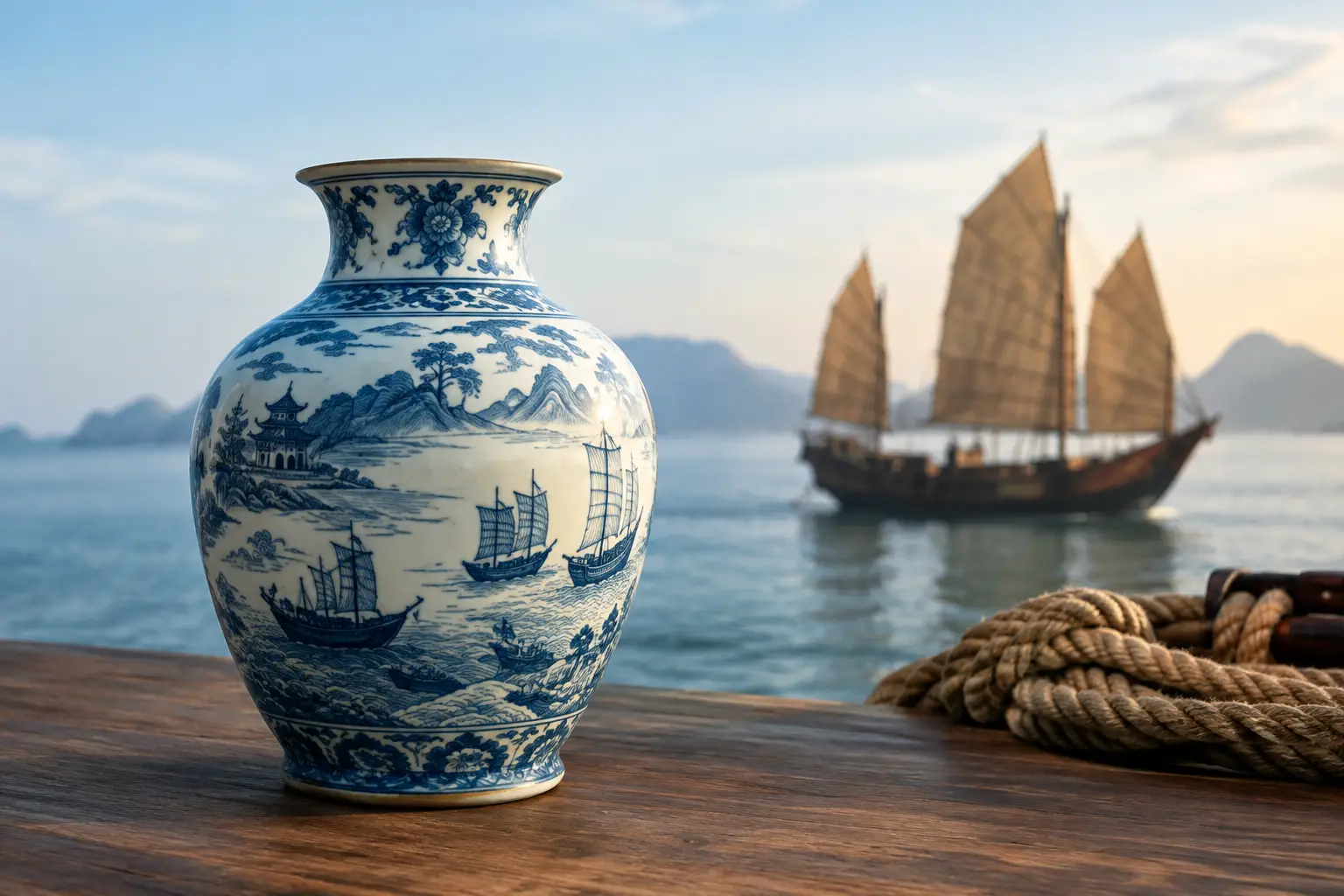
The famous blue-and-white palette is often the first image that comes to mind. Cobalt pigment, applied beneath a transparent glaze, created decoration of astonishing clarity after firing. Artisans used it to paint lotus scrolls, peonies, clouds, birds, mythical beasts and scenes drawn from literature. The limited palette was not limiting at all. In skilled hands, blue could appear deep and saturated, soft and misty, or animated with quick, confident brushwork.
Ming porcelain was made for more than the imperial court
It is tempting to imagine every fine Ming vessel sitting in a palace, reserved for emperors and their households. Imperial patronage was enormously important, especially at the great kilns of Jingdezhen, where official orders drove technical innovation and exacting standards. Court wares often followed strict requirements for form, colour, motif and inscriptions.
Yet this is only part of the picture. Private kilns made a vast range of ceramics for domestic use and export. Merchants and overseas buyers influenced what was produced, commissioning shapes and decorations suited to the tables, rituals and tastes of distant markets. A vessel intended for Southeast Asia might differ from one made for Japan, the Middle East or Europe.
This distinction matters when looking at a collection. Not every piece was imperial, and a non-imperial object is not a lesser object. Export ceramics reveal a different kind of achievement: the ability of makers and traders to adapt, produce at scale and create designs that could travel across languages and belief systems. Their slight irregularities, energetic painting and practical forms can make them especially engaging.
The sea made Ming porcelain a regional language
Ming porcelain became a shared visual language because it travelled. From southern Chinese ports, cargoes moved through the South China Sea and into the trading networks of the Malay Archipelago, India, the Persian Gulf and beyond. Ceramic vessels were durable, desirable and relatively easy to store in large quantities, making them ideal maritime cargo.
The sea journey was never straightforward. Monsoon winds governed sailing seasons, while reefs, storms, piracy and navigational misjudgement could turn a commercial voyage into a disaster. When a ship sank, its cargo was sealed beneath sediment and saltwater. Centuries later, recovered ceramics can offer rare, tangible records of exchange that written sources do not always preserve.
Shipwreck discoveries also complicate familiar ideas of luxury. A single wreck may contain elegant bowls alongside storage jars, everyday dishes and objects made specifically for foreign markets. Taken together, they show that porcelain was not simply a treasure for elites. It was woven into hospitality, gift-giving, trade relationships and household life across a wide maritime world.
At Straits & Oriental Museum, shipwreck ceramics provide a distinctive setting for this story. The objects are presented not merely as decorative survivors, but as travellers with a maritime past. Their presence invites visitors to consider the hands that made them, the people who selected them as cargo, and the communities that awaited them across the sea.
Reading the details of Ming porcelain
Looking closely rewards patience. Start with the form. Is the vessel a shallow dish, a deep bowl, a stem cup, a ewer or a covered box? Form often suggests how an object was used and where it may have found a market. A broad dish, for instance, offers a generous surface for painted decoration and a practical format for communal dining.
Then look at the decoration. Lotus can suggest purity, peonies prosperity, and dragons imperial power, though motifs do not always carry a single fixed meaning. Their arrangement matters as much as the subject. Borders, panels and the space left unpainted reveal the designer’s sense of rhythm and hierarchy.
The glaze tells its own story. A fine transparent glaze can make porcelain appear almost luminous, while a pale bluish cast, a tiny pinhole or a soft pooling of colour near the foot may reveal the realities of firing. Such features should not be dismissed too quickly as flaws. They can be useful clues to manufacture, age and the conditions the piece has endured.
Marks and reign names demand care. A reign mark may indicate an emperor’s period, but it can also be a later homage to an admired earlier style. Specialists assess marks alongside shape, material, decoration, footrim and firing characteristics. Attribution is a process of comparison and evidence, not a conclusion drawn from a few characters alone.
Why shipwreck context changes what we see
A porcelain bowl in isolation can be admired for its painting. A bowl found among hundreds or thousands of related pieces has a broader story to tell. Archaeological context can reveal how cargo was packed, what objects travelled together and which markets a ship may have been serving.
It can also change assumptions about rarity. An unusual vessel may be one of a small group made for a particular buyer, or it may be part of a once-common cargo whose surviving examples are now scarce. Conversely, a design widely represented in a wreck may indicate a popular and commercially successful pattern rather than a mass of identical, unconsidered goods.
There are trade-offs in how such objects are displayed. A pristine cabinet presentation highlights colour and craftsmanship, while a shipwreck grouping brings out the drama of discovery and commerce. Both approaches have value. The most rewarding encounter allows room for aesthetic pleasure while preserving the object’s archaeological and cultural context.
A closer look for collectors and curious visitors
For collectors, Ming porcelain calls for restraint as well as enthusiasm. Condition, provenance, restoration, attribution and legal documentation all affect significance and value. A small repaired area may be acceptable in a historically important piece, while an apparently flawless object with uncertain origins should prompt careful questions. Expertise is not an accessory to collecting; it is part of responsible stewardship.
For families and first-time museum visitors, the pleasure can be more immediate. Notice how a painted bird is given movement with only a few lines, compare the scale of a storage jar with the delicacy of a cup, or imagine the sound of ceramic cargo being packed into a ship’s hold. These are accessible ways into a history that can otherwise seem remote.
Ming porcelain deserves attention because it holds together two powerful ideas: the refinement of the individual object and the scale of a connected region. The next time a blue-and-white dish catches your eye, pause at the rim, the brushwork and the base. You may be looking at a work of art, but you are also looking at a survivor of an extraordinary journey.