
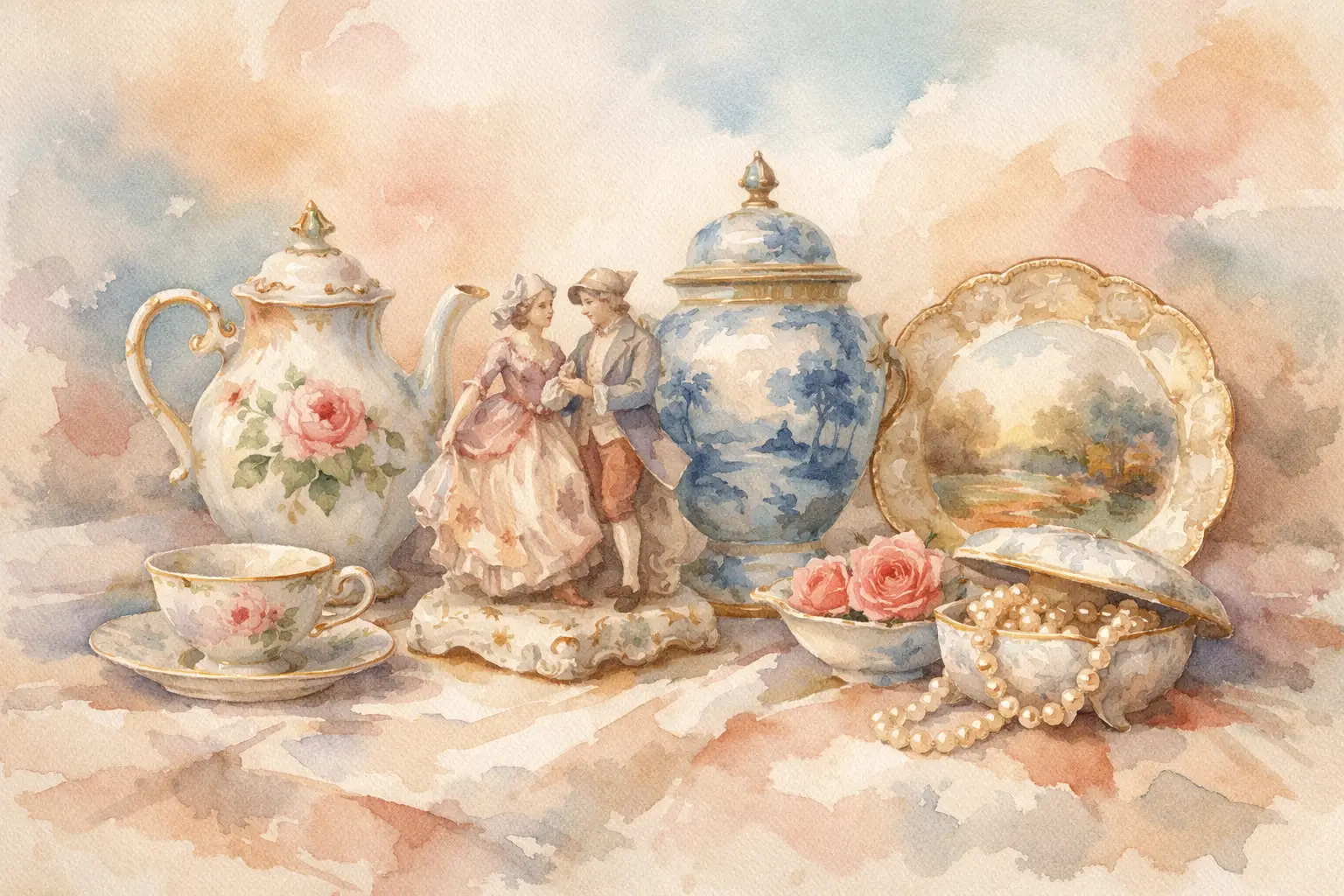

One hairline crack can halve the value of a plate. One honest kiln flaw can make a piece more interesting, not less. That is why any antique porcelain collectors guide worth reading must begin with a simple truth – collecting is not only about beauty, but judgement. The finest collections are built by people who learn to look slowly, ask better questions and understand that porcelain always carries two stories at once: the story of its making and the story of its survival.
For many collectors, the attraction begins with the surface. Porcelain catches light in a way earthenware never quite can. Its glaze has depth, its body can feel refined almost to translucency, and its decoration often reveals the ambitions of the workshop, the patron and the period. Yet collecting well requires more than falling in love with appearance. It means learning how age, provenance, craftsmanship and condition work together to shape significance.
What makes antique porcelain worth collecting
Porcelain occupies a special place in collecting because it sits at the meeting point of art, trade and technology. It was never only domestic ware. It travelled courts, merchant routes and colonial ports, carrying taste across continents. A bowl made in China, decorated for export and later found in a British cabinet tells a very different story from a European factory piece inspired by East Asian forms. Both may be desirable, but not for the same reasons.
Value, then, is rarely a matter of age alone. A nineteenth-century piece from an important kiln with fine hand decoration and excellent condition may be far more sought after than an older but damaged example of ordinary production. Rarity matters, but so does context. Collectors who understand where a piece fits within a broader history tend to buy more confidently and more selectively.
There is also the question of personal focus. Some collectors pursue imperial Chinese porcelain, others European factory wares, famille rose export pieces, blue and white tableware or maritime ceramics recovered from shipwreck contexts. A focused collection usually develops greater character than one assembled purely by impulse. It also makes research easier, because your eye improves faster when you compare like with like.
An antique porcelain collectors guide to first checks
The first examination should always begin with the body, glaze and decoration. Pick up the piece if possible. Porcelain tends to feel finer and denser than ordinary pottery, and the foot rim often reveals useful clues about age and manufacture. A neatly finished foot is not a guarantee of quality, but it can suggest care in production. So too can a glaze that sits evenly, with natural wear where the object would actually have been handled.
Decoration deserves close attention. Hand-painted motifs usually show slight variation, especially in floral details, border work and line thickness. Transfer decoration, common in later wares, can still be highly collectable, but it carries a different market position. Look for overpainting, gilding wear and any sign that decoration has been refreshed or added later. New colour on an old body is a warning, not a delight.
Marks can help, though they are not a shortcut. Factory marks, reign marks and retailer marks all need interpretation. Some were used accurately, some were copied, and some were added to flatter a piece rather than identify it truthfully. A spurious mark is common enough that it should never be the sole basis for dating. Treat it as one clue among several.
Condition comes next, and here discipline matters. Chips, cracks, restoration and staining all affect desirability. A tiny rim nibble on a rare eighteenth-century cup may be acceptable; heavy restoration across a central painted scene is another matter entirely. It depends on rarity, price and purpose. If you are buying for scholarship or display in a specialist collection, you may tolerate more. If you are buying for long-term value, condition should remain a stern companion.
Age, authenticity and the problem of looking old
One of the enduring challenges in any antique porcelain collectors guide is explaining that age is visible, but not always where inexperienced buyers expect it to be. Genuine wear appears in logical places: the base, the foot rim, the handle, the lid edge. It should make sense. Artificial distress often looks theatrical, scattered where it photographs well rather than where use would naturally leave a trace.
Glaze crazing is another area where judgement is needed. On some wares it is normal and even attractive. On others it can indicate damage, poor storage or later issues. Similarly, burial or marine encrustation may suggest an excavated or shipwreck-related origin, but such features require expertise. Romantic surface effects should not be accepted uncritically. Provenance, documentation and reputable sourcing matter more than a dramatic appearance.
When in doubt, compare. Serious collecting is built on visual memory. Study museum examples, auction catalogues and well-published collections. The more authentic pieces you see, the easier it becomes to notice when a form is too stiff, a palette too bright, or a mark too convenient.
Why provenance matters more than many buyers realise
A porcelain object with a clear history often carries greater confidence and cultural weight than one with none. Provenance may include previous ownership, collection labels, auction records, exhibition history or documented recovery from an archaeological context. It does not need to be aristocratic to be useful. Even a modest paper trail can strengthen attribution and support value.
This is especially true for pieces connected to maritime trade. Ceramics recovered from historic wrecks are compelling not merely because they are old, but because they were part of a journey interrupted. Their significance lies in movement, exchange and survival. They remind us that porcelain was once cargo as much as treasure. For collectors drawn to the wider story of Asia’s sea routes, such objects hold a particular fascination, joining aesthetic pleasure to historical depth.
Buying well without buying quickly
The market rewards patience. New collectors often feel pressure to secure a “find” before someone else does, yet haste is expensive. It is wiser to miss ten pieces than buy one doubtful one. Ask for condition reports, request additional photographs and look closely at the base, rim and any area where repair might be hidden.
Price should be assessed in relation to several moving parts: period, rarity, decoration, size, condition and market demand. Large pieces are not automatically more valuable than small ones. Nor are heavily decorated examples always superior. Sometimes a restrained blue and white bowl with excellent form and honest wear can be more desirable than a louder object that lacks refinement.
Where should a collector buy? Reputable dealers, established auction houses and specialist institutions offer more security than anonymous marketplace listings. That does not mean every private purchase is unwise, only that risk rises when expertise falls away. If you are still learning, buy from people whose reputation depends on getting things right.
Caring for porcelain once it is yours
Good collecting includes good stewardship. Porcelain should be handled with clean, dry hands and supported from the body, not lifted by a handle, finial or rim. Display shelves should be stable and not overcrowded. Sunlight can fade some enamels and textiles nearby, while fluctuating humidity can affect old restorations and associated materials such as wooden stands.
Cleaning should be conservative. Dust with a soft cloth or brush. Avoid harsh chemicals, abrasive pads and enthusiastic scrubbing around gilding or painted surfaces. If a piece appears dirty in a way that raises concern, consult a conservator rather than experimenting at home. The aim is preservation, not over-brightness.
Documentation is equally important. Keep purchase records, invoices, old labels and any notes on attribution. Photograph your collection well. Over time, these details become part of the object’s modern history and can be invaluable for insurance, resale or scholarly interest.
The pleasure of collecting with a point of view
The most memorable collections are not always the largest or the most expensive. They are the ones guided by a clear sensibility. You might collect export porcelain that reflects cross-cultural design, shipwreck ceramics that reveal maritime commerce, or table wares that illuminate changing habits of dining and display. A collection with a point of view becomes more than an arrangement of objects. It becomes an argument about taste, history and connection.
This is where places of serious interpretation matter. At Straits & Oriental Museum, porcelain is not presented as decoration alone but as witness – to trade, movement, craftsmanship and the splendour of objects that have endured extraordinary journeys. For collectors and curious visitors alike, that perspective sharpens the eye. It reminds us that the best pieces are not merely owned. They are understood.
A thoughtful collection grows piece by piece, but also question by question. If an object draws you in, ask not only whether it is beautiful, but why it has lasted, what it once meant, and whether its story will still reward your attention years from now.