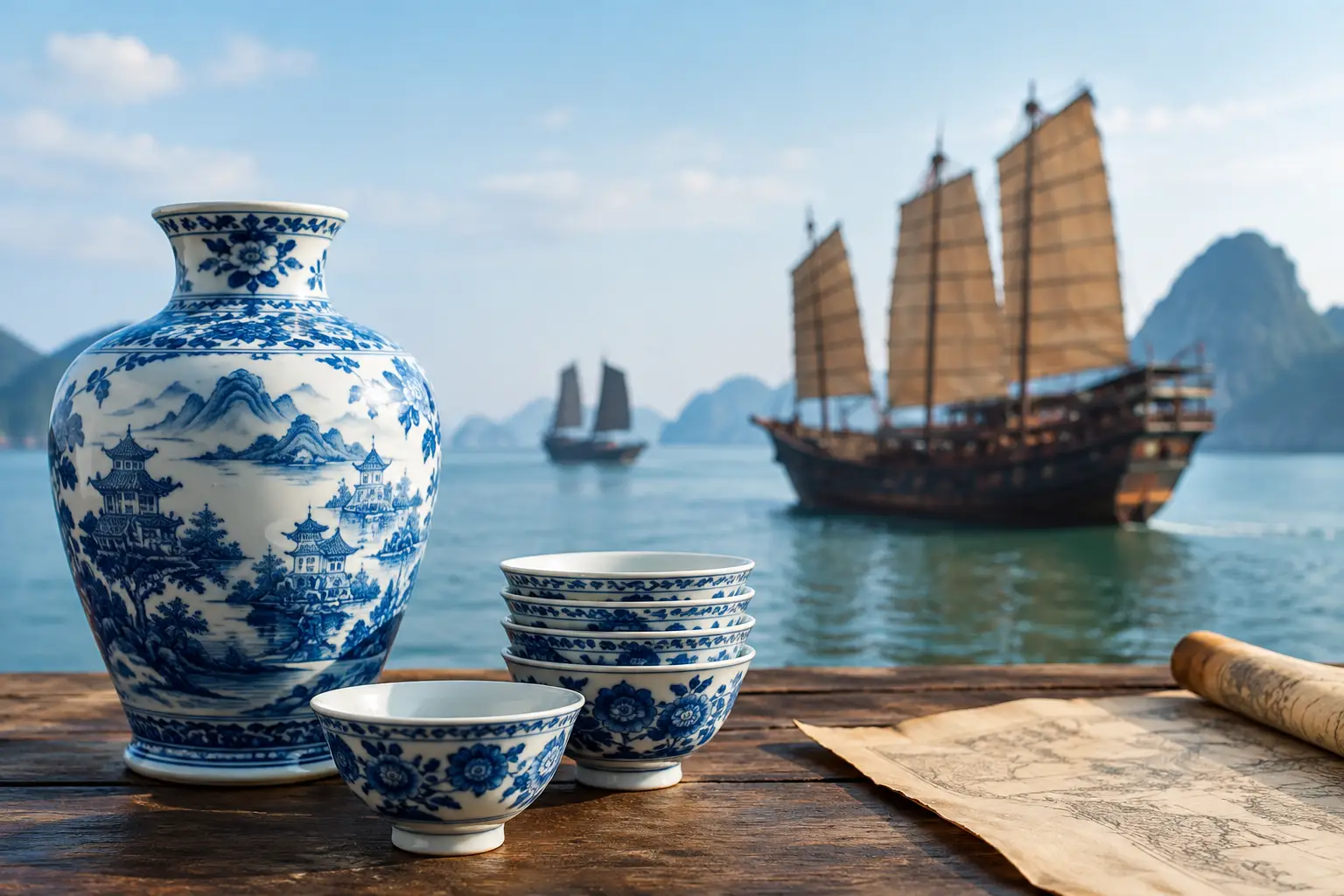

A dish lifted from a shipwreck can make the Indian Ocean feel suddenly close. Its cobalt-blue painting may still be crisp after centuries beneath the sea; its glaze may carry the faintest trace of the cargo hold that carried it. Chinese export porcelain was not simply beautiful tableware sent abroad. It was evidence of a vast commercial conversation between Chinese kilns, merchants, sailors, royal courts and households from Southeast Asia to Europe.
For visitors encountering shipwreck ceramics, the first surprise is often their quantity. A single vessel might have carried thousands of bowls, jars, dishes and storage vessels. Yet no two cargoes tell precisely the same story. Their forms, decoration and condition reveal where a ship may have been bound, who was expected to buy its wares, and how taste travelled across the seas.
What makes Chinese export porcelain distinctive?
The phrase refers broadly to ceramics made in China for overseas markets. Porcelain was particularly prized for its pale body, resonant hardness and luminous glazed surface. Chinese potters had developed extraordinary control over materials and firing long before many competing industries could produce similar wares at scale.
Export did not mean inferior. Some objects were practical, made in great numbers for everyday dining and trade. Others were ambitious luxury pieces, painted with exquisite detail or commissioned to suit the preferences of distant patrons. The distinction matters: a plain bowl with a carefully finished footring can be as historically revealing as a palace-quality charger.
China’s ceramic centres responded with remarkable flexibility. Kilns produced forms familiar to Asian diners, such as bowls and covered boxes, alongside ewers, plates and vessels adapted for foreign tables. Decorative language travelled too. Lotus scrolls, peonies, dragons, landscapes and auspicious symbols could retain their Chinese meanings while acquiring new associations in the homes and courts that received them.
The best-known production centre was Jingdezhen, whose kilns became synonymous with fine porcelain. But the story is wider than one place. Coastal kilns and regional workshops supplied large quantities of stoneware, celadon and other ceramics that moved through the same maritime networks. A shipwreck cargo may therefore present a more varied picture of trade than the word porcelain alone suggests.
Chinese export porcelain was made for a connected world
Maritime trade depended on seasonal monsoon winds, trusted intermediaries and ports where goods could be exchanged, taxed, repaired and redistributed. Chinese ceramics often left southern Chinese ports in the company of silk, metal goods and tea, then moved through commercial centres across the Malay Archipelago, the Indian Ocean and beyond.
Southeast Asia was not merely a passage between China and Europe. It was one of the great markets and meeting places of the trade. Merchants from different communities negotiated cargoes in port cities, while local buyers incorporated imported ceramics into domestic life, ceremonial practice and regional systems of prestige.
This is why a blue-and-white bowl found off the Malaysian coast has a story larger than its place of manufacture. It may have been ordered by a trader, packed by labourers, loaded alongside hundreds of related pieces, and intended for a market several ports away. Its journey reflects the skill of the potter, but also the knowledge of captains who read the winds and merchants who understood changing demand.
There were risks at every stage. Storms, reefs, piracy, shifting politics and simple navigational error could end a voyage abruptly. When ships sank, their cargoes sometimes became sealed time capsules. While life aboard disappeared, stacks of ceramics could remain remarkably intact beneath layers of sand and sediment.
Reading a shipwreck through its ceramics
Shipwreck ceramics are compelling because they preserve context. A museum cabinet may display a single exceptional vase, but a recovered cargo shows objects as commercial goods: repeated shapes nested together, standard patterns produced in batches, and occasional finer pieces that hint at different customers or trading strategies.
Archaeologists and specialists read several clues. The shape of a bowl or jar can indicate the market it served. A motif can help date an object, particularly when compared with known reign periods and kiln traditions. The base, footring, glaze and firing marks may reveal how and where it was made. Even imperfections deserve attention. Warping, grit in the glaze or uneven painting can expose the pace and pressures of production.
Condition must be interpreted with care. Sea burial can preserve porcelain beautifully, but salt, abrasion and marine growth can also alter its surface. A pale patch may be a firing feature, a burial effect or later damage. For collectors, this is one reason provenance and specialist assessment matter more than an appealing pattern alone.
The cargo as a whole is equally important. If a wreck contains large numbers of similarly decorated dishes, it suggests a deliberate commercial consignment rather than the personal possessions of a crew. If storage jars appear beside tablewares, they may point to provisions and the practical workings of the voyage. Each object gains meaning through its companions.
Blue and white: a language recognised across oceans
Blue-and-white porcelain remains the image many people first associate with Chinese export wares. Cobalt pigment painted beneath a clear glaze created decoration that was durable, vivid and endlessly adaptable. From spare floral sprigs to dense scenes crowded with figures and symbols, blue and white could meet very different tastes without losing its distinctive character.
Its popularity was never only visual. Blue-and-white wares offered a combination of refinement and usefulness. They could be used daily, displayed proudly, given as gifts or kept for special occasions. In many places, imported Chinese ceramics became heirlooms, passed through families and woven into local customs.
Later export pieces reveal a further exchange of ideas. European shapes, armorial designs and unfamiliar motifs began to appear alongside Chinese decorative traditions. These commissions are fascinating precisely because they are not culturally simple. A plate made in China for a European household may carry a coat of arms, yet its material, workmanship and visual rhythm remain rooted in Chinese ceramic practice.
How to look closely at export porcelain
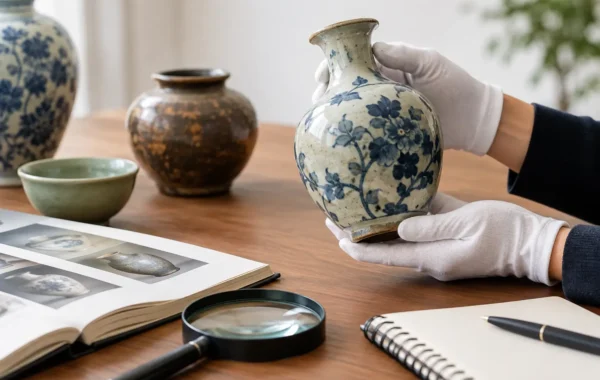
A rewarding encounter begins by slowing down. Start with the object’s silhouette. Is it a deep bowl designed for shared food, a broad dish intended for presentation, or a covered jar made for storage? Then notice the decoration: is it centred and formal, freely painted, or repeated from one object to the next?
Look beneath the rim as well as at the painted surface. The footring and unglazed areas often carry evidence of kiln support, stacking and finishing. Consider scale, too. Small pieces travelled efficiently and suited individual use, while large chargers made a statement at a banquet or in a display room.
It also helps to resist a common assumption that age is the sole measure of importance. Rarity, condition, workmanship, provenance and archaeological context all shape an object’s value. A later piece with a secure history can be more meaningful than an earlier fragment with no documented origin. For visitors, the most memorable question is often not “How much is it worth?” but “What journey made this object possible?”
At Straits & Oriental Museum in George Town, shipwreck collections bring that question into focus through ceramics recovered from voyages including the Wanli, Turiang, Royal Nanhai, Nanyang, Xuande and Desaru. Seen together, these objects turn maritime history into something immediate: a painted bowl, a merchant’s calculation, a vanished ship and a living regional heritage.
A legacy still held in the hand
Chinese export porcelain continues to reward close looking because it holds several histories at once. It is art, industry, trade, technology and human ambition made tangible. Its beauty is undeniable, but the deeper fascination lies in the routes it traces between places that might otherwise seem distant.
The next time you stand before a shipwreck dish or a carefully painted porcelain bowl, allow your eye to follow its painted line around the rim. That small gesture may lead from a kiln bench in China to a crowded port in Southeast Asia, and from the seabed to the present moment – a reminder that the sea has always carried more than cargo.