
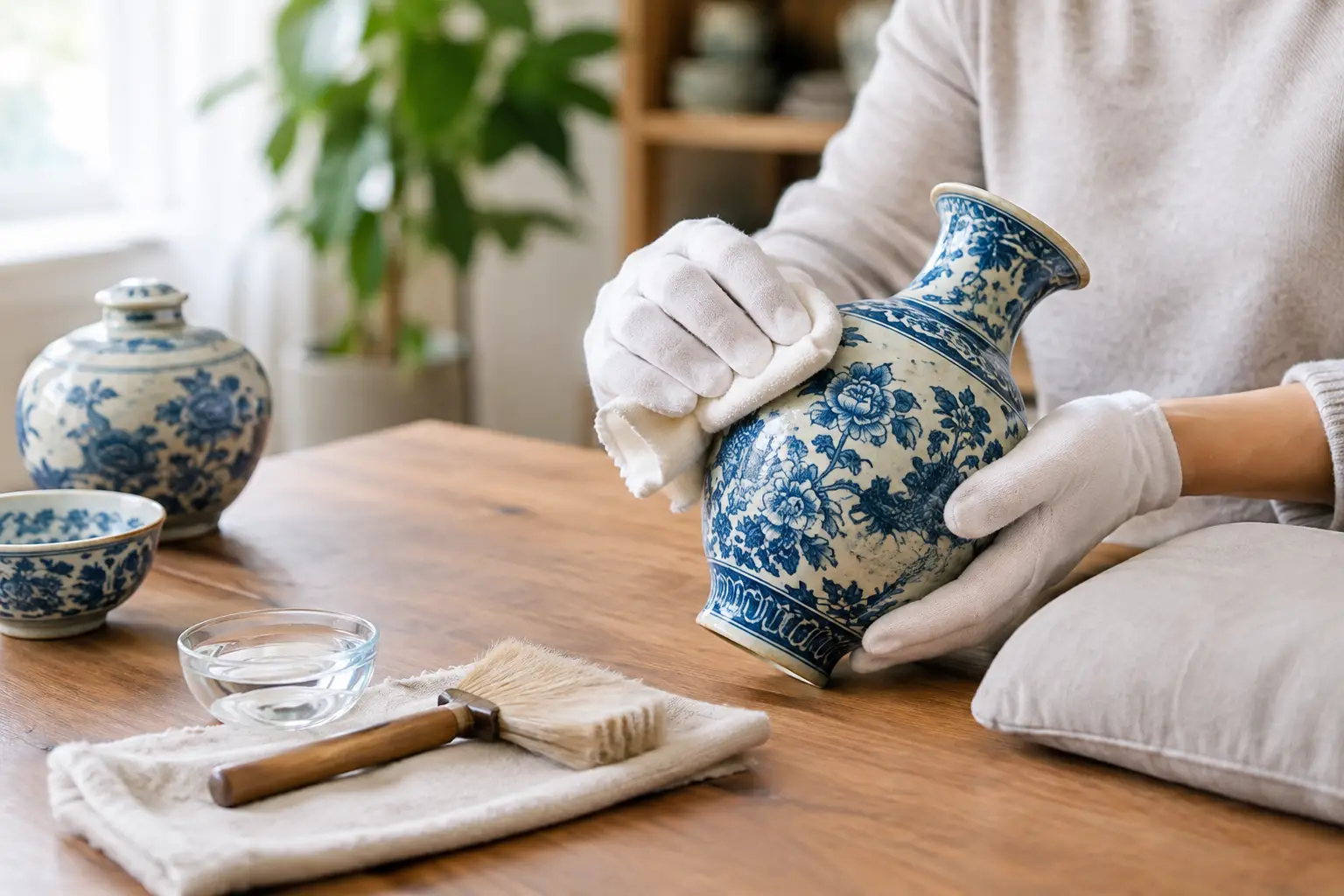

A fine porcelain bowl can appear remarkably strong until one careless lift places pressure on a weakened rim. Learning how to preserve antique ceramics begins with this recognition: each piece has already travelled through time, and its survival is part of its significance. Whether it is a family heirloom, a market find or a carefully acquired collectible, preservation is less about making it look new than protecting its material, history and quiet character.
For ceramics associated with maritime trade, that history may be especially complex. Porcelain and stoneware recovered from shipwreck contexts can bear kiln flaws, marine deposits, staining and evidence of centuries beneath the sea. These are not necessarily defects to erase. They are often part of the object’s story.
How to preserve antique ceramics through careful handling
Most damage occurs not in a dramatic accident, but during ordinary handling. Before moving a piece, clear the route and prepare a stable, padded surface where it can be placed down. Handle one object at a time, with clean, dry hands, and remove rings, watches or bracelets that might knock against the glaze.
Support ceramics from beneath with both hands. Never lift a teapot by its handle, a cup by its rim, or a covered vessel by its lid. Handles, spouts, finials and handles on jars are often the most vulnerable areas, even when they appear secure. A large plate or charger should be carried vertically with two hands, rather than balanced flat against the palm.
Gloves are not always the safer choice. Cotton gloves can reduce grip, while many modern ceramics are best handled with clean bare hands. For fragile, dusty or unusually valuable pieces, nitrile gloves may be appropriate, provided they do not make handling less secure. The aim is control, not ceremony.
If guests, children or visitors wish to see a piece closely, place it on a table rather than passing it from hand to hand. A moment of proximity should never become a gamble with a centuries-old object.
Create the right environment for antique ceramics
Ceramics are generally more stable than paper, textiles or paintings, but they are not immune to their surroundings. Sudden changes in temperature can cause stress between a ceramic body and its glaze, particularly where there are old repairs, hairline cracks or painted decoration. Keep treasured pieces away from direct sunlight, fireplaces, air-conditioning outlets, radiators and humid kitchens.
Strong sunlight can fade enamels and overglaze decoration over time. Heat may also weaken older adhesives used in repairs. High humidity is especially unhelpful for porous earthenware, unglazed surfaces and objects with metal mounts, as it can encourage staining, corrosion and deterioration around joins.
A calm, consistent domestic environment is preferable to perfection pursued at great expense. Avoid placing a valuable bowl on a windowsill or a cabinet above a cooker. A well-chosen shelf in a living room, away from vibration and direct light, will usually serve it better.
For a collection of particular importance, consider a display cabinet with stable shelving, low light exposure and doors that reduce dust. The cabinet should stand on a solid floor, away from slamming doors and busy walkways. In Penang’s warm, humid climate, thoughtful placement is particularly worthwhile, as rapid shifts between outdoor heat and heavily cooled interiors can be hard on vulnerable objects.
Clean only when cleaning is necessary
The safest cleaning is often the least ambitious. Dust is best removed before it settles into crevices, but an antique ceramic does not need frequent washing. Use a very soft, clean brush to gently lift loose dust while the object rests on a padded surface. A soft microfibre cloth may be suitable for stable glazed areas, but should not be pushed into cracks, gilding, painted details or rough, unglazed clay.
Do not soak antique ceramics. Water can enter cracks, travel beneath glaze, disturb old restoration and leave deposits behind. Dishwashers are wholly unsuitable: heat, detergent and water pressure can turn a minor vulnerability into a visible loss.
Avoid household cleaners, bleach, abrasive powders, scouring pads and oil-based polishes. They may dull a glaze, strip painted decoration or leave a residue that alters the surface. Equally, resist home remedies involving vinegar, lemon, toothpaste or bicarbonate of soda. Their apparent simplicity is precisely what makes them tempting, but they can be difficult to control on historic material.
If a stable, fully glazed object has light surface grime, a conservator can advise whether carefully applied deionised water is appropriate. This depends on the object. A nineteenth-century decorative plate, a porous earthenware vessel and a shipwreck ceramic should not be treated as though they have identical needs. Marine archaeological ceramics may contain residual salts, and improper washing or drying can create further damage.
Stains, dark lines, old adhesive, mould, powdery surfaces and flaking decoration all call for professional assessment rather than stronger cleaning. Preservation sometimes means leaving evidence in place until the correct expertise is available.
Display and store with intention
A display should allow a ceramic to be admired without placing it in danger. Use stable stands designed for the size and weight of the object, and ensure plates do not rest on a narrow point of pressure. Keep displayed pieces back from the shelf edge and leave space between objects so that one cannot knock another when being moved.
Line shelves with an inert, non-slip material if needed, but avoid sticky pads, tapes or rubbery materials that can mark a surface or adhere to an old glaze. Heavy vessels belong on lower shelves. Light, fragile cups and small figures should be placed where they cannot be easily brushed by a sleeve or handbag.
When storing pieces, wrap each item separately in acid-free tissue and place it in a clean, dry box with supportive padding. Do not stack plates directly on one another. Separate them with tissue or inert foam, and avoid newspaper, bubble wrap in direct contact with a surface, or old cardboard that may transfer acids, inks or moisture.
Lids should be stored beside their vessels, not fitted tightly in place. A small padded support can prevent rubbing at the rim. Keep an inventory with photographs, dimensions, condition notes and any known provenance. This record is useful for insurance, estate planning and future conservation, but it also protects the knowledge that gives a collection its meaning.
When damage has already occurred
If a ceramic breaks, gather every fragment, however small, and place them in a labelled container. Do not attempt to test-fit shards repeatedly, as the edges can abrade with each movement. Photograph the damage and retain any loose material found nearby.
Do not use household glue. It can discolour, become brittle, seep into porous ceramic and make later professional treatment far more difficult. A skilled ceramics conservator uses reversible or retreatable methods wherever possible, respecting both the object and the possibility that future research may offer better options.
Old repairs deserve the same caution. A repaired object may be suitable for display but not for regular handling, and an apparently neat join may conceal a structurally weak area. Value is not measured only by flawless condition. Authenticity, rarity, provenance and historical importance can matter more than an invisible repair.
Preserve the story as well as the object
An antique ceramic is more than clay, glaze and decoration. Its maker, route of trade, former owner and place within a collection all contribute to its cultural value. Keep purchase records, auction descriptions, family recollections and photographs together with your condition notes. Never remove labels, inscriptions or collection marks without specialist advice.
At Straits & Oriental Museum, shipwreck ceramics offer a compelling reminder that survival is rarely accidental. Each vessel carries traces of craft, exchange and passage across the seas. Caring for ceramics at home follows the same principle: make thoughtful choices, avoid irreversible interventions and allow every object to retain the evidence of its journey.
The finest form of preservation is often quiet. A stable shelf, clean hands, gentle light and the patience to seek expert help can ensure that a ceramic’s next chapter is as enduring as the ones before it.