
A porcelain bowl lifted from the seabed can be beautiful in its own right. Yet its greater value may lie in what surrounded it: the timber beneath it, the cargo stacked beside it, the route the vessel was taking, and the people who never completed their journey. That is the essential difference in maritime archaeology versus treasure hunting. One seeks to preserve a shared historical record; the other has often treated a wreck as a source of saleable objects.
For visitors encountering shipwreck ceramics, this distinction changes the experience. These are not simply rare wares recovered from the sea. They are fragments of trade, craftsmanship, migration, belief and exchange across the waters that connected Asia for centuries.
Maritime archaeology versus treasure hunting: the central distinction
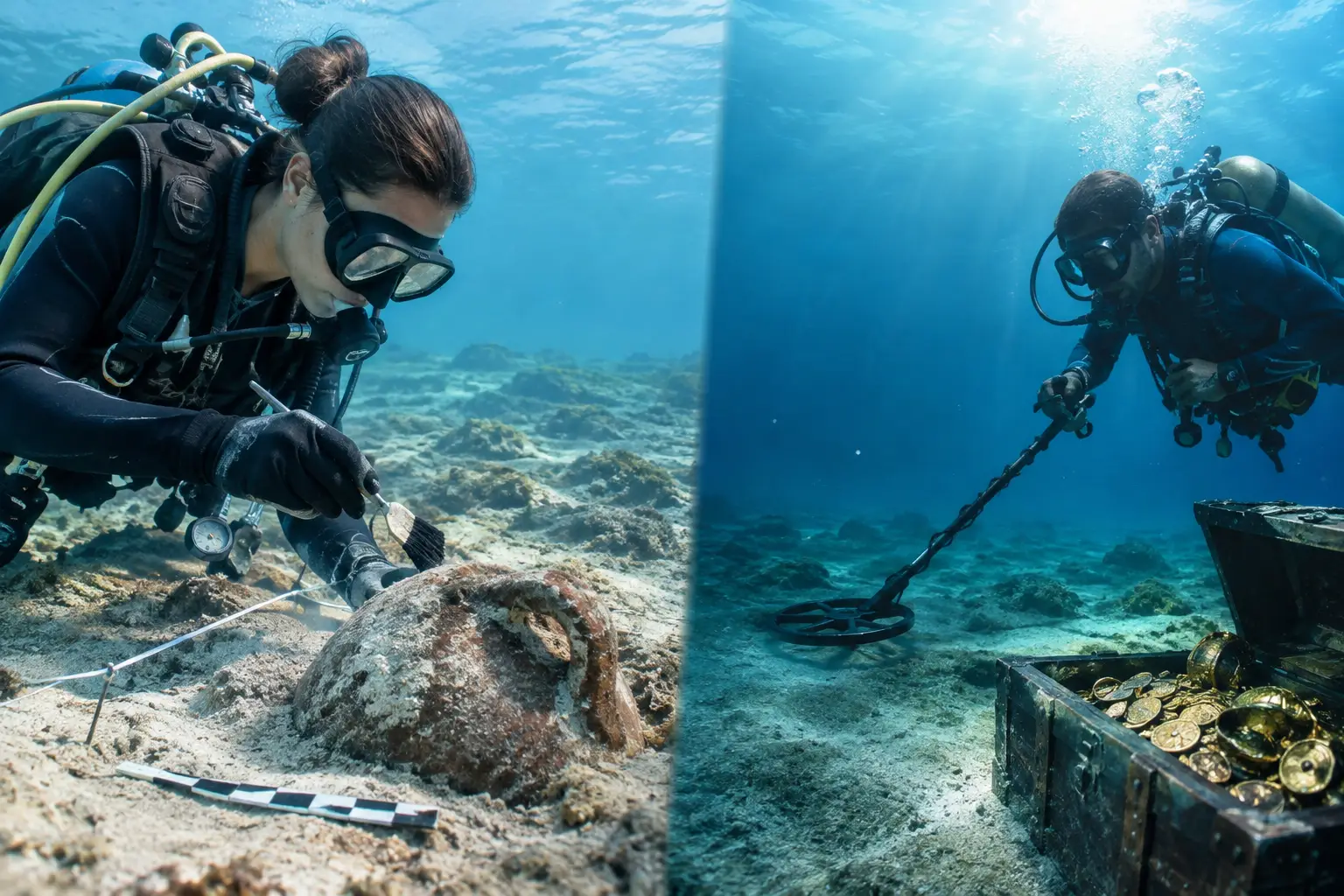
Maritime archaeology is the careful study of human life through material remains found in seas, rivers, ports and coastlines. A shipwreck is not approached as a chest of valuables. It is treated as an archaeological site – a time capsule whose meaning depends on relationships between objects, place and evidence.
Before recovery begins, archaeologists survey and map a site. They record the vessel’s position, its construction, sediment layers, cargo distribution and signs of disturbance. Each artefact is photographed, measured, catalogued and connected to a precise location. Samples of wood, rope, food remains and ballast may reveal as much as the finest ceramic vessel.
Treasure hunting, by contrast, is commonly driven by the market value or visual appeal of recoveries. The focus tends to fall on gold, silver, porcelain, coins and other portable items. When objects are removed selectively, without full documentation or conservation planning, the site can lose much of its ability to answer historical questions. A bowl may survive, but the knowledge of how it travelled, who packed it, and what it meant within a wider cargo may be gone.
The contrast is not always as simple as a label. Commercial salvage operations can employ skilled divers, advanced survey technology and qualified specialists. Private collectors may care deeply for an object’s history. Conversely, poor archaeological practice can cause harm. The defining question is whether recovery serves long-term research, protection, legal responsibility and public understanding – or whether the object is primarily valued as a commodity detached from its original setting.
Why context is the real treasure
A wreck’s most compelling story is rarely contained in one spectacular find. It emerges from patterns.
Consider a cargo of Chinese ceramics found alongside Southeast Asian stoneware, European glass and everyday equipment used by a crew. Together, these materials can illuminate a trading network spanning ports, patrons and markets. The placement of stacked bowls may indicate how merchants packed fragile goods for a long voyage. Repairs to a hull may suggest where a vessel had already travelled. Even humble objects can complicate or enrich what written records tell us.
This is why archaeologists often favour preservation in situ – leaving a wreck where it lies – when conditions allow. The seabed can protect materials that deteriorate rapidly once exposed. It also leaves the possibility of future investigation, when better methods and new questions may produce insights unavailable today.
Recovery is sometimes necessary. Sites may be threatened by erosion, harbour construction, looting, trawling or other disturbance. In those cases, responsible excavation involves a commitment extending far beyond the moment an artefact reaches the surface. Documentation, stabilisation, conservation, research, storage and interpretation all require expertise, time and substantial resources.
Shipwreck ceramics and the maritime world they reveal
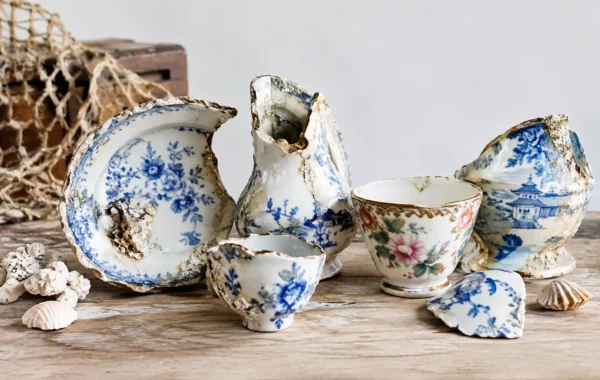
Ceramics are particularly evocative survivors of Asian maritime history. Their durability allows them to endure where textiles, paper and organic cargoes may disappear. Their forms, glazes, kiln marks and decorative styles also provide valuable clues about dates, places of manufacture and intended markets.
A single piece of porcelain may speak of technical brilliance at a kiln hundreds or thousands of miles from its final destination. A complete cargo can reveal something larger: the scale of demand for particular wares, the tastes of overseas consumers, and the commercial relationships that connected Chinese production centres with ports throughout Southeast Asia and beyond.
Yet even ceramics can be misunderstood when stripped of provenance. A blue-and-white dish described only as an antique is aesthetically pleasing, but historically incomplete. Knowing that it came from a documented wreck, was found among a particular cargo, and has been studied alongside related material gives it another dimension. It becomes evidence of a voyage and a trading world, rather than merely a decorative survivor.
At Straits & Oriental Museum, authentic shipwreck ceramics offer visitors a rare opportunity to encounter this dimension directly. The collections invite attention not only to the splendour of porcelain, but to the remarkable maritime passages that carried such objects through the region.
Conservation is not an afterthought
Objects recovered from the sea are often stable only because they have remained underwater. Once brought into air, salts within ceramic pores, metal corrosion and fragile organic materials can create urgent conservation challenges. A recovered artefact may require desalination, controlled drying, specialist treatment and carefully managed storage before it can safely be displayed.
This work is less dramatic than a recovery at sea, but it is central to responsible stewardship. Conservation aims to slow deterioration without disguising an object’s age or altering its evidence. It allows future generations to study and appreciate material heritage rather than consuming it in a single moment of discovery.
Museums also have an important role after conservation. The strongest displays do not present artefacts as isolated trophies. They explain their origins, acknowledge what is known and unknown, and connect individual objects to the people and routes behind them. This approach makes a visit more rewarding because it restores the human scale of maritime history.
The ethics behind ownership and collecting
Shipwrecks can raise difficult questions. Who owns a vessel lost centuries ago? Does a state have the right to control material found in its waters? What happens when a wreck carries goods made in one place, loaded in another and destined for somewhere else? There is no single answer that fits every site.
International conventions, national heritage laws and maritime law all shape how wrecks are managed. Their purpose is increasingly clear: underwater cultural heritage should not be treated as an unregulated frontier. Legal permission alone does not settle the ethical question, however. A responsible approach also considers provenance, excavation records, the interests of descendant communities and whether artefacts remain accessible for public research and education.
For collectors, provenance is especially significant. Clear, credible documentation helps establish an object’s lawful history and protects its cultural value. It also helps distinguish a carefully recorded artefact from material that may have been removed without proper authorisation or documentation. Rarity is not the same as significance, and a high price is not evidence of a good history.
How to look at a shipwreck artefact with greater care
The next time you stand before a recovered jar, dish or vessel, begin with a question broader than “What is it worth?” Ask where it was made, who might have used it, and what route brought it to the sea. Notice wear, repairs, markings and variations within a group of objects. These details can be traces of ordinary lives as well as elite trade.
It is also worth asking how the object was recovered and recorded. A museum label, catalogue or exhibition narrative should help establish its context rather than merely heighten its mystery. Where information is uncertain, honest interpretation is a mark of care, not a limitation.
The sea has preserved extraordinary evidence of the region’s past, but preservation is never guaranteed. Choosing context over spectacle allows shipwreck objects to remain more than beautiful things. They can continue to carry the voices of makers, merchants, sailors and coastal communities across time.