

A single date has come to stand for the beginning of modern Penang: 11 August 1786. On that day, Francis Light raised the British flag on an island already known to its Malay neighbours as Pulau Pinang. The story of Penang and Francis Light is often told as a simple founding tale. In truth, it is a more revealing story of maritime ambition, local sovereignty, trade, diplomacy and the powerful legends that endure long after an empire has gone.
For visitors to George Town, Light’s name appears on streets, schools and monuments. Yet the man behind the name deserves to be viewed in the full context of the late eighteenth-century Straits – not as a solitary founder arriving in an empty wilderness, but as an influential trader and negotiator whose decisions reshaped an established island and its surrounding region.
Penang before Francis Light
Penang did not begin with the British. Long before 1786, it was part of the Kedah Sultanate, a Malay polity with deep commercial and political connections across the Malay Peninsula, Sumatra, Siam, India and the wider archipelago. Its sheltered waters and position at the northern entrance to the Strait of Malacca gave it value in a world where monsoon winds, sea routes and port relationships determined prosperity.
The island was known as Pulau Pinang, probably for its betel-nut palms. Communities were already present, including Malay settlers and seafaring peoples whose lives were tied to fishing, cultivation and coastal exchange. The mainland opposite, now Seberang Perai, formed part of the same Kedahan sphere. To describe the island as deserted is therefore misleading. It may not have been a grand port city, but it was neither unknown nor without people, ownership or meaning.
This distinction matters. Penang’s history is richer when it acknowledges the world that existed before British occupation: a Malay kingdom balancing regional threats, a maritime crossroads shaped by Asian trade, and a landscape whose future was already being negotiated by powerful interests.
Why Francis Light wanted the island
Francis Light was an English merchant and East India Company representative with long experience in the region. By the 1780s, the Company needed a secure base between its Indian possessions and the trading centres of Southeast Asia. A port on Penang offered several advantages: a strategic anchorage, a defensible position, access to shipping lanes and the prospect of drawing merchants away from rival ports.
For Light, Penang was not merely a settlement project. It was a solution to a commercial and geopolitical problem. The British East India Company wanted to strengthen its position in the Malay world while avoiding the expense and complexity of direct territorial conquest wherever possible.
Kedah had its own urgent concerns. Sultan Abdullah Mukarram Shah faced pressure from Siam and feared further instability in the region. An alliance with the British appeared to offer protection. Light negotiated for the use of Penang, presenting British assistance as part of the arrangement. The difficulty was that he did not possess clear authority from the East India Company to promise military intervention on Kedah’s behalf.
That gap between expectation and authority would shape the relationship for years to come.
The 1786 settlement and its consequences
After landing in 1786, Light named the island Prince of Wales Island, in honour of the future King George IV. The settlement that grew around its harbour became George Town, named for King George III. Under British administration, the port was declared free, a decision that proved decisive. Traders from China, India, the Malay Archipelago, Arabia and Europe could enter without the restrictive duties imposed elsewhere.
The result was rapid growth. Penang drew merchants, labourers, artisans and families from across Asia. Its population became strikingly diverse, and its streets developed through the enterprise of communities who brought their languages, faiths, foodways and trading networks with them. The island’s heritage cannot be separated from this movement of people, goods and ideas across the sea.
Yet settlement also brought conflict. When Kedah sought the military protection it believed had been promised, the Company declined to provide it. Relations deteriorated. In 1790, Kedahan forces attempted to retake Penang but were defeated by British forces. A subsequent agreement formalised British possession of the island in exchange for an annual payment to Kedah.
The British later acquired a strip of mainland territory in 1800, known first as Province Wellesley and now as Seberang Perai. These arrangements created the territorial foundations of the modern state of Penang, but they also reveal the unequal nature of colonial negotiation. The island’s transformation came at a cost to Kedah’s sovereignty and security.
The cannonball legend: memorable, but uncertain
Perhaps no tale about Francis Light is more vivid than the claim that he loaded a cannon with silver coins and fired them into the jungle, encouraging settlers to clear the land in search of treasure. It is an irresistible image: enterprise literally scattered across the soil.
It is also difficult to verify. The story emerged in later retellings and has become part of Penang’s popular folklore, but contemporary evidence for it is thin. That does not make it worthless. Legends often express a deeper truth about how communities remember their beginnings. In this case, the tale captures the energy, risk and opportunism of a fast-growing port.
Still, the real work of establishing Penang was carried out not by a dramatic cannon shot but by thousands of people. Labourers cleared land, sailors unloaded cargo, merchants opened networks, builders made homes and places of worship, and families created neighbourhoods. The city’s achievement belongs to them as much as to any celebrated official.
Penang and Francis Light in a maritime world
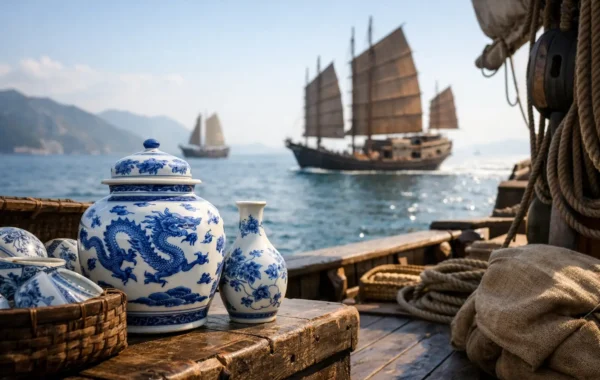
The most compelling way to understand Francis Light is to place him within the maritime world that made Penang possible. The Strait of Malacca was one of the great arteries of global exchange. Chinese ceramics, Indian textiles, spices, timber, metals, tea and ideas crossed these waters in vessels large and small. Ports rose through their ability to welcome ships, protect commerce and connect different peoples.
Penang flourished because it entered this world at precisely the right moment. The free port policy encouraged movement, while its harbour gave traders a practical refuge. Its growth was not predetermined, nor was it created by British policy alone. It depended on the confidence and resourcefulness of Asian merchant communities who chose to make the port their home.
This is why maritime artefacts have such resonance in Penang. A recovered porcelain bowl, storage jar or trading ceramic is not simply a beautiful object. It is evidence of journeys made, cargoes exchanged and lives connected across oceans. At Straits & Oriental Museum, shipwreck ceramics offer a tangible way to encounter the trading cultures that formed the wider world into which Penang emerged.
A founder, but not the whole story
Light died in 1794, only eight years after the British flag was raised. He did not live to see Penang’s later emergence as one of the region’s most cosmopolitan ports, nor the scale of George Town’s architectural and cultural inheritance. His legacy is nevertheless embedded in the island’s public memory.
Calling him Penang’s founder is understandable, provided the phrase is used carefully. He was central to the creation of the British settlement and to the administrative framework that allowed George Town to develop. But he did not create Penang from nothing. He arrived in a place with a name, a ruler, communities and a place in regional trade. Nor did he act alone: Kedah’s rulers, East India Company officials, migrants and local inhabitants were all participants in the story.
That fuller account does not diminish Penang’s drama. It makes it more human. It allows visitors to see beyond the familiar statue and commemorative plaque towards an island shaped by negotiation as much as conquest, and by maritime exchange as much as imperial ambition.
When walking through George Town’s historic streets, look for more than the markers of British rule. Listen for the many languages of a port city, notice the places where faiths and communities gathered, and imagine the ships that carried people and porcelain through the Straits. Francis Light may be the best-known name in the founding story, but Penang’s enduring splendour lies in all the lives that made the island a meeting place for the world.