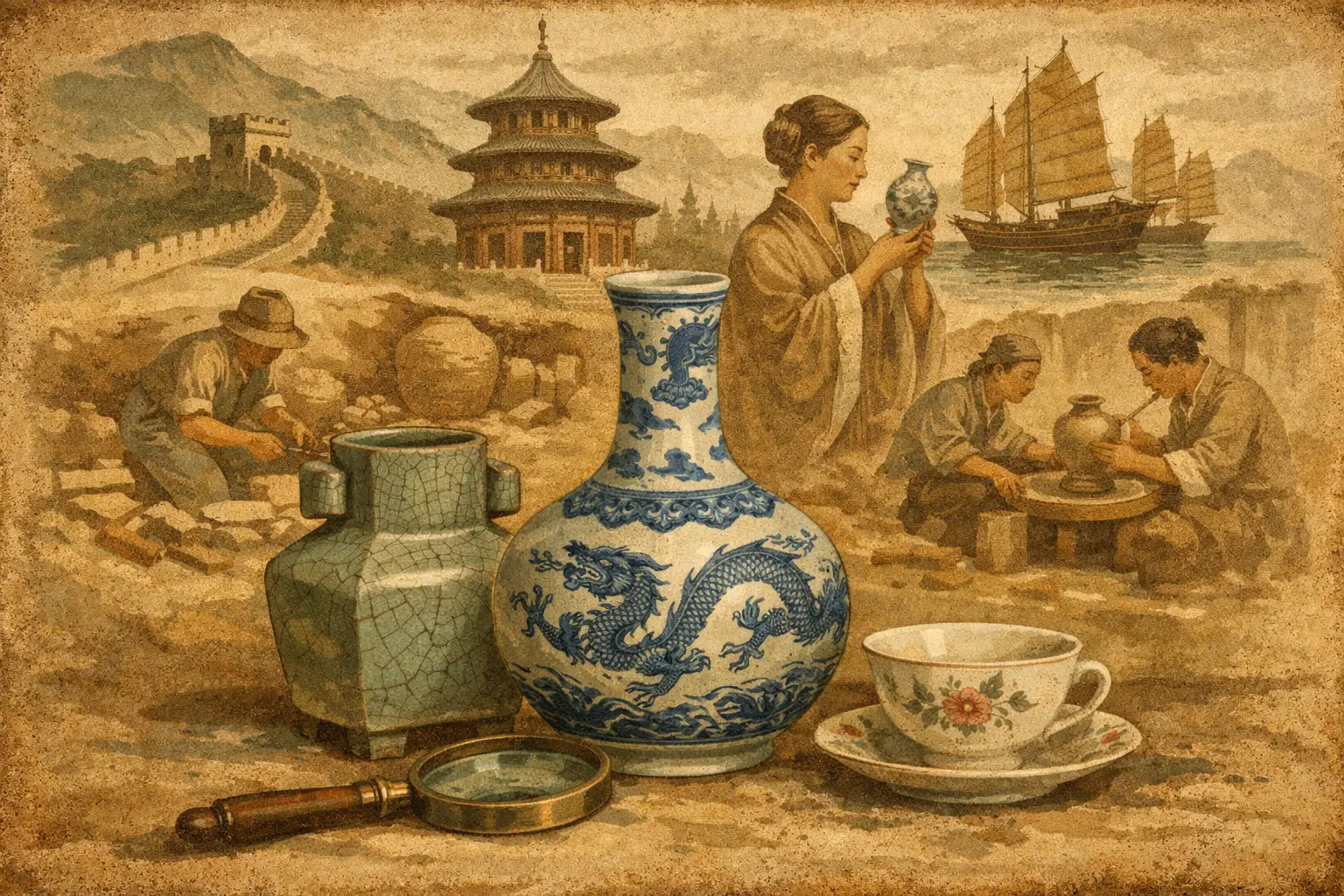

A bowl lifted from a shipwreck may have spent centuries beneath the sea, yet its painted scroll, foot ring and glaze can still speak with remarkable precision. Chinese ceramic dating is the art of listening to those details. It connects an object not only to a dynasty or reign, but also to the kiln that made it, the merchant who shipped it and the ports that received it.
For collectors and curious visitors alike, the appeal lies in this layered story. A small blue-and-white dish is never simply decorative. It can be evidence of imperial taste, technical innovation and the maritime networks that once linked China with Southeast Asia, the Indian Ocean and beyond.
A date is more than a number
Dating Chinese ceramics is rarely a matter of finding one decisive clue. Specialists build a case from several forms of evidence: the object’s shape, clay body, glaze, decoration, marks, manufacturing method and archaeological setting. Each clue has a level of reliability, and the strongest attributions are those in which the evidence agrees.
This matters because Chinese potters often revived admired forms from earlier periods. A Ming potter might deliberately emulate a Song shape; a Qing workshop could reproduce a famous Ming reign mark. Such references were part of a sophisticated visual language, not necessarily an attempt to deceive. For that reason, a mark alone cannot settle a date.
The most useful question is not, ‘How old is this porcelain?’ but, ‘What does every feature of this porcelain tell us when read together?’ That shift turns looking into historical enquiry.
Chinese ceramic dating begins with close looking
The first examination is often visual and tactile. Before laboratory testing or archival research, a trained eye studies the object as a made thing: its proportions, the way the base was cut, the colour and texture of the paste, and the relationship between decoration and form.
Form, foot and firing
Shapes travelled through time. The broad, gently curved bowls associated with the Song period differ from the more forceful profiles and heavier construction of many later export wares. Ewers, kendi, jars and covered boxes also changed as dining habits, export markets and kiln practices evolved.
The underside is particularly revealing. The foot ring may be neatly trimmed, rough, wide, narrow or glazed in a characteristic way. Spur marks, grit adhering to the base and kiln furniture traces can indicate how a vessel was stacked and fired. These details are modest, but they are often more dependable than a striking motif on the front.
Ceramic dating also requires an understanding of technology. A hard, white porcelain body fired at high temperature differs from a stoneware body or a softer, more porous earthenware. The composition and finish can help distinguish, for example, products associated with Jingdezhen from those of Longquan, Dehua, Cizhou or southern coastal kilns. Attribution is not always certain, but identifying a likely production tradition can narrow the date considerably.
Glaze and decoration
Glaze has its own chronology. The luminous green of Longquan celadon, the creamy ivory tone of Dehua blanc de Chine and the pale blue-green of certain Qingbai wares each reflect particular materials and firing conditions. Variations within those families matter too. A glaze that pools thickly in carved recesses, or one that has fine crackle from cooling, may provide valuable comparison points.
Decoration should be read with care. Lotus scrolls, peonies, dragons, phoenixes and waves recur across centuries, but their drawing changes. The confidence of a brush line, the spacing of a border, the shade of cobalt and the placement of a motif can reveal workshop habits and period preferences. In blue-and-white porcelain, imported cobalt, local cobalt and later recipes can produce different effects, although colour alone is never enough to establish a date.
Reign marks and their limits
A reign mark can be thrilling to find, especially on the base of a finely made vessel. It may name an emperor and appear to offer a precise answer. Yet marks were copied in later reigns as gestures of respect, commercial strategy or artistic convention. Some were added by later hands, while others are too blurred or partial to read securely.
Experts therefore ask whether the mark is consistent with the vessel itself. Does the script suit the claimed period? Is the form right? Does the glaze, foot and painted style support the same conclusion? When these elements conflict, the object deserves further study rather than a convenient label.
Context turns an object into evidence
An excavated ceramic has an advantage over an unprovenanced example: it has a context. A piece recovered from a documented shipwreck, sealed burial or carefully recorded settlement layer can be compared with the other material found alongside it. Coins, timber, cargo records and associated ceramics may establish a useful date range.
Shipwreck cargoes are especially significant for Chinese ceramics. They preserve commercial consignments that were packed for real customers, rather than objects selected later for a collection. A cargo can show which shapes were being exported, which decorative styles appealed to overseas buyers and how ceramics were arranged within regional trade.
Still, context has its own limits. A ship may carry older heirlooms alongside newly made goods, and a wreck date provides the latest possible date for its cargo, not necessarily the exact year every piece was produced. Archaeologists call this a terminus ante quem: the object must have been made before the ship sank. Used carefully, that boundary is immensely valuable.
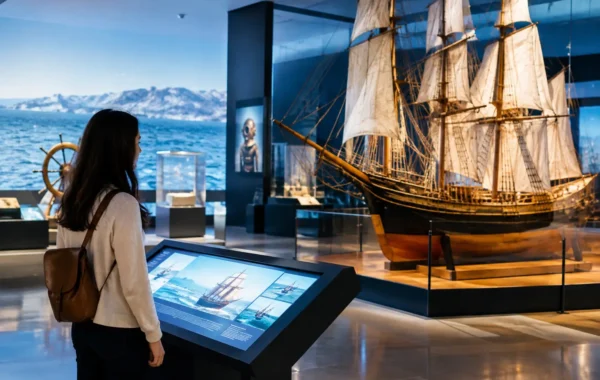
At Straits & Oriental Museum, shipwreck ceramics offer an immediate way to see this principle at work. A display gains depth when visitors consider not only the beauty of a vessel, but also the voyage that interrupted its passage and preserved its story beneath the water.
Scientific testing is a useful check, not a shortcut
Scientific methods can support connoisseurship, especially where an object is unusual, damaged or difficult to compare. Thermoluminescence testing can estimate when a ceramic was last fired by measuring stored energy in its mineral grains. It is most useful for confirming broad age ranges, but it involves taking a small sample and has a margin of uncertainty. It cannot reliably identify a specific emperor’s reign.
Chemical and mineral analysis can examine clay, glaze and pigments. These approaches may help identify raw-material sources or distinguish a modern composition from a historical one. They are often more effective for questions of origin and authenticity than for providing a neat calendar date.
The trade-off is clear. Testing can add evidence, but it should be interpreted alongside visual examination and provenance. A laboratory result without historical context is incomplete; an attractive stylistic attribution without technical support may also be fragile.
How to read a ceramic in a gallery
Visitors need not become specialists to enjoy the process. Begin by looking slowly at the whole object, then turn attention to its practical details. Is the shape designed for serving, storing, pouring or ritual use? Is the decoration painted freely or arranged in a repeated pattern? Where has the glaze stopped, pooled or worn away?
Then consider the intended journey. A refined imperial-looking vessel and a robust export bowl may have been made in the same broad era but for very different worlds. The former might express courtly taste; the latter may have been packed by the hundreds for merchants trading across the seas. Neither is a lesser story. Both reveal the range and ambition of Chinese ceramic production.
Comparing several objects is often more instructive than studying one in isolation. Notice how a border changes from one dish to the next, how cobalt can appear inky or soft, or how one foot ring is more carefully finished than another. Patterns emerge through comparison, and those patterns are the foundation of dating.
Why these dates reshape maritime history
Chinese ceramics are among the most durable witnesses to Asia’s maritime past. Unlike textiles, timber or foodstuffs, they can survive burial and submersion for centuries. Their presence in ports and wrecks helps map trade routes, changing consumer tastes and the movement of ideas across cultural boundaries.
A date assigned to one vessel can therefore affect a much larger story. It may help establish when a port was active, when a trade connection intensified or when a particular decorative fashion reached a distant market. For Penang and the wider Straits region, such objects make the sea feel less like a divide and more like a historical highway.
The next time you encounter a porcelain bowl, resist the urge to seek a single, instant answer. Look at its form, surface, base and setting, then imagine the hands and waters between kiln and collection. The most rewarding dates do more than identify an era: they restore an object to the living world that made, traded and treasured it.