
A small blue-and-white dish can appear deceptively simple behind glass. Yet its foot rim, the rhythm of its painted scrolls, a trace of sea-worn glaze and the objects recovered beside it may hold centuries of evidence. This ceramic authentication case example follows the considered process through which a shipwreck ceramic moves from an attractive object to a credible historical artefact.
For visitors, authentication gives a collection its depth. It explains why a porcelain bowl is more than a beautiful survivor, and why its journey across the seas matters as much as the kiln that made it.
The object: a dish with a maritime history
Consider a shallow porcelain dish recovered from a documented Southeast Asian shipwreck site. It has a gently flared rim, a low ring foot and a translucent white body. Under its clear glaze, cobalt-blue decoration frames a central floral motif. The surface shows small areas of abrasion, while compact marine deposits remain in protected recesses beneath the foot.
At first glance, it may resemble many export wares produced for maritime trade. That resemblance is precisely why authentication cannot rest on visual appeal alone. Chinese ceramics were copied in their own period, reproduced in later centuries and continue to inspire modern decorative wares. A confident assessment must bring together provenance, material evidence, construction, decoration and comparison with securely recorded examples.
The aim is not always to declare an exact kiln, month or individual potter. Often, the more responsible conclusion is a carefully defined attribution: an object is likely from a particular production region, period and trading tradition, supported by the evidence available.
Ceramic authentication case example: starting with provenance
The strongest clue in this case is not the painted design. It is the documented recovery context.
An object recovered during a properly recorded maritime archaeological excavation has an evidential advantage over an unprovenanced piece on the market. Its location within the wreck, its association with other cargo and the records of recovery can help establish that it belongs to a particular vessel and voyage. If hundreds of comparable dishes were found packed together in a cargo area, that pattern is far more meaningful than a single isolated discovery.
Documentation should include excavation reports, photographs taken during recovery, conservation records, inventory numbers and an unbroken record of custody after the object has been raised. These records do not make an object genuine by themselves. They do, however, give specialists a historical framework in which the physical ceramic can be assessed.
There is a necessary caution here. Saltwater exposure is not proof of age. Artificial staining, applied encrustation and misleading stories can be used to create an impression of maritime origin. Marine deposits therefore need to be read alongside the object, not treated as a theatrical seal of authenticity.
Reading the body, foot and glaze
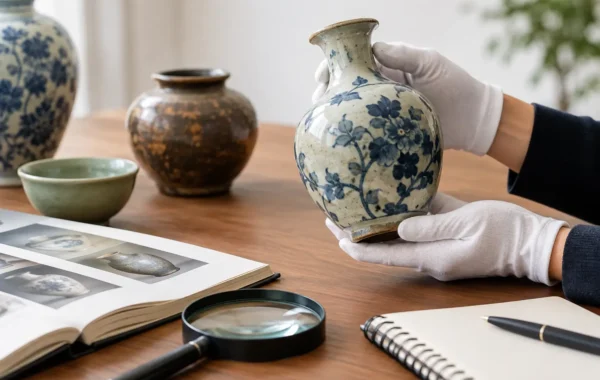
The next stage is close physical examination. Specialists look first at the ceramic body: its colour, density, texture and the character of any visible inclusions. True porcelain is typically fired to a high temperature, creating a hard, resonant body with varying degrees of translucency. The exact appearance depends on the materials used and the firing conditions, so no single feature should be isolated from the rest.
The dish’s ring foot is particularly revealing. Its width, height, trimming marks and the treatment of the unglazed base can be compared with known production practices. On historical export ceramics, a foot may retain a fine sandy texture from kiln furniture, display an iron-rich firing blush or show marks left by the potter’s tools. These details can be difficult to reproduce convincingly when they are part of the making process rather than added afterwards.
Glaze offers another record. On our dish, the glaze pools slightly where the well meets the cavetto, the sloping area between the centre and rim. It has minute pinholes and a soft, naturally varied surface rather than a uniformly glossy finish. Such features may be consistent with historical firing, but they must be interpreted with care. Aged-looking glaze can also result from poor modern firing, later damage or conservation treatment.
Condition matters too. Long immersion can dull a glaze or leave mineral residues, but it can also cause genuine damage. A heavily restored vessel may still be historically important, yet restoration affects both appearance and market value. Authentication should identify repairs plainly rather than allowing a reconstructed object to be mistaken for one that has survived intact.
The blue decoration under scrutiny
Cobalt decoration can provide valuable supporting evidence. Specialists examine whether the blue was painted beneath the glaze, how it has softened or spread during firing, and whether brushwork suits the proposed period. On an authentic hand-painted dish, a line may vary in pressure, density and speed. A flower petal may be briskly suggested rather than mechanically repeated.
That does not mean every irregular mark signals age. Skilled contemporary decorators can paint with great fluency, while historical workshops also produced standardised designs at considerable scale. The question is whether the painting, form and material all speak the same visual language.
In this case, the floral motif is compared with catalogued cargoes and dated examples from related maritime contexts. Its composition, border pattern and cobalt tone point towards a late Ming export tradition rather than a later decorative revival. The conclusion is strengthened if the same design family appears repeatedly among ceramics recovered from the same wreck.
Comparison turns observation into attribution
Authentication becomes persuasive when observations can be tested against reference material. Museum collections, archaeological reports, kiln studies and published excavation catalogues allow specialists to compare shape, dimensions, decorative vocabulary and manufacturing details.
For the dish in this case, comparison might show that its diameter and foot profile align closely with known export dishes made for Southeast Asian markets in the late sixteenth or early seventeenth century. The cargo context may also contain other diagnostic objects, such as dated coins, marked ceramics or trade goods with independently established chronologies. Together, these form a network of evidence.
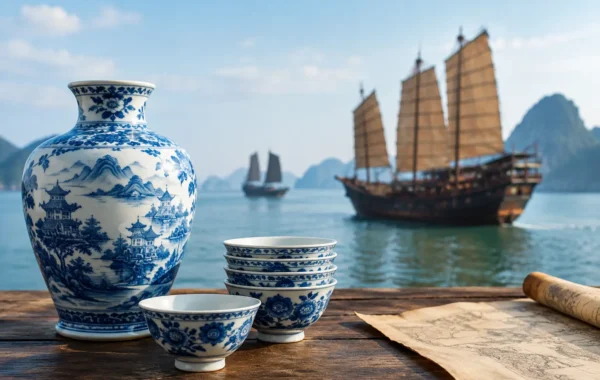
This is where a shipwreck collection carries exceptional interpretive value. A single ceramic on its own can be difficult to place. A cargo of thousands of objects reveals commercial choices: what was loaded, what was made in quantity, which forms travelled together and which consumers were being served. The artefact becomes part of a maritime story rather than an isolated collectible.
At Straits & Oriental Museum, shipwreck ceramics invite visitors to see this larger picture: porcelain as a record of craftsmanship, taste, trade and the movement of ideas across Asia’s waterways.
Scientific testing: useful, but not a shortcut
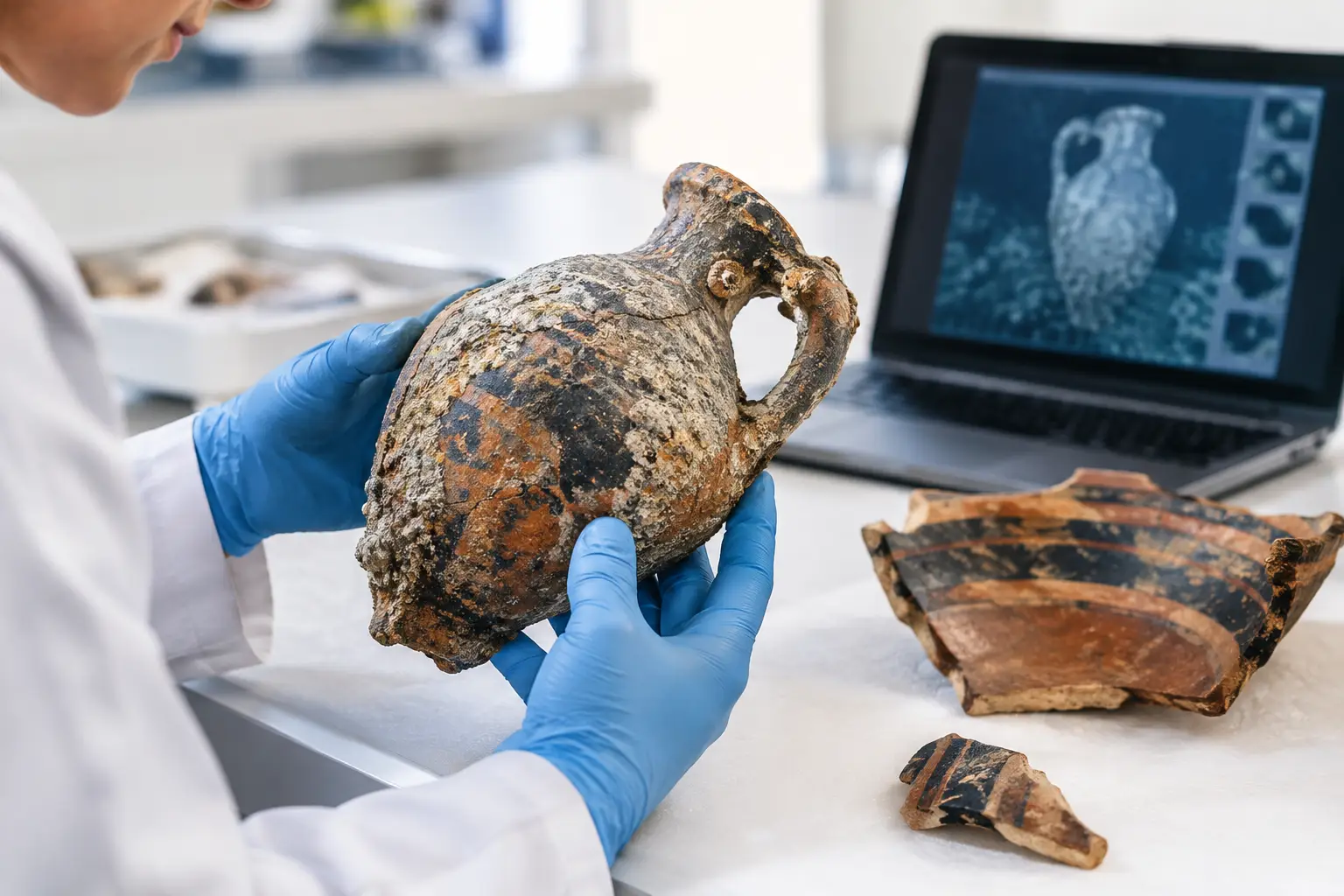
Scientific methods can support an authentication, particularly when visual assessment and provenance leave questions unresolved. Thermoluminescence testing may help determine whether a ceramic body was last fired in antiquity rather than recently. Chemical analysis can examine glaze and pigment composition, while microscopy may reveal manufacturing and weathering features beyond the naked eye.
But science has limits. Thermoluminescence requires sampling, which may not be appropriate for a complete or significant object. Results are usually expressed as ranges, not precise dates, and contamination or previous heating can affect interpretation. Chemical composition may suggest a material tradition without identifying one exact kiln.
A laboratory result should therefore be treated as one voice in a wider conversation. The best practice combines conservation science with connoisseurship, archaeology and rigorous documentation. When the findings agree, confidence grows. When they conflict, the uncertainty should remain visible.
A measured conclusion, not an extravagant claim
After examining the dish’s recovery record, body, foot, glaze, painted decoration and comparative material, a responsible catalogue entry might describe it as a Chinese blue-and-white porcelain export dish, probably produced during the late Ming period and recovered from a documented regional shipwreck cargo. It may identify a likely production tradition while avoiding a claim that the evidence cannot sustain.
That restraint is a mark of quality. Authentication is not about attaching the grandest possible label. It is about preserving trust in the object, the collection and the history it carries.
When viewing a shipwreck ceramic, linger at the details that survive beneath its beauty: the unglazed foot, the uneven blue line, the evidence of firing and the quiet marks of a voyage interrupted. They are invitations to look closer, and to let a small porcelain object tell a story measured not only in centuries, but in oceans crossed.