
A Desaru shipwreck porcelain example is not simply an attractive antique. It is a surviving witness to a working maritime world: made in China, packed for trade, carried across busy Southeast Asian waters, and ultimately preserved beneath the sea after a voyage went wrong. In the hand, a bowl or dish from such a cargo may seem modest. In context, it opens a remarkable story of craftsmanship, commerce and the people who relied on the sea.
What Makes a Desaru Shipwreck Porcelain Example Significant?
The Desaru wreck is associated with the waters off Johor and is generally understood as an early 19th-century trading vessel. Its ceramic cargo reflects a period when Chinese export wares travelled in considerable quantities through the ports and coastal settlements of the Malay Archipelago. These were not necessarily objects made for imperial courts or private palaces. Many were practical, desirable wares intended for daily use, gifting and resale across a thriving regional marketplace.
That distinction matters. A shipwreck porcelain example from Desaru gives us a view of history from the table rather than the throne. A rice bowl, serving dish or storage jar can reveal what merchants believed customers wanted, how ceramics were packed for the journey, and how taste moved between China and Southeast Asia.
Shipwreck archaeology also changes how an object is read. A similar bowl found in a house or antique collection tells one story. Found as part of a submerged cargo, alongside hundreds or thousands of related pieces, it becomes evidence of a trade network. The repetition of form, decoration and size can suggest that the cargo was selected commercially, not assembled at random.
Reading the Porcelain: Form, Decoration and Finish
A useful way to approach a Desaru shipwreck porcelain example is to begin with close looking. The object does not need to be rare in isolation to be historically compelling. Its details are the starting point.
The shape tells you how it may have been used
Many export ceramics were designed for everyday life. Small bowls suited rice, soups or shared dishes. Plates and shallow dishes accommodated serving and presentation. Jars and covered vessels could carry foodstuffs, liquids or household goods. Their proportions were practical, but the best examples still show a confident command of balance and touch.
Look at the foot ring beneath a bowl, the thickness of its walls and the curve of its rim. A neatly finished foot and an even, resonant body can indicate careful production. Slight irregularities are equally valuable. They remind us that porcelain was made through demanding processes of throwing, trimming, glazing, painting and firing, often at scale.
Blue and white was made for movement
Blue-and-white porcelain became one of the most recognisable visual languages of Asian maritime trade. Cobalt decoration beneath a clear glaze was durable, legible and visually striking. On a Desaru piece, floral sprays, scrolling foliage, landscapes, stylised symbols or border patterns may appear in tones ranging from soft grey-blue to a deeper blue.
The decoration was more than ornament. It made a familiar product immediately appealing across different markets. A floral bowl could sit comfortably in a Chinese household, a port settlement or a merchant’s dining room far from the kiln where it was made. Its design travelled well because it combined beauty with utility.
At the same time, no single motif should be treated as a shortcut to certainty. Decorative vocabulary was widely shared, copied and adapted. Dating and identification depend on the whole object: paste, glaze, painting style, shape, firing marks and, crucially, documented archaeological context.
The sea leaves its own record
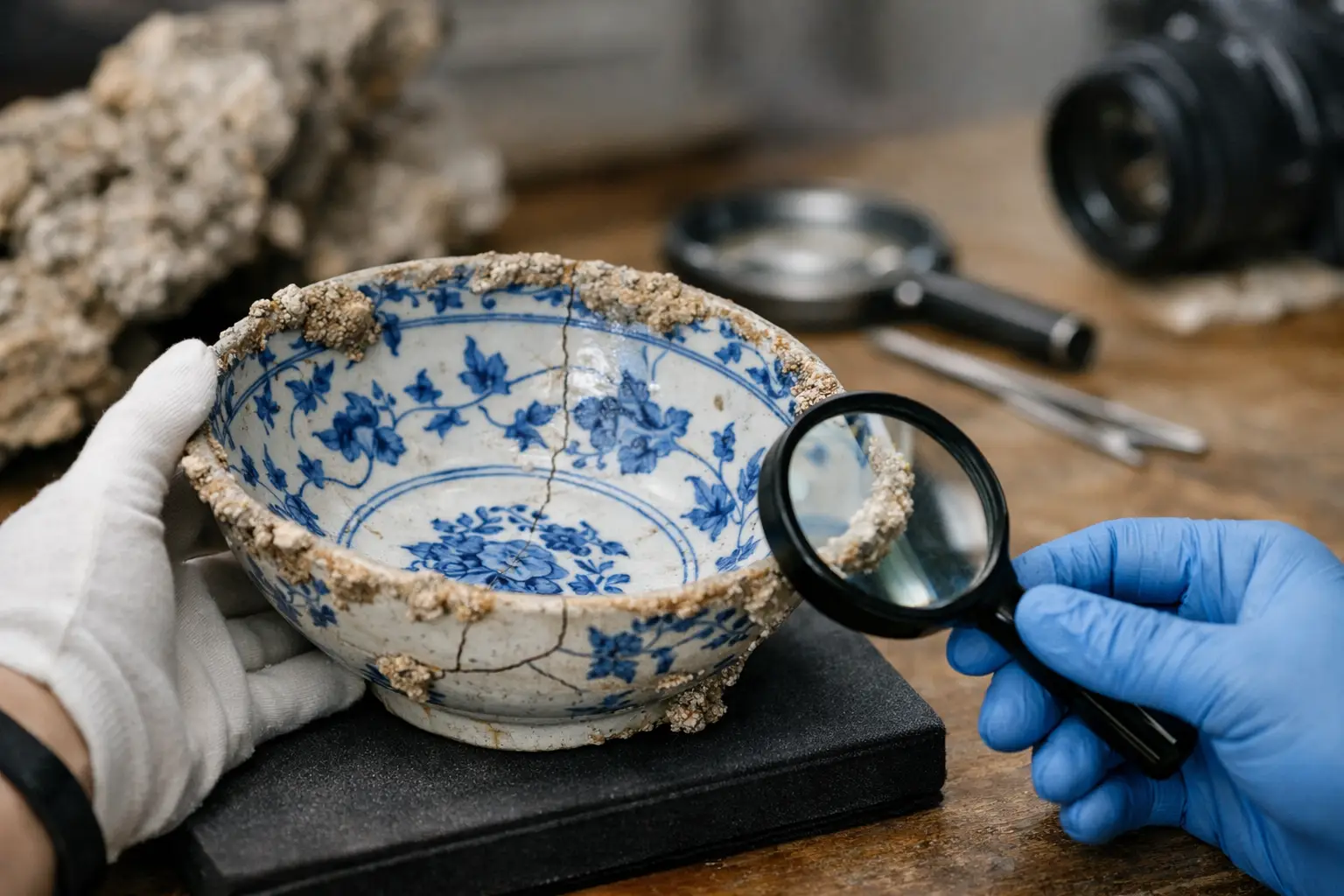
Marine burial can alter porcelain in subtle ways. A piece may carry deposits around the foot, abrasion at the rim or a softened surface where it rested against other objects. These traces should not automatically be mistaken for damage or dismissed as imperfections. They can be part of the object’s biography.
Conservation is therefore a careful balance. The aim is not to make a shipwreck ceramic look newly made, but to stabilise it and allow its original workmanship, as well as its time beneath the sea, to be understood. A perfectly glossy appearance can be less informative than a surface that still bears quiet evidence of its journey.
From Kiln to Coastal Market
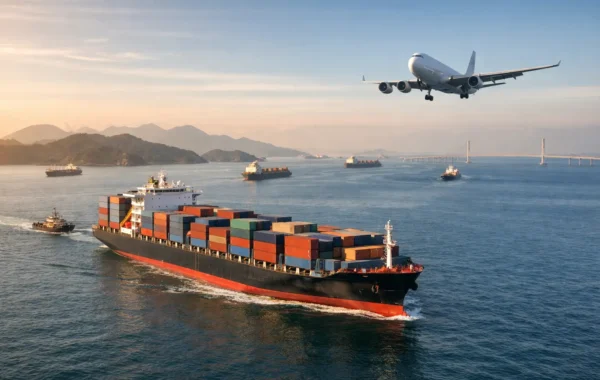
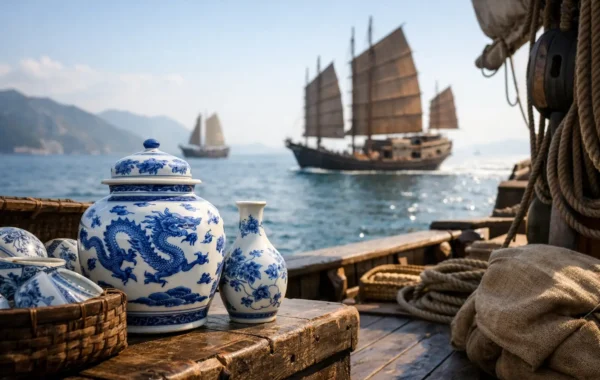
The Desaru cargo belongs to a larger story of maritime Asia, where the South China Sea connected kiln centres, entrepôts, island communities and colonial-era ports. Porcelain was compact, valuable and comparatively resilient. When tightly packed, often nested one inside another, it was an ideal cargo for merchants working across long distances.
Yet resilience did not mean safety. A vessel faced changing monsoon conditions, reefs, navigation errors, conflict and mechanical failure. The wreck itself is a reminder that sea trade was built on skill and ambition, but never free from risk.
For consumers, imported porcelain carried both practical and social value. It was suitable for meals and hospitality, while its white body and painted decoration signalled refinement. Pieces could become part of local customs, passing between communities and generations. This is why shipwreck ceramics are so useful for understanding cultural exchange: they show not only what was produced, but what was wanted.
The cargo also complicates the idea that historical trade moved in one direction. Chinese kilns supplied the wares, but Southeast Asian buyers, traders and port cities shaped demand. Their preferences affected which forms were commissioned, carried and sold. A Desaru vessel was part of that shared commercial world.
Why Condition and Context Matter to Collectors
For collectors, shipwreck porcelain has an undeniable presence. It offers a tangible connection to a lost voyage, and every authentic piece carries the fascination of recovery. But provenance deserves as much attention as appearance.
A responsible assessment considers whether an object has credible documentation linking it to the Desaru wreck, whether its form and materials align with the stated period, and whether conservation work has been disclosed. A bright glaze, a dramatic marine accretion or an appealing label alone cannot establish origin. The most meaningful objects are those whose stories can be supported, not merely suggested.
Condition also depends on purpose. A collector may favour an intact bowl with clear decoration, while a museum may value a fragment because it preserves a kiln mark, packing trace or unusual glaze effect. Neither judgement is inherently superior. The question is what the object can communicate.
This is where display makes a difference. Seen alone, porcelain can invite admiration. Seen with related cargo groups, maps, period references and interpretive storytelling, it becomes evidence of a voyage and an era. At Straits & Oriental Museum, shipwreck ceramics are presented within precisely this wider maritime conversation, allowing visitors to see splendour alongside context.
A Small Object With a Far-Reaching Story
The most memorable Desaru shipwreck porcelain example may be a humble vessel rather than an elaborate showpiece. Its appeal lies in the tension it holds: it was made to be used, traded and carried onward, yet it survived because it never reached its intended destination.
When viewing such a piece, take a moment to follow its possible path. Notice the painter’s brushwork beneath the glaze, the stacking marks or surface wear, and the practical shape that made it worth transporting. Then imagine the hands that produced it, loaded it, sold it and might have waited for it at another shore. That is where porcelain becomes more than a beautiful object. It becomes a journey through time.