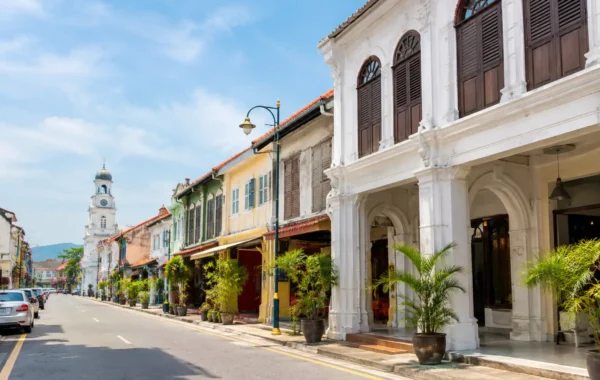
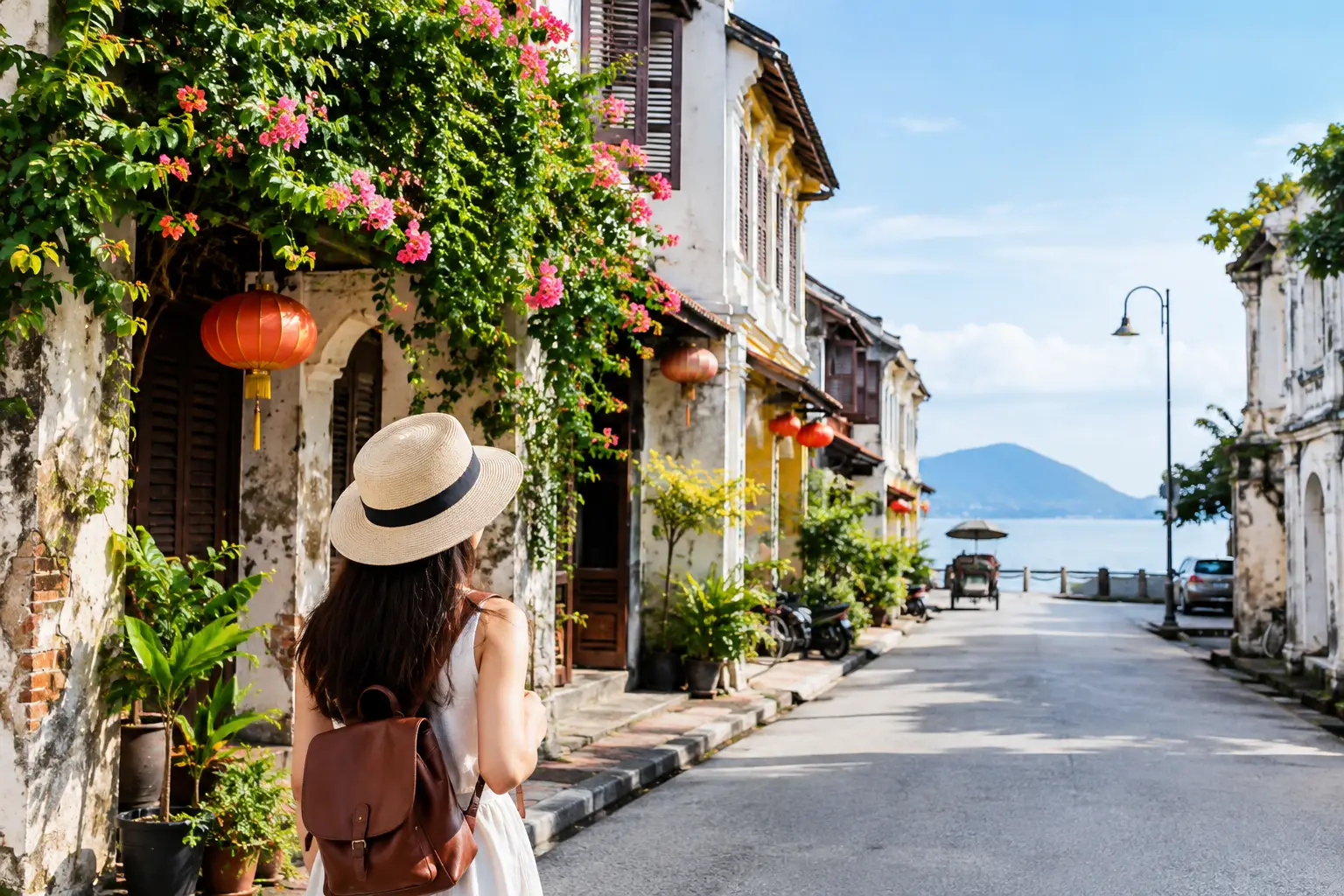

George Town, Penang is often photographed in fragments: a mural at the end of a lane, a row of painted shophouses, a bowl of noodles arriving at a pavement table. Yet its real distinction lies in how those fragments connect. This is a historic port city shaped by trade, migration, faith, craft and conversation – a place where a morning walk can move from Chinese clan houses to Indian Muslim cooking, colonial facades and stories carried ashore from distant seas.
For visitors who want more than a checklist of sights, George Town rewards curiosity. Its UNESCO-listed historic core is compact enough to explore on foot, but layered enough to deserve pauses. The best day here is not rushed. It leaves room for the detail above the five-foot ways, the scent from an old coffee shop, and the objects that make the city’s maritime past feel present rather than remote.
Georgetown Penang beyond the postcard
The city’s celebrated street art is worth seeing, particularly early in the day before the lanes become busy. But murals are only one chapter of a much older visual language. Look beyond them to the ornamental plasterwork, shuttered windows, tiled thresholds and signboards that reveal the ambitions of merchants, families and communities who made their lives here.
George Town grew through the movement of people and goods across the Straits of Malacca. Chinese, Malay, Indian, Eurasian, Arab and European influences did not simply arrive side by side; they formed a living urban culture. That is why one street may hold a temple, mosque, church, kopitiam and traditional trades within a short walk of one another. Heritage here is not arranged behind a rope. It is part of daily life.
This also means the city asks something of its visitors. Residential lanes are not a film set, and places of worship are not merely architectural backdrops. Dress respectfully, keep voices low where appropriate, and give yourself time to notice what remains in use. The pleasure of George Town comes from its lived-in character, not from treating it as a museum without people.
Begin with the streets, then follow the stories
A considered route often begins in the morning, when the light is gentler and the pavements are more comfortable for walking. The heritage core can be explored without a fixed itinerary, though it helps to choose a theme: architecture, food, faith, trade or family histories. A theme turns wandering into a story.
For architectural detail, look at the shophouse. Its proportions were shaped for both commerce and home life: business at the front, family spaces beyond, courtyards bringing air and light into deep, narrow plots. Five-foot ways created sheltered public passage, while decorative facades announced taste, prosperity and identity. Some buildings are carefully restored; others show weathered layers that are equally revealing.
For cultural history, seek out the institutions that anchor the neighbourhoods. Clan houses speak of mutual aid and migration. Temples preserve ritual, memory and craftsmanship. Markets and coffee shops show how food remains one of Penang’s most generous forms of welcome. A city this dense cannot be understood by looking at buildings alone. It must be heard, tasted and observed at street level.
The trade-off is simple: covering everything means absorbing little. Choose fewer stops and spend longer at each one. A quiet courtyard, an antique tiled floor or a conversation with a shopkeeper may stay with you longer than another photograph.
The sea that made George Town possible
George Town’s story is inseparable from the sea. The island’s position on historic trading routes connected Penang to China, India, the Indonesian archipelago and Europe, bringing spices, textiles, ideas and ceramics through its harbour. Porcelain in particular became more than a luxury commodity. It travelled as cargo, household ware, diplomatic gift and marker of status, carrying the artistic traditions of its place of origin across oceans.
That history is especially compelling because much of it survived beneath the water. Shipwreck ceramics offer a rare record of maritime exchange: bowls, jars, dishes and vessels that were made to travel, then lost for centuries before being recovered. Their surfaces may be delicate, but their survival tells of monsoon routes, commercial risk and the immense reach of Asian trade.
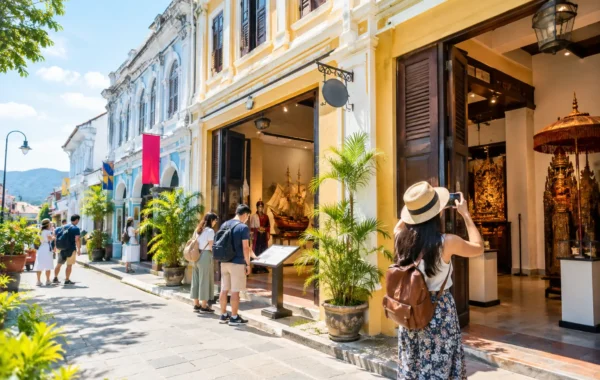
At Straits & Oriental Museum, authentic artefacts recovered from significant Asian shipwrecks bring this wider world into focus. Collections associated with wrecks such as the Wanli, Turiang, Royal Nanhai, Nanyang, Xuande and Desaru offer a tangible encounter with objects once in transit. Seen closely, a porcelain piece is not simply decorative. It becomes evidence of a journey, a market and a civilisation’s confidence in craft.
This is where a heritage visit gains depth. The streets of George Town show the result of centuries of connection; maritime archaeology reveals some of the routes and objects that helped create it. For families, it gives children a more vivid way to understand trade than dates on a timeline. For collectors and design enthusiasts, it offers the rare pleasure of studying form, glaze and pattern in an historical context.
Make room for food, art and conversation
A heritage day should not feel like an endurance test. George Town has always been a place of exchange, and its food culture remains one of its most immediate expressions. A simple breakfast at a traditional coffee shop, lunch built around local favourites, and an unhurried afternoon refreshment can frame the day as naturally as any itinerary.
The most rewarding meals are often modest in setting and exacting in preparation. Recipes change by neighbourhood, family and stall, so there is little value in searching for one definitive version of a dish. Follow the queues when they move with purpose, but do not confuse popularity with the only measure of quality. Sometimes the better discovery is the small place you can return to, rather than the celebrated stop you rush through once.
Art galleries, independent makers and thoughtfully curated shops add another layer. George Town’s creative life is strongest when it remains connected to place: contemporary work that responds to local materials, inherited motifs or the city’s social history. A well-chosen object makes a more meaningful souvenir than a generic keepsake, particularly when it reflects the skill and stories encountered during the day.
A better pace for a heritage city
George Town is highly walkable, but heat and rain shape the experience. Start early, seek shade through the middle of the day, and use indoor cultural stops as a considered pause rather than a retreat from the weather. Comfortable footwear matters more than a perfectly planned route, especially where uneven pavements and frequent stops invite a slower pace.
It is also worth separating the city’s historic atmosphere from the expectation of perfection. Conservation is ongoing, tourism brings pressure, and not every handsome facade has been restored. Those tensions are part of what makes heritage meaningful. A city preserved too neatly can lose its pulse; a city left entirely to chance can lose the fabric that carries its memory. George Town’s continuing challenge is to welcome visitors while remaining a place where communities can live, work and practise their traditions.
The most generous way to visit is therefore to spend with intention. Choose local food, support cultural venues, respect private spaces and allow independent businesses time to be more than a backdrop. Heritage survives through care, but also through participation.
As evening gathers, look again at the streets that seemed so busy by day. Light settles on shutters and tiled facades, conversations drift from dining rooms, and the old port city becomes less like an attraction than a continuing story. Leave room in your plans for that final, unhurried walk. In George Town, the detail you almost missed is often the one that brings the whole journey into view.