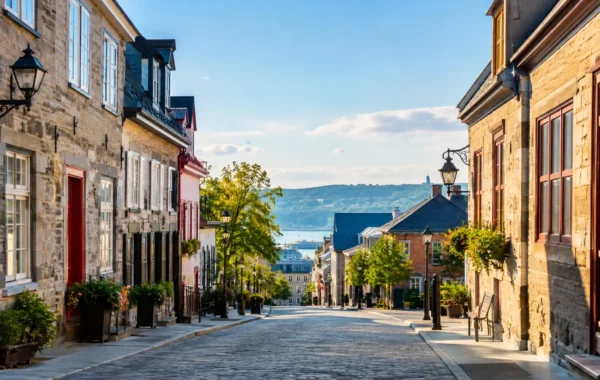
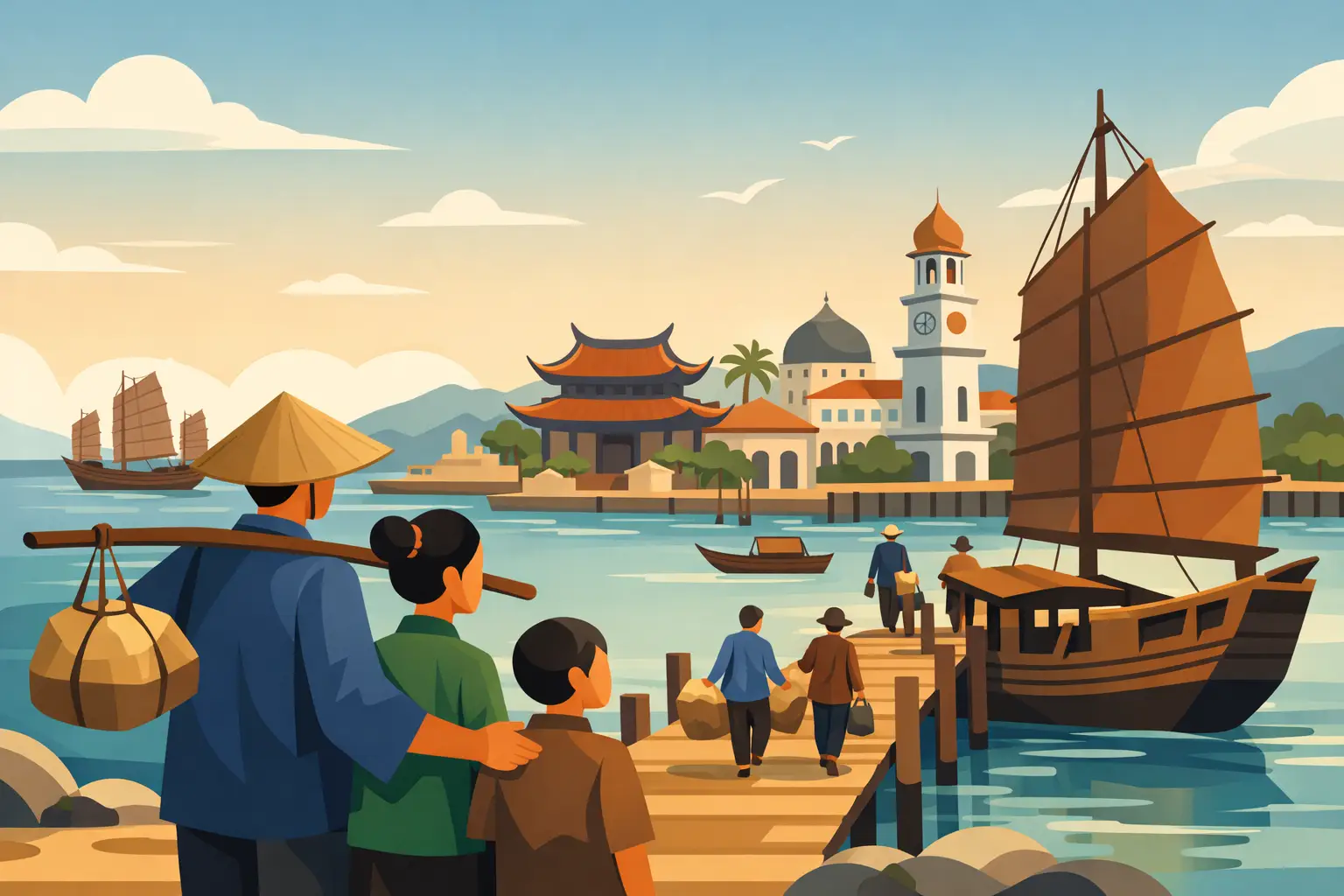

A harbour tells the truth about a place. Long before heritage streets and celebrated townhouses became emblems of Penang, the island was defined by movement – cargo in wooden hulls, dialects carried across the sea, and families arriving with little certainty beyond the promise of work. The story of the Chinese diaspora in the 19th and early 20th century to Penang is, at heart, a story of maritime passage and reinvention.
Penang did not simply receive migrants. It was transformed by them. Its ports, warehouses, clan houses, places of worship, kitchens and commercial streets all bear the imprint of Chinese communities who arrived from southern China during a period of profound regional change. To understand Penang properly, one must look not only at who came, but why they came, what they built, and how the sea connected their ambitions to a wider Asian world.
Why Penang drew the Chinese diaspora
Penang’s appeal was not accidental. Founded as a British trading port at the end of the 18th century, it quickly became part of an expanding maritime network linking the Malay Peninsula, the Indonesian archipelago, India, China and beyond. For migrants from Fujian and Guangdong, Penang offered something unusually powerful – access.
Access meant trade, labour, mobility and, in some cases, refuge. Southern China in the 19th century was marked by economic strain, population pressure, local unrest and later the shocks of war and political upheaval. For many men in particular, migration was not a romantic voyage but a hard calculation. Penang promised wages in docks, plantations, construction, petty trade and shipping-related work. It also offered established Chinese networks that could soften the risk of arrival.
That matters. Migration rarely happens into a vacuum. A port becomes attractive when earlier migrants create pathways for later ones. In Penang, kinship ties, dialect-group associations and commercial partnerships helped turn individual journeys into sustained migration streams.
The Chinese diaspora in the 19th and early 20th century to Penang
The Chinese presence in Penang was never a single, uniform community. Migrants came from different districts, spoke different dialects and often organised themselves through associations based on origin, surname, occupation or belief. Hokkien merchants, Cantonese artisans, Teochew traders and Hakka labourers all contributed to the island’s development, but not in identical ways.
Some arrived with capital and commercial experience. Others arrived indebted, vulnerable and tied to systems of labour recruitment that could be harsh. This is one of the essential trade-offs in the migration story. Penang offered possibility, yet those possibilities were unevenly distributed. A successful merchant house and a struggling coolie lodging both belonged to the same historical landscape.
Even so, over time many Chinese migrants and their descendants moved beyond survival and into influence. They became central to trade, retail, shipping support, food production, artisanal crafts and property ownership. They funded temples, schools and clan institutions that gave structure to communal life. Through these institutions, migrants preserved familiar customs while adapting to a new colonial port society.
A maritime world, not an isolated island
It is tempting to tell Penang’s history through streets alone, but its deepest logic lies at sea. The island prospered because it sat within dense shipping circuits. Goods moved constantly through the port – ceramics, tea, textiles, spices, opium, tin and everyday wares that sustained domestic life across the region.
Chinese migrants were part of this circulation in more ways than one. Some worked directly in maritime trades, while others built businesses that depended on the rhythm of arriving vessels and redistributed cargo. Penang’s commercial energy was inseparable from the sea lanes that connected it to Chinese ports and Southeast Asian markets.
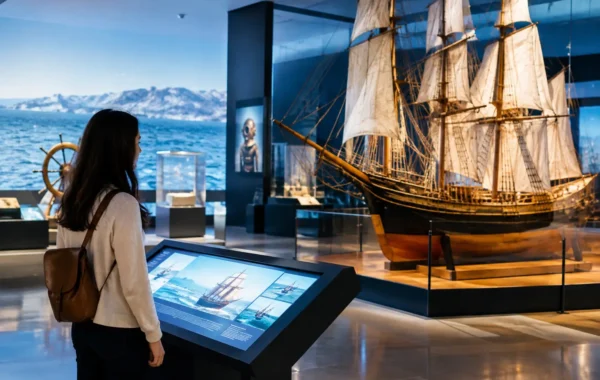
This is where material culture becomes especially revealing. Ceramics, for instance, are not just beautiful objects. They are evidence of exchange, taste, aspiration and the practical movement of goods across water. Shipwreck cargoes remind us that migration and trade were entwined. A bowl, a storage jar or a porcelain dish can speak quietly of the same networks that carried human lives to Penang’s shore.
For visitors interested in that maritime dimension, institutions such as Straits & Oriental Museum bring exceptional clarity to the conversation by placing shipwreck ceramics within the wider story of regional movement and encounter. It is a powerful way to see migration not as an abstract demographic shift, but as part of a living seaborne world.
Community, identity and adaptation
Migration did not end at disembarkation. Arrival was only the first negotiation. Chinese communities in Penang had to decide how much of home to retain, what to adapt, and how to position themselves in a multi-ethnic colonial society that included Malays, Indians, Eurasians, Europeans and other Asian communities.
One answer lay in institution-building. Clan houses and temples were not merely decorative heritage landmarks. They were practical anchors. They provided support to newcomers, mediated disputes, organised religious observances and created a sense of belonging in an unfamiliar environment. In a port city where mobility could be constant and precarious, such institutions gave continuity.
Another answer lay in cultural blending. Not every Chinese resident in Penang remained culturally bounded by ancestral norms. Over generations, especially among locally rooted communities, distinctive Straits Chinese identities developed with their own language habits, domestic styles, foodways and social customs. This was not a loss of Chineseness, nor a simple preservation of it. It was a local evolution shaped by trade, intermarriage, education and colonial modernity.
That complexity is worth preserving. Heritage becomes less meaningful when it is flattened into a single origin story. Penang’s Chinese past is richer because it contains merchants and labourers, temple patrons and dock workers, recent arrivals and locally born elites, continuity and change.
Wealth, labour and the realities beneath success
Any polished account of Penang’s rise must also make room for difficulty. Migration generated prosperity for some families, but many lives were defined by instability. Employment could be insecure. Labour arrangements could be exploitative. Secret societies and factional rivalries emerged in part because communities were competing for influence, protection and economic control in a rapidly growing port environment.
This does not diminish the achievement of the Chinese diaspora. If anything, it sharpens it. The built environment, commercial legacy and cultural institutions that survive today were not produced under easy conditions. They were forged amid colonial regulation, shifting market forces and the vulnerability that comes with migration.
There is also a tendency to read success backwards, as though Penang’s prominence was inevitable. It was not. Ports rise because people keep choosing them, investing in them and imagining futures through them. The Chinese diaspora helped make Penang legible as a place of opportunity, but that position had to be constantly renewed across generations.
Why this history still matters now
The legacy of the Chinese diaspora in the 19th and early 20th century to Penang remains visible in the island’s urban form, religious life, cuisine, commerce and collecting traditions. Yet its importance goes beyond heritage aesthetics. It tells us how cities are made through movement – through arrivals that reshape local identity without erasing what came before.
For the modern visitor, this history also changes how Penang can be experienced. A restored façade becomes more than a photogenic backdrop when one understands the migration networks behind it. A ceramic artefact becomes more than a display object when seen as part of maritime exchange. A meal shaped by layered Chinese and Straits influences becomes a record of adaptation as much as taste.
Penang’s appeal has always rested on this interplay between journey and settlement, commerce and culture, the sea and the street. The Chinese diaspora did not merely add one chapter to that story. It helped define the island’s character.
To walk through Penang with that knowledge is to see more than heritage. It is to recognise an entrepot shaped by courage, negotiation and memory – and to appreciate that every port city is, in some sense, a collection of arrivals still speaking to the present.