
George Town was shaped by the sea long before it became known for its shophouses, murals and celebrated street food. The history, culture and art of Penang George Town begin with a harbour: a place where merchants, migrants, faiths, languages and precious cargoes met, settled and left their mark.
That layered inheritance is what makes the city compelling. Its heritage is not confined to a single monument or era. It lives in the five-foot ways that shelter pedestrians from tropical rain, in clan houses and places of worship, in hawker kitchens, and in the glazed surfaces of ceramics that once travelled the waters of Asia. To understand George Town is to see how a port became a culture.
A port city built on exchange
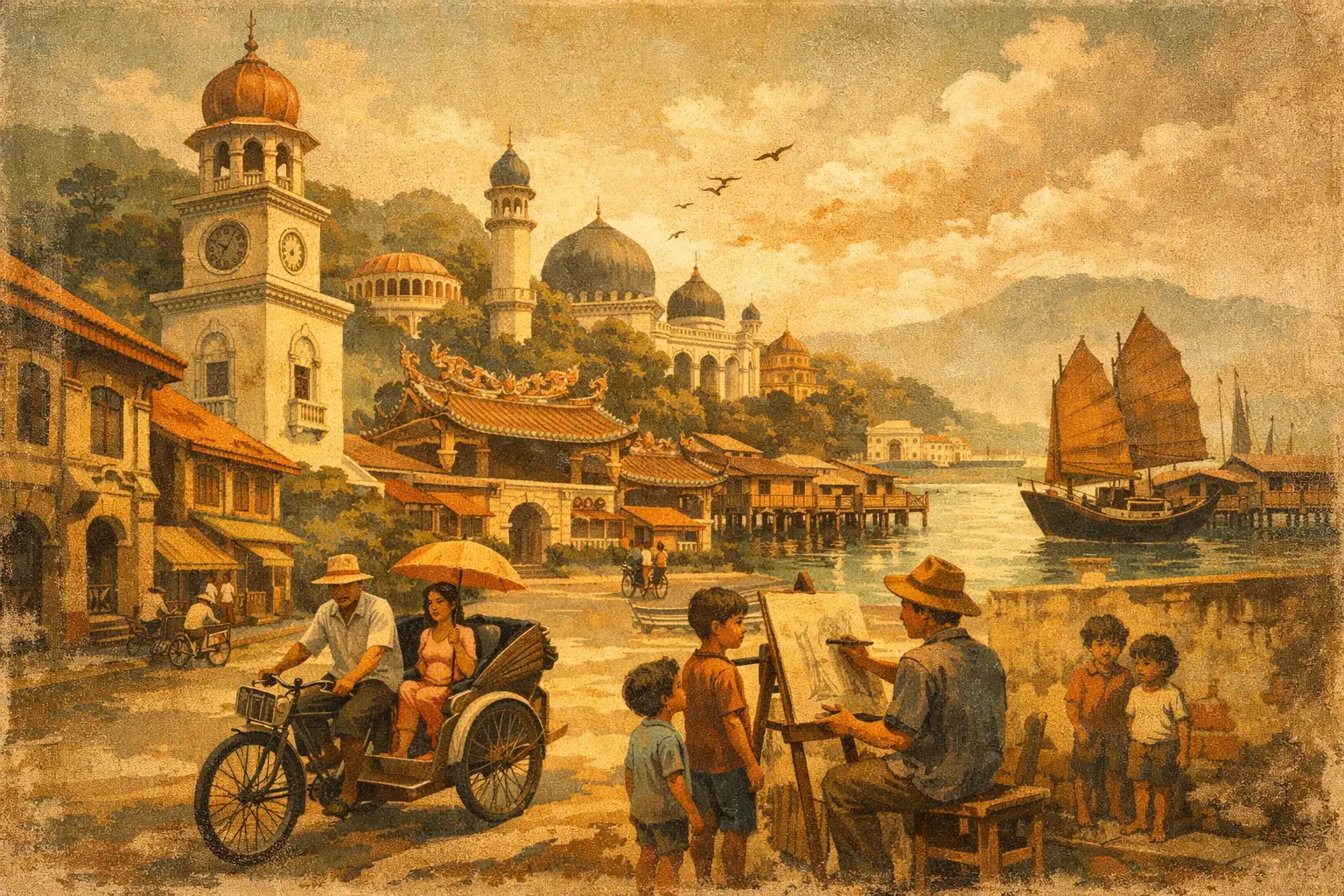
Founded by the British East India Company in 1786, Penang quickly gained importance as a free port on the Strait of Malacca. Its strategic position connected the Indian Ocean with the South China Sea, drawing traders from China, India, the Malay Archipelago, Siam, Arabia and Europe. Goods passed through its warehouses, but so did ideas, beliefs and artistic traditions.
The people who made a life here created a city of remarkable proximity. Chinese temples stand near mosques; Hindu shrines, churches and Buddhist associations are woven into the same historic streets. This is not a tidy story of cultures existing in separate quarters. George Town developed through contact – commercial, domestic, religious and culinary – and that contact produced new local identities.
The Peranakan communities are among the clearest expressions of this exchange. Their homes, textiles, cuisine and ceramics combine Chinese ancestral customs with Malay craft, regional ingredients and colonial-era tastes. A richly decorated townhouse might contain Chinese porcelain, English tiles, carved timber screens and Malay-influenced motifs, all belonging to one visual language of status, hospitality and family memory.
Its UNESCO World Heritage status recognises this exceptional multicultural trading history. Yet the most rewarding way to encounter it is not as a label. It is in the ordinary details: incense drifting from a temple doorway, a hand-painted signboard, a kopitiam conversation in several languages, or the changing rhythm of a street as worshippers, schoolchildren and traders move through it.
History, culture and art of Penang George Town
George Town’s art is often introduced through its public murals, and rightly so. Street art has given many visitors a playful and immediate way into the old town, turning weathered walls, bicycles and lane corners into sites of discovery. It has also helped direct attention towards neighbourhoods that might otherwise be passed by.
But the artistic story is older and broader than any mural trail. It includes the craft of shophouse façades, where plasterwork, louvred shutters, ceramic tiles and ornate ventilation panels balanced beauty with the demands of heat and monsoon weather. It includes calligraphy on temple plaques, gold-leafed altar carvings, rattan work, bead embroidery and the bold graphics of traditional coffee-shop packaging.
Architecture offers a particularly revealing record. Early buildings often follow practical mercantile forms: narrow-fronted shophouses with covered walkways, internal courtyards and upper floors for family life. Across the nineteenth and early twentieth centuries, these forms acquired Chinese, Malay, Indian, European and Art Deco details. The result is neither wholly Eastern nor Western. It is George Town’s own urban vocabulary, created by a cosmopolitan trading society.
Art here has always had a social purpose. Decoration announced prosperity, faith and belonging. A clanhouse was not simply an attractive building but a centre of kinship, welfare and ritual. A ceramic bowl was useful at the table, yet it could also signal taste, trade connections and reverence for inherited objects. This is why the city rewards close looking. Its beauty is rarely detached from the lives that made it.
The sea behind the porcelain
For centuries, ceramics were among Asia’s most sought-after exports. Chinese kilns produced porcelain and stoneware in enormous quantities for courts, households and trading ports across the region. Jars, dishes, ewers and storage vessels were packed into ships because they were valuable, practical and widely desired. Some reached their intended markets. Others were lost to storms, reefs, collision or the hazards of long-distance navigation.
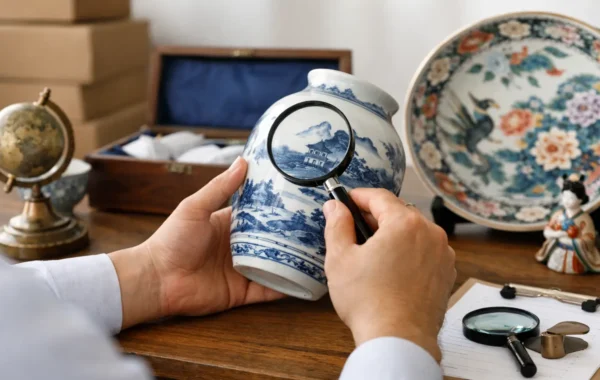
Shipwreck ceramics offer an unusually direct encounter with this maritime world. A bowl recovered from the seabed is more than a beautiful object. Its glaze, form and decoration can indicate where it was made, when it was fired and who may have wanted to buy it. The wider cargo can reveal the scale of trade, while the wreck itself preserves a moment when objects, crew and commerce were suspended between departure and arrival.
There is a necessary note of care here. Maritime archaeology is not a treasure hunt. The context in which an artefact is found matters as much as the object itself. Responsible conservation, documentation and interpretation allow ceramics to tell a credible historical story rather than becoming decorative curiosities detached from their origins.
At Straits & Oriental Museum, authentic ceramics recovered from significant Asian shipwrecks place Penang’s maritime setting within this far-reaching network. Collections associated with wrecks including the Wanli, Turiang, Royal Nanhai, Nanyang, Xuande and Desaru make the scale of regional exchange tangible. A visitor can stand before porcelain that crossed the same broad sea routes that helped define Penang’s fortunes.
The effect is quietly powerful. The sea may look like a horizon from the island’s shore, but these objects show it as an archive: a route of movement, risk, skill and cultural encounter. Their surfaces bear the elegance of their original makers and the extraordinary passage of centuries underwater.
How to read the details in historic streets
A meaningful visit does not require specialist knowledge. It requires a little patience. Rather than trying to cover every landmark, choose a few streets and notice what they reveal about work, worship, domestic life and trade.
Start at eye level. Look for tiled thresholds worn smooth by generations, old shop signs, timber shutters and the five-foot way – the covered pedestrian passage that links many shophouses. These details speak of a city designed for commerce and community, where public and private life met at the edge of the street.
Then look upwards. Rooflines, gables and façade ornament often reveal changing tastes and ambitions. Chinese-inspired motifs may sit beside neoclassical columns; floral tiles may frame a building with modernist proportions. Such contrasts are not errors of style. They are evidence of adaptation, renovation and the confidence of owners who participated in a connected world.
Finally, listen and taste. Penang’s food culture is part of its historical record, not an afterthought to it. Recipes developed through migration, religious practice, seasonal ingredients and the practical needs of busy trading communities. A meal can illuminate the same cultural crossings found in architecture and antiques, provided it is approached with curiosity rather than as a checklist.
Heritage that remains alive
George Town faces the familiar pressures of a much-loved historic city. Conservation can raise property values and bring new life to old buildings, yet it can also make it harder for long-standing residents and independent trades to remain. Tourism sustains many businesses, but a heritage district cannot thrive on photographs alone. It needs residents, craftspeople, worshippers, cooks and shopkeepers whose daily routines give its streets meaning.
This is why cultural visits matter when they are thoughtful. Enter sacred spaces respectfully. Ask before photographing people or private premises. Support businesses that maintain traditional skills and recipes. Allow time for museums and galleries, where objects can be encountered with their histories rather than simply used as a backdrop.
The finest memory of George Town is rarely one dramatic sight. It may be the blue-white gleam of a porcelain dish, a carved doorway catching the afternoon light, or a conversation over tea in a building that has witnessed generations of change. Here, history is not behind glass alone. It remains present in the streets, the table and the sea beyond them.