
A Tang bowl can feel surprisingly modern at first glance. The profile is clean, the glaze can be restrained or exuberant, and the decoration often carries a confidence that speaks of a world open to ideas, materials and trade. That is exactly why Tang dynasty ceramic features continue to fascinate collectors, museum visitors and anyone drawn to the story of Asia’s great maritime past.
The Tang dynasty, which ruled from 618 to 907, is often remembered as one of China’s most cosmopolitan ages. Ceramics from this period reflect that character with unusual clarity. They were made for courtly life, religious settings, burial practice, daily use and export beyond China’s shores. Some pieces are elegant and quiet. Others are vivid with flowing glazes in amber, green and cream. Together, they reveal a ceramic culture that was technically adventurous and visually assured.
What makes Tang dynasty ceramic features distinct
The first thing to understand is that Tang ceramics do not belong to a single look. This was a broad and inventive period, so the defining features are best understood as a family of qualities rather than a strict formula. Form, glaze, clay body and function all matter.
One of the clearest Tang qualities is vitality of shape. Vessels were often poised but never lifeless. Ewers, jars, dishes and figures carry a sculptural rhythm that makes them feel animated even when standing still. Curves tend to be confident, necks can be long and elegant, and animal or human forms are handled with a strong sense of silhouette.
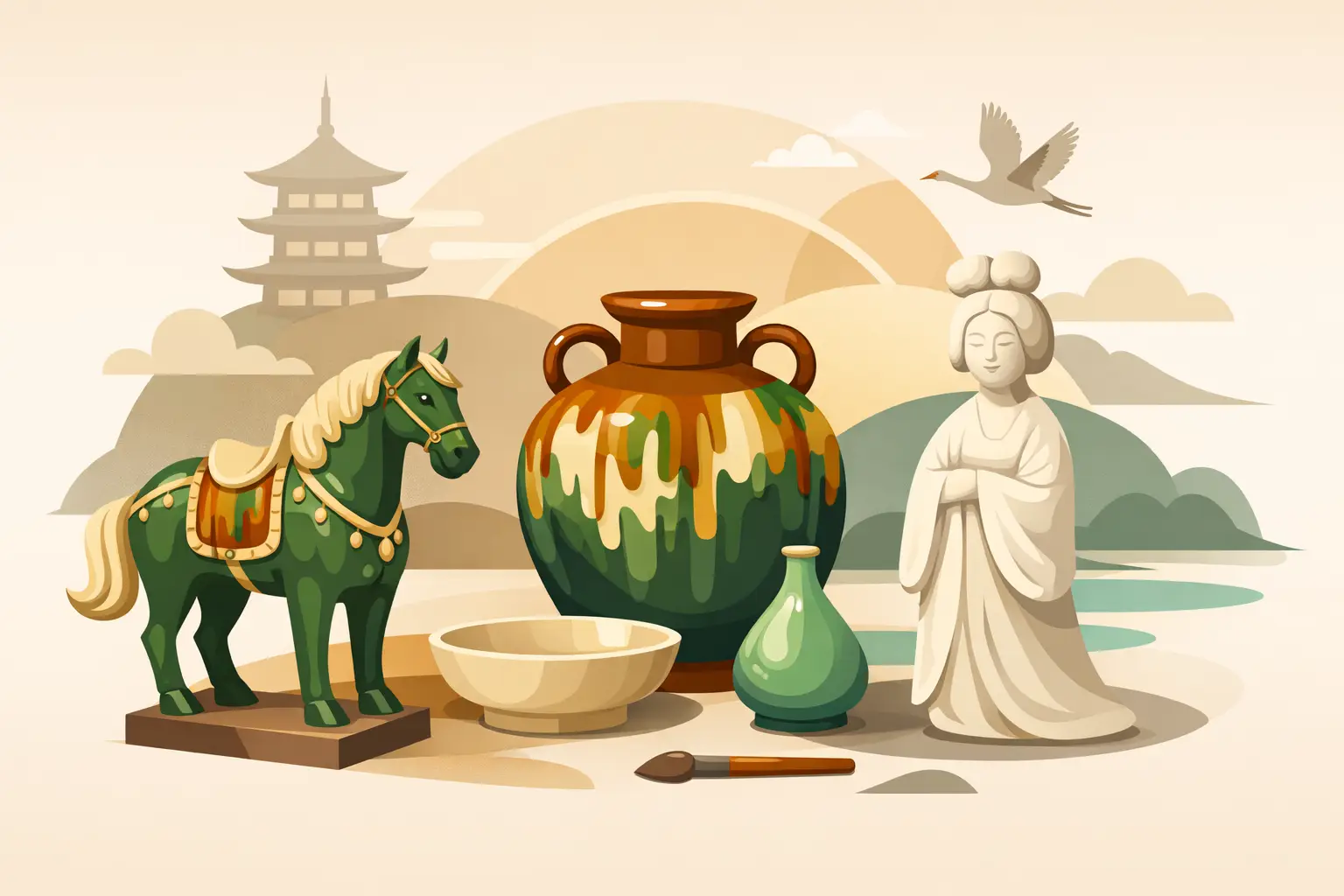
A second feature is technical variety. Tang kilns produced earthenware, stoneware and early high-fired wares, and the period is especially celebrated for sancai, the so-called three-colour lead-glazed ceramics. In practice, the palette often extends beyond three tones, but the name remains useful. These wares are admired for their flowing glazes and painterly unpredictability. No two pieces are exactly alike, and that sense of movement is part of their enduring appeal.
Then there is the matter of exchange. Tang China was deeply connected to Central Asia, the Middle East and maritime routes across Southeast Asia. Ceramic design absorbed outside influences without losing its own identity. Shapes inspired by metalwork, foreign drinking vessels and long-distance trade all left their mark. In that sense, Tang ceramics are not simply beautiful artefacts. They are evidence of a connected world.
Glaze, colour and surface in Tang dynasty ceramic features
If one visual element defines the public imagination of Tang ceramics, it is glaze. Sancai wares in particular are known for lead glazes that pool, streak and blend across the surface. Amber runs into green, cream breaks against darker edges, and the kiln does the rest. The result is less about strict pattern and more about controlled spontaneity.
This does not mean every Tang ceramic is brilliantly coloured. Some of the most refined pieces are restrained. Yue wares, for instance, are prized for their subtle greenish celadon tones and smooth stoneware bodies. Xing wares offer a different kind of prestige with pale, fine-bodied ceramics that anticipate later white wares. Looking only for dramatic colour can therefore give a partial picture of the period.
Surface treatment is equally revealing. Tang potters used moulding, incising, appliqué and painting, depending on the type of ware. Decorative motifs may include floral scrolls, birds, geometric borders and Buddhist or courtly themes. On figurines, the treatment of robes, harnesses, hair and facial expression can be remarkably sensitive. Even when made in quantity, the best examples retain individuality.
There is also a pleasing tension in Tang surfaces between refinement and energy. Some glazes appear polished and controlled, while others celebrate drips, uneven pooling and tonal shift. For modern viewers, this balance can feel especially compelling because it combines artistry with evidence of the firing process itself.
Forms shaped by court life, ritual and trade
Tang ceramics become more interesting when viewed in relation to how they were used. Many surviving pieces were made as mingqi, or burial goods, intended to accompany the dead. This helps explain the abundance of tomb figures, horses, camels and attendants associated with the period. These are not merely decorative objects. They express status, belief and the visual language of an empire at its height.
The horse is a particularly famous Tang subject. Strongly modelled and often richly glazed, ceramic horses suggest both military power and cosmopolitan sophistication. Camels, too, appear frequently, reflecting the importance of overland trade and the Silk Roads. Some carry foreign riders or musicians, making visible the movement of people and culture across regions.
Domestic and ceremonial vessels tell another story. Ewers with elegant spouts, storage jars with broad shoulders, dishes with neatly turned foot rims and cups influenced by foreign metal shapes all point to a period responsive to changing habits of dining, pouring and display. The best Tang forms feel resolved from every angle, which is one reason they sit so comfortably in museum galleries today.
For visitors interested in maritime archaeology, export wares are especially telling. Ceramics travelled because they were practical, desirable and durable. When recovered from shipwreck contexts, they illuminate not just production in China but circulation across Asia. A bowl or jar is never only a vessel. It is also a witness to route, cargo, taste and risk.
Reading quality in Tang ceramics
Not every Tang piece was made to the same standard, and that distinction matters. High-quality examples tend to show assurance in potting, balance in form and a glaze application that feels intentional even when exuberant. Details such as the placement of handles, the crispness of moulded ornament and the relation between foot and body can tell an experienced eye a great deal.
Condition, of course, affects how we read a piece. Burial wares may show weathering, iridescence or losses. Marine-recovered ceramics can carry marks of long immersion. These traces are not always defects in the ordinary sense. In the right context, they become part of the object’s biography. For collectors and museum audiences alike, authenticity often lies not in perfection but in the visible survival of time.
It is also worth treating labels with care. Because Tang ceramics are highly admired, later copies and revival pieces exist. Some are honest homages, while others are more problematic. This is where provenance, connoisseurship and archaeological context become essential. A well-presented museum collection offers a valuable advantage here: it places the object within a broader story rather than asking the viewer to admire surface alone.
Why Tang ceramics still feel fresh
Part of the answer lies in their clarity. Tang potters understood how to make a profile feel inevitable, how to let glaze animate a form, and how to bring sculpture into daily objects. That visual confidence travels well across centuries.
Another reason is the period’s international character. Modern audiences often respond instinctively to objects that embody exchange. Tang ceramics do exactly that. They reflect imperial ambition, technical innovation and contact across land and sea. For a museum centred on shipwreck ceramics and the wider history of Asian trade, this makes them especially resonant. They sit naturally within a larger narrative of movement, encounter and enduring craftsmanship.
There is also a more human explanation. Tang ceramics reward slow looking. A jar may reveal its strength in the shoulder line. A figurine may become more affecting when seen from the side. A sancai glaze, lively at first glance, grows more complex as colours separate and merge across ridges and recesses. These are objects that continue to unfold.
Tang dynasty ceramic features in a museum setting
Seen in person, Tang wares offer something photographs rarely capture: scale, weight and presence. The slight asymmetry of a thrown body, the pooled edge of glaze, the warmth of fired clay beneath a thinner coating – these details restore the object as a made thing rather than an image of an artefact.
That is why context matters so much. In a heritage setting, a Tang ceramic can be appreciated not just as an isolated masterpiece but as part of a wider story about trade, taste and survival. At Straits & Oriental Museum, this approach invites visitors to read ceramics through both beauty and journey, which is where many of these pieces become most memorable.
For some, the appeal will be scholarly. For others, it will be emotional or aesthetic. Both responses are valid. Tang ceramics have lasted because they speak across those categories with unusual ease.
The next time you stand before a Tang bowl, ewer or sancai figure, look beyond age alone. Look for the boldness of the form, the intelligence of the glaze and the traces of a world in motion. That is where their real splendour begins.