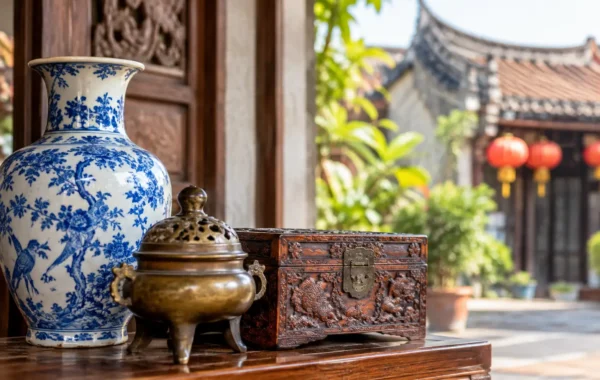


A cargo of finely made Chinese porcelain lay beneath the South China Sea for centuries, preserving a vivid record of trade at its height. Yet the question of what caused the Wanli shipwreck has no neat, final answer. No captain’s log has survived, no eyewitness account tells of its final hours, and the sea has altered much of the physical evidence. What remains is a compelling archaeological mystery shaped by monsoon waters, maritime risk and the extraordinary value of the cargo itself.
The Wanli wreck is generally associated with the early seventeenth century, during a period when Chinese export ceramics travelled in vast quantities through the trading networks of Southeast Asia. Its name refers to the Wanli era of the Ming dynasty, although the ship’s cargo is more precisely understood through the styles, kiln production and trade conditions of its time. Recovered ceramics offer remarkable evidence of the journey the vessel was making. They cannot, on their own, tell us precisely why it ended beneath the waves.
What Caused the Wanli Shipwreck?
The most accurate answer is that the exact cause remains unknown. Maritime archaeologists can assess clues from a wreck’s location, the condition and distribution of its cargo, surviving timbers and the character of the seabed. But a definitive cause – such as a named storm, collision, fire or navigational failure – requires evidence that is rarely preserved after four centuries underwater.
A sudden loss at sea is likely. Trading vessels carrying fragile, densely packed ceramics depended on favourable weather, skilled seamanship and safe passage through waters that could change rapidly. A serious storm, a grounding on an uncharted reef, damage to the hull, or a combination of these events could have overwhelmed a heavily laden ship with little warning.
It is tempting to choose one dramatic explanation. A storm makes immediate sense in the South China Sea, while a reef strike is equally plausible along complex coastal routes. However, responsible interpretation requires restraint. The Wanli wreck should be understood not as a solved disaster, but as a material record of a voyage interrupted.
The South China Sea Was a Highway of Opportunity and Hazard
The ship sailed within one of Asia’s great maritime corridors. By the seventeenth century, merchants, crews and cargoes moved between Chinese ports, the Malay Peninsula, the Indonesian archipelago, Siam, Vietnam and markets further west. The same routes that created prosperity also demanded careful timing and local knowledge.
Seasonal monsoon winds governed much of this movement. They made long-distance sailing possible, but they also imposed a schedule. A vessel caught in worsening conditions could face high seas, violent winds and reduced visibility. Wooden hulls were resilient, yet they were not invulnerable. Heavy cargo shifted in rough water, leaks could develop, steering became difficult and an attempt to find shelter could bring a ship dangerously close to shoals or reefs.
The location of a wreck matters greatly when considering the cause. If a vessel lies near a reef or coast, grounding becomes a stronger possibility. If it rests farther offshore, severe weather, structural failure or another emergency may deserve more attention. Even then, the evidence is rarely simple. Currents can move objects, storms can break apart a wreck after sinking, and salvage activity can disturb an original pattern that might otherwise explain the event.
A Cargo That Reveals Trade, Not the Final Moment
The Wanli shipwreck is especially significant because of its porcelain cargo. Blue-and-white wares, everyday vessels and more decorative objects were not merely beautiful possessions. They were commercial goods, made for buyers across maritime Asia and beyond. Their forms, motifs and quantities reveal a sophisticated export economy in which ceramics functioned as desirable, durable and recognisable trade commodities.
Cargo can also offer limited clues about a sinking. A tightly stowed load may suggest a vessel prepared for a planned commercial passage. Large accumulations of ceramics can indicate where storage areas once stood. Broken pieces, scattered stacks and areas of compression may show how a ship settled or collapsed on the seabed.
But these signs must not be overread. A bowl broken by the force of a sinking may look much like a bowl damaged centuries later by currents, corrosion of surrounding materials or disturbance on the site. Porcelain survives remarkably well, while the timber, rope, sailcloth and personal possessions that might explain a catastrophe often decay. The very durability of ceramic cargo is why it survives to be admired today – and why the story of the ship itself remains incomplete.
Could Overloading Have Played a Part?
A vessel carrying a valuable cargo was likely loaded with commercial ambition in mind. That does not automatically mean it was dangerously overloaded. Merchants and captains understood weight, balance and the demands of long voyages, even if their methods differed from modern shipping practice.
Still, a full cargo could make a crisis harder to manage. A loaded ship sat deeper in the water, responded differently in heavy seas and had less margin for error if water entered the hull. In poor weather, every practical decision mattered: whether to press on, turn back, reduce sail or seek shelter. Overloading is possible in principle, but without firm evidence of the vessel’s dimensions, ballast and complete cargo arrangement, it remains speculation rather than a proven cause.
Was It a Storm, Grounding or Fire?
Storms, groundings and onboard fires are among the most common explanations considered for historic shipwrecks. Each leaves different traces, though time and seawater can obscure them.
A grounding may produce hull damage concentrated in a particular area and place the wreck close to a navigational hazard. A storm might be inferred from an exposed setting, widespread breakage or a rapid loss of control, though none of these is conclusive by itself. Fire can sometimes leave charred timbers or heat-altered materials, but such evidence needs careful scientific assessment before it is treated as proof of a blaze.
For the Wanli shipwreck, it is wiser to see these as informed possibilities rather than competing certainties. The sea did not preserve a verdict. It preserved fragments of a voyage: ceramics intended for exchange, traces of a working vessel and a site that continues to invite study.
Why Uncertainty Is Part of the Story
Visitors often expect shipwreck archaeology to provide a final revelation. Occasionally it can. More often, its value lies in building a credible account from incomplete evidence. This is not a weakness. It is what makes recovered artefacts so powerful. A porcelain dish can be dated, attributed to a kiln tradition, compared with related examples and placed within a wider pattern of trade. It can tell us where it was made, how it travelled and what distant markets desired. Yet it also carries the silence of the ship that carried it.
That silence asks us to look more closely. The Wanli wreck belonged to an era when the seas connected communities, cuisines, artistic tastes and commercial fortunes across the region. Its loss reminds us that maritime trade was never an abstract network on a map. It depended on crews making difficult decisions in changeable conditions, aboard vessels exposed to the full force of the sea.
At Straits & Oriental Museum in George Town, shipwreck ceramics offer a rare opportunity to encounter this history at human scale. Their glaze, painted detail and occasional imperfections bring an interrupted journey into the present. They are objects of refinement, but they are also survivors.
The most meaningful response to the question is therefore not a single dramatic cause. The Wanli shipwreck likely resulted from one of the enduring dangers of seafaring, perhaps intensified by weather, navigation and a heavily laden vessel. Until new evidence emerges, its unresolved ending remains part of its cultural value: an invitation to appreciate each recovered piece not simply as porcelain, but as a witness to an unfinished voyage.