
George Town rewards the curious visitor. Behind its shophouse façades, grand residences and hillside fortifications are collections that make Penang’s past tangible: trade routes, migration, domestic life, resistance and craft. So, what are the best museums in Penang? The answer depends on whether you are drawn to rare objects, architecture, family history or a more immersive day out, but these seven offer a memorable route into the island’s many stories.
What are the best museums in Penang for a meaningful visit?
The strongest museum visits do more than provide a pleasant hour indoors. They give context to the streets, food and communities encountered outside. A ceramic bowl recovered from the sea can reveal a trading network; a tiled courtyard can speak of a family’s social world; an old bunker can make wartime history feel uncomfortably close.
For visitors with limited time, choose one museum that matches your interests rather than trying to rush through several. George Town’s heritage core is best experienced at an unhurried pace, with time to notice the details between stops.
1. Straits & Oriental Museum
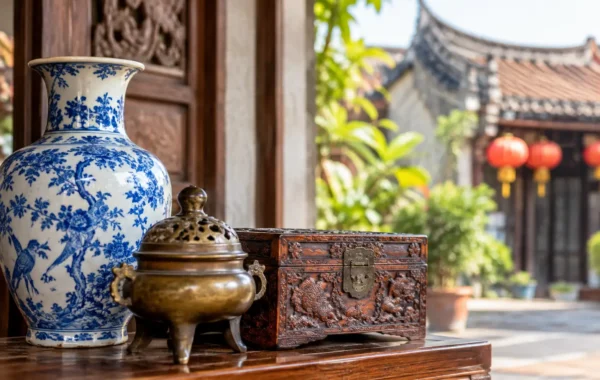
For a museum experience shaped by the sea, Straits & Oriental Museum offers a singular starting point. As Penang’s first museum dedicated to this kind of collection and Malaysia’s first integrated heritage and lifestyle museum, it brings maritime archaeology into a setting designed for lingering, conversation and discovery.
Its permanent displays centre on authentic porcelain and ceramic artefacts recovered from significant Asian shipwrecks, including the Wanli, Turiang, Royal Nanhai, Nanyang, Xuande and Desaru. These are not replicas arranged to suggest history. They are objects that travelled across maritime Asia centuries ago, carrying evidence of craftsmanship, commerce and the astonishing reach of regional exchange.
The appeal lies in both rarity and perspective. A visitor can admire the colour, form and condition of a vessel, then consider the voyage that left it on the seabed and the world that produced it. With gallery spaces, dining, drinks and a gift house alongside the museum experience, it suits travellers seeking a cultured afternoon rather than a quick, conventional gallery stop.
2. Pinang Peranakan Mansion
Pinang Peranakan Mansion is one of the most visually rich introductions to Peranakan culture in Penang. Set within a lavishly restored residence, it presents the domestic world of the Straits Chinese community through furniture, jewellery, clothing, porcelain, carved screens and ceremonial objects.
The house itself is central to the experience. Chinese, Malay and European influences meet in its architecture and decoration, reflecting a culture formed through generations of movement, adaptation and local belonging. It is easy to be captivated by the opulent interiors, but look beyond the photographs: the objects reveal how families marked weddings, entertained guests and expressed status.
This is an excellent choice for first-time visitors to George Town, particularly those who want an immediate sense of the city’s layered cultural identity. It can be busy at popular times, so an earlier visit often allows for a more contemplative look at its rooms and collection.
3. Cheong Fatt Tze, The Blue Mansion
Part historic house, part architectural masterpiece, Cheong Fatt Tze’s Blue Mansion is best approached as a guided encounter with one extraordinary life and property. The indigo-blue façade is instantly recognisable, but the real value of a visit lies in understanding the design principles, craftsmanship and social ambition behind the building.
Constructed for the Chinese merchant Cheong Fatt Tze, the mansion combines Chinese courtyard-house traditions with local materials and influences from a trading port open to the world. Guides bring its spaces alive with stories of family, business and restoration, making it particularly rewarding for visitors who enjoy architecture as much as artefacts.
Because entry is usually structured around guided tours, it requires a little more planning than a walk-in museum. That is also its strength: the interpretation gives the house texture and prevents the visit from becoming merely a stop for exterior photographs.
4. Penang War Museum
On Penang Hill’s southern side, Penang War Museum offers a markedly different atmosphere. Located at a former British fortress, the site preserves gun emplacements, tunnels, barracks and other remnants associated with the Second World War and the Japanese occupation.
This is not a polished salon-style museum. Its scale, outdoor setting and physical remains make history immediate, especially when visitors stand in spaces built for defence and confinement. The experience can be sobering, and it is not the most suitable choice for everyone, particularly very young children or those uncomfortable with unsettling historical material.
Allow more time than you might for a city museum. The grounds are extensive, weather can be hot and the terrain is part of the visit. For travellers interested in military history or the wider history of Malaya during the war, however, it provides vital context that should not be overlooked.
5. Sun Yat-sen Museum Penang
Tucked within an atmospheric heritage building, Sun Yat-sen Museum Penang tells a story that reaches far beyond the island. The house is associated with Dr Sun Yat-sen’s revolutionary activities and illuminates Penang’s role in the overseas Chinese networks that supported political change in early twentieth-century China.
It is a smaller, more intimate museum than the grand mansions on many visitors’ lists. That is precisely why it is rewarding. The rooms encourage a closer reading of the city as a place connected to ideas, fundraising, organising and international movements, not simply a picturesque colonial-era port.
Choose this museum if you enjoy political history and personal stories, or if you are returning to George Town and want to move beyond its most familiar heritage attractions. It pairs well with a slow walk through the surrounding streets, where the sense of an active historic neighbourhood remains strong.
6. Batik Painting Museum Penang
Batik Painting Museum Penang brings attention to a distinctly Malaysian art form through works by pioneering artists and later practitioners. Rather than treating batik solely as fabric or souvenir material, the museum frames it as a medium of artistic expression, capable of bold colour, fine detail and striking modern composition.
For collectors, art lovers and visitors interested in Southeast Asian visual culture, this is a valuable counterpoint to George Town’s house museums. Look closely at how wax-resist techniques shape line and texture, and how artists use traditional processes to create landscapes, figures and abstract scenes.
The visit is generally shorter than a large historical museum, making it ideal as part of a broader day in the heritage zone. It also offers a useful reminder that Penang’s cultural life is not confined to the distant past: living traditions continue to be reinterpreted by artists.
7. The Camera Museum
The Camera Museum appeals to anyone who has ever wondered how images moved from the darkroom to the pocket. Its collection traces the development of photographic equipment, with cameras and related objects that reveal changing technologies and changing ways of seeing.
It is an accessible choice for families, design enthusiasts and visitors looking for a lighter historical stop between more demanding sites. Older cameras have a satisfying material presence: polished metal, leather cases, mechanical dials and lenses that make the process of image-making feel deliberate.
Do not expect the depth of a national photography archive. Instead, treat it as a compact, engaging collection that sparks curiosity. It works particularly well for visitors who enjoy objects with both technical ingenuity and visual charm.
How to choose the right Penang museum itinerary
A balanced museum day often combines one substantial historical visit with one more specialised collection. Pair the Peranakan Mansion or Blue Mansion with batik art, for example, or begin with shipwreck ceramics before exploring the streets that once prospered through maritime trade. If the War Museum is on your list, give it a dedicated half-day rather than trying to fit it between central George Town stops.
Opening hours, guided-tour schedules and temporary exhibitions can change, so confirm practical details before setting out. Modest clothing, comfortable footwear and a willingness to slow down will serve you well, especially at heritage houses and outdoor sites.
The finest museums in Penang leave visitors with more than photographs. Choose the one whose story stays with you, then carry that new perspective into the next street, meal and conversation of your time on the island.