
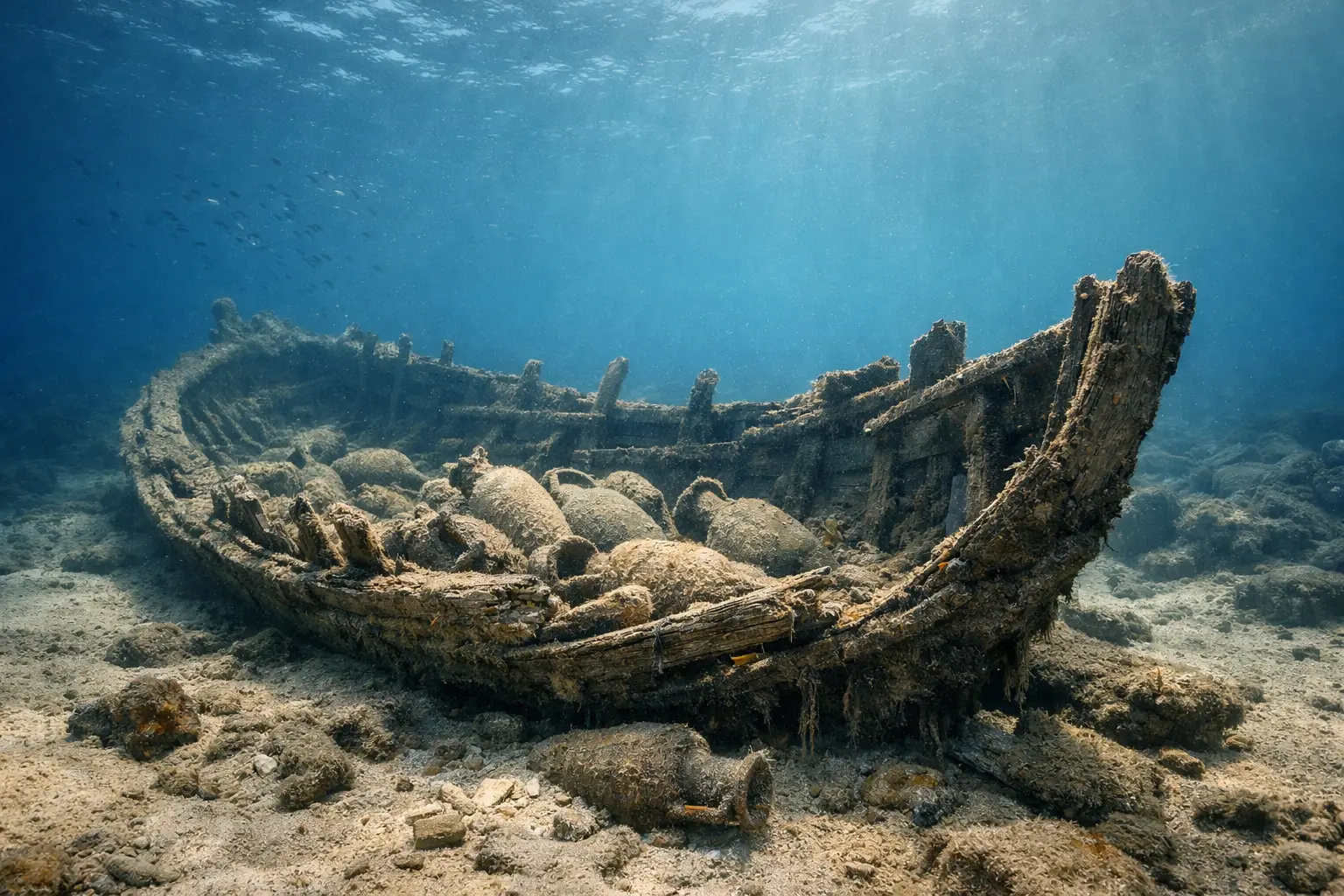

A broken hull on a dark seabed can reorder history. Ask what is the oldest shipwreck in the world, and the answer is not a neat one-line fact but a fascinating archaeological debate shaped by preservation, dating methods and the simple accident of what survives.
For visitors drawn to maritime history, this question matters because shipwrecks are not just lost vessels. They are time capsules. A wreck can preserve trade routes, craftsmanship, cargo, diet, ritual practice and the reach of entire civilisations in a way few land sites can. Yet the further back we look, the harder certainty becomes.
What is the oldest shipwreck in the world?
The most widely cited answer is the Dokos shipwreck, found off the Greek island of Dokos in the Aegean Sea. It is generally dated to around 2200 to 2000 BCE, placing it in the Early Helladic period. If that dating holds, Dokos is the oldest known shipwreck discovered so far.
That phrase – oldest known – is crucial. Archaeology deals in evidence, not absolutes. The sea has swallowed countless vessels over millennia, but only a very small number have been found, excavated and securely dated. So when people ask what is the oldest shipwreck in the world, they are really asking which wreck currently has the strongest claim based on surviving material.
Dokos has that claim because its cargo and context are unusually early. The wreck site yielded a large assemblage of pottery, including sauceboats, storage jars and other ceramic forms associated with mainland Greece during the Early Bronze Age. There is very little timber surviving from the vessel itself, which is typical for wrecks of such antiquity. In many ancient shipwrecks, the cargo outlasts the ship.
Why the answer is not as simple as it sounds
There is a difference between the oldest shipwreck ever to sink and the oldest one we can identify with confidence. Thousands of earlier boats almost certainly existed. Some may have foundered in rivers, estuaries or coastal waters long before the Dokos vessel sank. The problem is that early watercraft were often made of organic materials – wood, reeds, rope and pitch – that do not survive well unless conditions are exceptional.
Even when a wreck is found, dating it is rarely straightforward. Archaeologists may date the cargo, the ship’s timbers, associated organic remains or the sediment around the site. These methods can produce a date range rather than a single year. A cargo of pottery, for instance, tells us when the goods were made or in use, not necessarily the exact moment the vessel sank.
That is why scholars tend to speak carefully. Dokos is widely recognised, but maritime archaeology is a field where a new discovery can reshape the conversation overnight.
The Dokos shipwreck and its significance
The Dokos wreck matters not just because it is old, but because it sits at the threshold of organised seaborne exchange in the eastern Mediterranean. Its cargo suggests a working trade vessel, not a ceremonial craft or local fishing boat. That distinction is important.
By the late third millennium BCE, communities in the Aegean were already moving goods between islands and mainland centres. A wreck like Dokos points to regular traffic, practical seamanship and an economy linked by sea. It tells us that maritime networks were already sophisticated far earlier than many casual readers imagine.
The site also reminds us that ceramics are among the great storytellers of underwater archaeology. Pottery survives where textiles decay and timber vanishes. Its shapes, fabrics and firing methods help archaeologists identify place of origin, approximate date and patterns of distribution. For museums built around shipwreck ceramics, that is precisely where the sea begins to speak most clearly.
Could there be older contenders?
Possibly, yes. Some prehistoric boat remains and submerged finds are older than Dokos, but they do not always qualify in the same way. A preserved canoe in a peat bog, for example, is not the same as a seagoing shipwreck on the seabed. Likewise, isolated boat fragments do not provide the same level of evidence as a coherent wreck site with cargo and archaeological context.
There are also ancient Egyptian boats and funerary vessels that are older in date than Dokos. The boats buried beside royal tombs at Abydos, and the famous Khufu ship associated with the Great Pyramid, are extraordinary early watercraft. But they are not shipwrecks. They were intentionally buried or deposited on land for ritual purposes.
This is where definitions matter. If we define a shipwreck as a vessel lost in water and preserved as an archaeological site, Dokos remains the leading answer. If we broaden the question to include the oldest surviving boat of any kind, then other examples enter the discussion. The headline question sounds simple, but the categories beneath it are anything but.
How archaeologists decide the age of a wreck
Dating an ancient wreck is a careful exercise in combining clues. No single method always settles the matter.
Ceramic typology is one of the most useful tools. Pottery styles changed over time, and specialists can often place a jar, bowl or amphora within a surprisingly narrow chronological window. This is one reason cargo-rich wrecks are so valuable.
Radiocarbon dating can be used on organic remains such as wood, seeds, rope or bone, if any survive. It is powerful, but it has limits. Timber may have been reused, and radiocarbon results usually give date ranges rather than one exact point.
Stratigraphy also plays a role. Archaeologists study how objects are layered within marine sediments and whether the site has been disturbed by currents, anchors or human interference. A well-preserved site in stable conditions offers stronger evidence than a scattered field of displaced artefacts.
Finally, comparison matters. Maritime archaeologists rarely assess one wreck in isolation. They compare hull construction, cargo composition and artefact styles across regions and periods. Confidence grows when several lines of evidence point in the same direction.
Why ancient shipwrecks matter beyond the headline
The fascination with firsts is understandable. People naturally want to know the oldest, largest or richest discovery. Yet the deeper value of an ancient wreck lies in what it reveals about human movement and exchange.
A shipwreck shows that the sea was not a barrier but a corridor. It can reveal what people ate, what they traded, which ports they knew and what technologies they trusted. Cargoes of ceramics tell us about commerce, taste and daily life. Raw materials show the reach of supply chains. Personal possessions hint at the people on board, from merchants to sailors.
This is especially compelling in Asia and the wider Indian Ocean world, where shipwreck ceramics have transformed our understanding of regional trade. A bowl lifted from the seabed is not merely decorative. It can map centuries of movement between kilns, ports and distant consumers. That is part of the enduring appeal of collections such as those presented at Straits & Oriental Museum, where maritime archaeology is experienced not as a dry catalogue of objects but as a story of exchange, ambition and cultural encounter.
What the oldest shipwreck cannot tell us
It is tempting to expect a single wreck to explain an era. In reality, every site is partial. Dokos does not give us a complete picture of Bronze Age seafaring. It offers one moment, one cargo, one loss event. The ship’s crew, exact route and cause of sinking remain uncertain.
That uncertainty is not a weakness. It is part of what makes maritime archaeology so compelling. The sea preserves selectively. It keeps fragments, not full scripts. Scholars must read absence as carefully as presence.
There is also a preservation bias in the record. Wrecks found in calmer waters, under protective sediment or in zones with limited biological decay stand a better chance of survival. Others disappear almost entirely. So the oldest wreck we know may say as much about preservation luck as about the true beginnings of navigation.
So, what is the oldest shipwreck in the world really?
If you want the clearest current answer, it is the Dokos shipwreck off Greece, dated to roughly 2200 to 2000 BCE and widely regarded as the oldest known shipwreck yet discovered.
If you want the more honest answer, it depends on definitions, evidence and future discoveries. Older boats exist. Older losses almost certainly happened. But based on present archaeological consensus, Dokos remains the benchmark.
That is often how history works at sea. The most rewarding questions are not the ones with the neatest answers, but the ones that draw us closer to the people, objects and voyages that time nearly erased. The next wreck uncovered from sand or silt may move the date back further – and that possibility is reason enough to keep looking.