
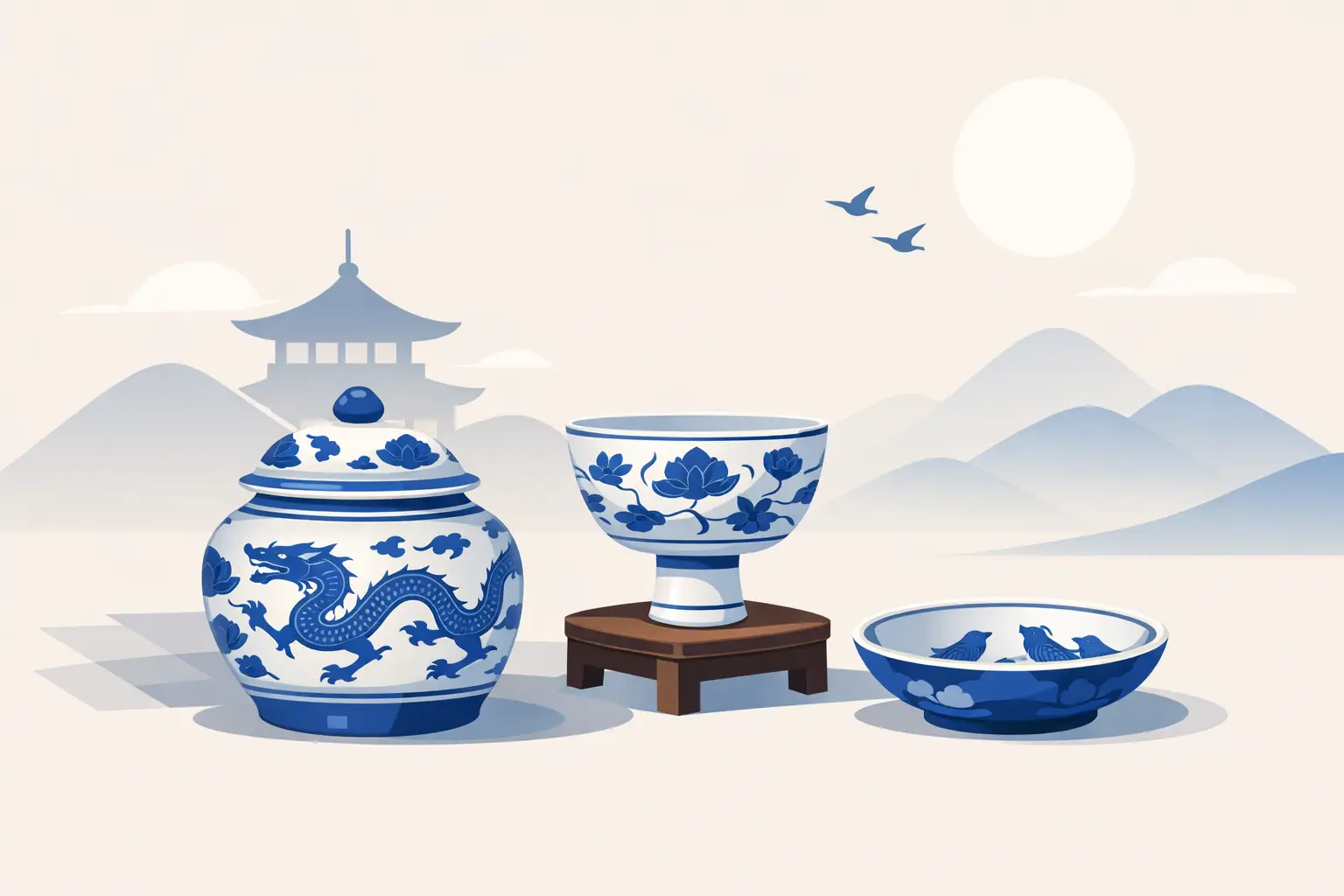

Few names in Chinese ceramics carry the same quiet authority as Ming Chenghua Mark and Period Porcelain. To collectors, curators and curious museum visitors alike, it signals a moment in imperial porcelain history when refinement mattered more than sheer display, and when elegance was often expressed through restraint rather than excess.
Porcelain of the Chenghua reign, which lasted from 1464 to 1487 during the Ming dynasty, is prized not simply because it is old, but because it represents a distinctive aesthetic ideal. The finest pieces are celebrated for delicate potting, balanced form, controlled decoration and a painterly subtlety that later periods often admired and imitated. For that reason, the phrase “mark and period” carries real weight. It suggests that both the reign mark and the actual date of manufacture belong to the Chenghua era itself, rather than to a later homage.
What “mark and period” really means
In the world of Chinese ceramics, a reign mark on its own is never enough. Many later porcelains bear earlier marks out of respect, revivalism or commercial intent. A six-character Chenghua mark may appear on an object made decades, centuries or even much later than the fifteenth century.
When specialists describe an object as mark and period, they mean there is convincing evidence that the piece was made during the reign named in the mark. That judgement depends on the whole object – the body, glaze, footrim, enamel style, brushwork, proportions, firing quality and wear – rather than on the inscription alone.
This distinction matters because Chenghua porcelain was so admired that it became one of the most copied categories in later imperial production. Marks were repeated during the Kangxi, Yongzheng and Qianlong reigns, and again in later periods, often with considerable skill. A genuine Chenghua mark without a genuine Chenghua date is still historically interesting, but it is not the same thing.
Why Chenghua porcelain is so admired
The Chenghua period occupies a special place in ceramic history because it sits at the meeting point of technical confidence and artistic restraint. Earlier Ming wares could be bold and commanding. Later imperial wares could be technically dazzling. Chenghua often feels more intimate.
The period is especially associated with fine doucai decoration, where underglaze blue outlines are combined with soft overglaze enamels. On the best examples, the result is not loud or crowded. Instead, there is a remarkable sense of space, control and lyrical detail. Small cups, bowls and dishes from the era can seem almost understated at first glance, yet that understatement is part of their prestige.
Collectors often respond to Chenghua porcelain because it rewards close looking. The palette is gentle, the compositions are poised, and the potting can be exceptionally light. Even when a piece is small, its presence is unmistakable.
Hallmarks of Ming Chenghua Mark and Period Porcelain
Recognising Ming Chenghua Mark and Period Porcelain requires patience. There is no single feature that proves authenticity, but several qualities tend to work together.
The body is usually fine and carefully potted, often with an elegant thinness that feels deliberate rather than fragile. Forms are balanced and refined. Glazes tend to have a soft, even surface rather than the hard brilliance associated with some later wares.
In underglaze blue pieces, the cobalt is often gentle in tone. It may appear somewhat muted compared with the stronger, more assertive blues of Xuande wares. On doucai examples, the overglaze enamels are characteristically soft and controlled, with iron-red, green, yellow and aubergine used in a measured way.
Brushwork is another key clue. Authentic Chenghua decoration often shows extraordinary confidence in miniature. Lines can be fine but alive, never stiff. Motifs such as flowers, birds, grapes, chickens and garden scenes are rendered with charm and clarity rather than mechanical precision.
The footrim and base also deserve close attention. Genuine fifteenth-century bases often show natural firing and age characteristics that are difficult to imitate convincingly. The recessed base, the texture of the unglazed foot, and the way the mark is written all contribute to the judgement.
The Chenghua mark itself
The standard Chenghua reign mark is usually written in six characters: Da Ming Chenghua Nian Zhi – “Made in the Chenghua reign of the Great Ming”. It may appear in underglaze blue or, more rarely, in overglaze script depending on the ware type.
Yet even a beautifully written mark should be treated with caution. Later copies can be excellent. Specialists therefore look at calligraphy in relation to the object, not in isolation. On genuine pieces, the mark often has a natural fluency and spacing that feels integral to the vessel. On later imitations, the script may be too careful, too neat, too heavy or simply inconsistent with the period style of the porcelain itself.
There is also an irony at the heart of Chenghua collecting. Some of the most famous Chenghua wares are unmarked, while some boldly marked wares are later tributes. A mark can support an attribution, but it cannot carry it alone.
Why later periods copied Chenghua so often
Chenghua porcelain became a benchmark of taste within China itself. By the Qing dynasty, imperial kilns looked back to Chenghua as an ideal of refinement. That admiration was not always deceptive. In many cases, later wares bearing Chenghua marks were respectful recreations made for court appreciation.
This is why identification is rarely a simple matter of genuine versus fake. Some later pieces are high-quality historical works in their own right. A Yongzheng or Qianlong porcelain with a Chenghua mark can be exceptionally beautiful and highly collectible, even though it is not a Chenghua-period object.
For museums and collectors, the real task is accuracy. Dating a piece correctly deepens its story. A later homage tells us about imperial taste, collecting culture and the continuing prestige of Chenghua porcelain across centuries.
Forms and decoration most associated with Chenghua porcelain
Small-scale wares are particularly important in this period. Cups, stem cups, dishes and delicate bowls are among the forms most closely associated with Chenghua taste. The famous “chicken cups” are perhaps the most celebrated examples, with intimate domestic scenes painted in refined doucai enamels.
Floral sprays, fruiting vines, children at play, birds in landscape settings and neatly composed auspicious motifs also appear. What unites many of these designs is a sense of proportion. Decoration is rarely allowed to overwhelm the form. Empty space is used intelligently, giving the porcelain a calm visual rhythm.
That balance is one reason Chenghua pieces remain so compelling in display. They do not shout for attention, yet they hold it.
How specialists judge authenticity
No serious authentication should rely on photographs alone, especially for an area as heavily copied as Chenghua. Experts compare documented examples, examine the ceramic body under magnification, assess enamel behaviour, study kiln characteristics and consider provenance where available.
Wear can help, but it can also mislead. Artificial ageing is common. Similarly, excavation or marine contexts may alter a surface dramatically, but such changes need informed interpretation. In collections shaped by maritime history, the journey of an object can add another layer of complexity. Shipwreck ceramics, burial conditions, storage environments and restoration history all affect appearance.
That is why the strongest attributions come from cumulative evidence. The question is never simply, “Does this look old?” but “Does every part of this object behave like a fifteenth-century Jingdezhen imperial porcelain?”
Rarity, value and caution for collectors
Authentic Chenghua mark and period pieces are rare. Imperial wares of the reign were produced for a court environment, and survival rates are limited. The most desirable examples can command extraordinary prices, especially if they combine excellent condition, recognised form, fine decoration and secure provenance.
But high value also attracts risk. The market includes later period copies, workshop imitations, altered pieces and objects with optimistic attributions. For newer collectors, the wisest approach is to move slowly, study widely and treat claims of Chenghua date with healthy caution.
Condition also matters in nuanced ways. Minor rim fritting or expected wear may be acceptable in very early porcelain, while heavy restoration, repainting or reground surfaces can affect both scholarly and market value. An untouched later-copy piece may, in some circumstances, be more desirable than a damaged object misrepresented as period Chenghua.
Why Chenghua still matters to museum visitors today
Chenghua porcelain rewards more than connoisseurship. It tells a wider story about imperial taste, kiln excellence, artistic continuity and the long afterlife of admired objects. When visitors encounter porcelain of this calibre in a museum setting, they are not just seeing luxury. They are seeing how beauty travels through time – preserved in court collections, copied by later dynasties, traded across seas and studied anew by each generation.
For institutions shaped by maritime heritage, that story carries particular resonance. Ceramics were among the great travellers of the premodern world, moving through ports, shipwrecks, palaces and private collections. To understand Chenghua porcelain is to understand how one refined artistic language could echo far beyond its kiln of origin.
The most rewarding way to approach it is with a slow eye. Look at the line of a rim, the softness of a glaze, the confidence of a painted leaf, the restraint of a composition. In porcelain of true distinction, the smallest details often speak the loudest.