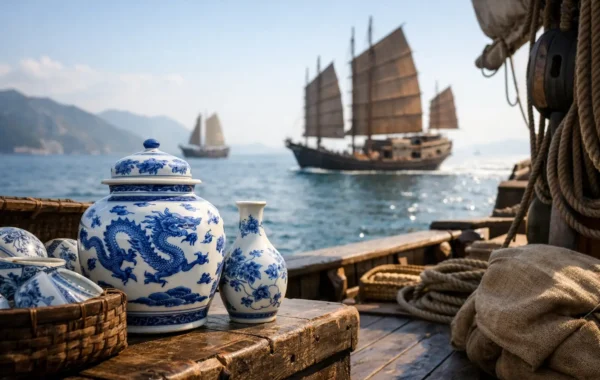


A Ming dish can appear startlingly modern: a white surface, a confident sweep of cobalt, a dragon or flowering branch painted with extraordinary economy. Yet the object carries far more than beauty. It may have passed through an imperial kiln, a merchant’s warehouse, a storm at sea, and centuries beneath the water before arriving in a gallery case. For travellers wondering where to see Ming ceramics, the most rewarding answer is not simply the museum with the largest collection. It is the place that lets you understand how porcelain shaped courts, kitchens, trade routes and the cultural life of Asia.
The Ming dynasty, which ruled China from 1368 to 1644, produced ceramics of remarkable technical range and global influence. A thoughtful itinerary should therefore include both major Chinese collections and museums in Southeast Asia, where shipwreck cargoes reveal the commercial journeys that brought Chinese ceramics into the wider world.
Begin with the imperial story in Beijing
For a close encounter with the pinnacle of Ming court porcelain, the Palace Museum in Beijing is a defining destination. Within the former Forbidden City, its imperial collections place ceramics in the world for which many of the finest examples were made: a highly ordered court where colour, motif, inscription and form could all carry meaning.
Look for blue-and-white wares, especially pieces associated with the Xuande and Chenghua reigns. Xuande porcelain is admired for its rich cobalt blue, balanced shapes and lively designs, while Chenghua pieces are celebrated for delicacy and restraint. The famous doucai style, in which outlines are painted in underglaze blue before coloured enamels are added, shows just how sophisticated Ming kiln technology became.
This is not necessarily the easiest stop for a short holiday itinerary, and galleries rotate displays. But it is difficult to match the authority of seeing imperial ceramics in the heart of the dynasty’s ceremonial capital. Take time with the labels and the objects themselves. The smallest cup may reveal as much about refinement, ritual and royal taste as a monumental vase.
See the kilns behind the masterpieces in Jingdezhen
If Beijing explains who commissioned Ming porcelain, Jingdezhen explains how it was made. The city in Jiangxi province was China’s great porcelain centre, supplying the imperial court while producing wares for domestic and overseas markets. It remains a living ceramics city, making it an especially compelling choice for visitors who want process as well as spectacle.
Museum collections and kiln-site interpretation in Jingdezhen can bring technical details to life: the preparation of porcelain stone and kaolin, the shaping of a vessel on the wheel, the application of cobalt under the glaze, and the exacting heat of the kiln. Ming ceramics were never merely decorative objects. They were the result of specialised labour, controlled materials and hard-won knowledge.
Jingdezhen is best for the curious visitor willing to look beyond the headline masterpiece. The trade-off is that it may feel less immediately grand than a palace collection. In return, it offers a stronger sense of the hands, workshops and firing chambers behind the porcelain that travelled across the world.
Where to see Ming ceramics through maritime trade
Ming porcelain was one of Asia’s great travelling luxuries. Bowls, jars, dishes and ewers left Chinese ports in vast quantities, carried aboard merchant vessels to ports throughout Southeast Asia and beyond. Shipwreck collections are therefore essential to understanding the story. They preserve groups of objects as they were packed for trade, rather than as later collectors chose to display them.
This changes the questions a visitor can ask. Instead of admiring a single exceptional bowl, you can consider why hundreds of related pieces were produced, who was expected to buy them, and how their decoration was adapted for particular markets. A cargo may include practical storage jars alongside finely painted tableware, reminding us that maritime commerce mixed utility, status and taste.
At Straits & Oriental Museum in George Town, authentic ceramics recovered from Asian shipwrecks offer this wider seaborne perspective. Displays associated with vessels including the Wanli and Xuande shipwrecks place porcelain within the dramatic realities of navigation and exchange. Here, the appeal lies not only in the splendour of the ceramics but in their survival: objects once intended for circulation, interrupted by the sea and returned to tell a different history.
For visitors to Penang, this is an opportunity to see Ming-era trade as a regional story rather than a distant chapter in Chinese art. It also suits families and first-time museum-goers particularly well. A shipwreck is an immediate human narrative, and it opens a natural conversation about voyages, risk, markets and the enduring allure of porcelain.
Look for regional collections in Southeast Asia
Southeast Asian museums can provide a valuable counterpoint to collections in China because the region was not simply a destination for imported goods. It was an active network of ports, patrons, traders and local ceramic traditions. Ming wares reached households, religious sites and royal centres in forms that reflected local preferences.
When visiting a regional collection, notice the shapes and decorative vocabulary. A large blue-and-white dish may have been made for communal dining or display. A covered box, kendi or storage jar may speak more directly to everyday use and local customs. Export porcelain is sometimes dismissed as less important than imperial ware, but that misses its achievement. These objects connected makers in China with consumers separated by thousands of miles, often through designs that had to be legible and desirable in many places at once.
The best regional displays make room for this complexity. They do not treat ceramics as isolated treasures. They show how objects moved with spices, textiles, metalware and people, and how a port city’s cultural identity was formed through contact.
What to look for when you are in the gallery
You do not need specialist knowledge to enjoy Ming ceramics, but a few visual cues can make a visit more satisfying. Blue-and-white porcelain is the natural starting point. Its blue decoration sits beneath a clear glaze, giving the painted surface a luminous depth that became popular across the world. Look closely at the brushwork: a vigorous dragon, a soft wash on a leaf or a border of repeating scrolls can reveal an artist’s pace and confidence.
Then pay attention to form. A porcelain vessel was designed to be held, filled, poured from or displayed. The foot rim, thickness of the body and curve of the lip are not minor details. They help distinguish a finely made object from a more functional commercial piece, while also suggesting its intended use.
Marks and reign names deserve a little caution. A mark may honour an earlier emperor, indicate a workshop tradition or be a later addition. Museums with strong interpretation will distinguish between a piece made during a reign and one bearing that reign’s mark. When in doubt, ask a gallery attendant or read the object label slowly. Ceramics reward close looking, not rushed certainty.
Plan a visit that leaves room for surprise
For the richest experience, choose one major imperial or kiln-centre collection and one maritime or regional museum. That pairing makes the contrasts clear: courtly perfection beside commercial abundance, controlled production beside perilous passage, a single treasured masterpiece beside a cargo of objects meant to be used.
It also helps to visit with a question in mind. Which pieces were made for the emperor, and which were made for trade? How did an object’s journey change its meaning? Why did blue-and-white decoration become so recognisable across cultures? A museum visit becomes more memorable when porcelain is seen not as a static relic, but as evidence of ambition, craftsmanship and movement.
Before leaving the gallery, find one piece that stays with you and study it for another minute. Its surface may be calm, but its story is likely to contain a kiln fire, an ocean crossing and a world of people who believed beautiful things were worth carrying far from home.