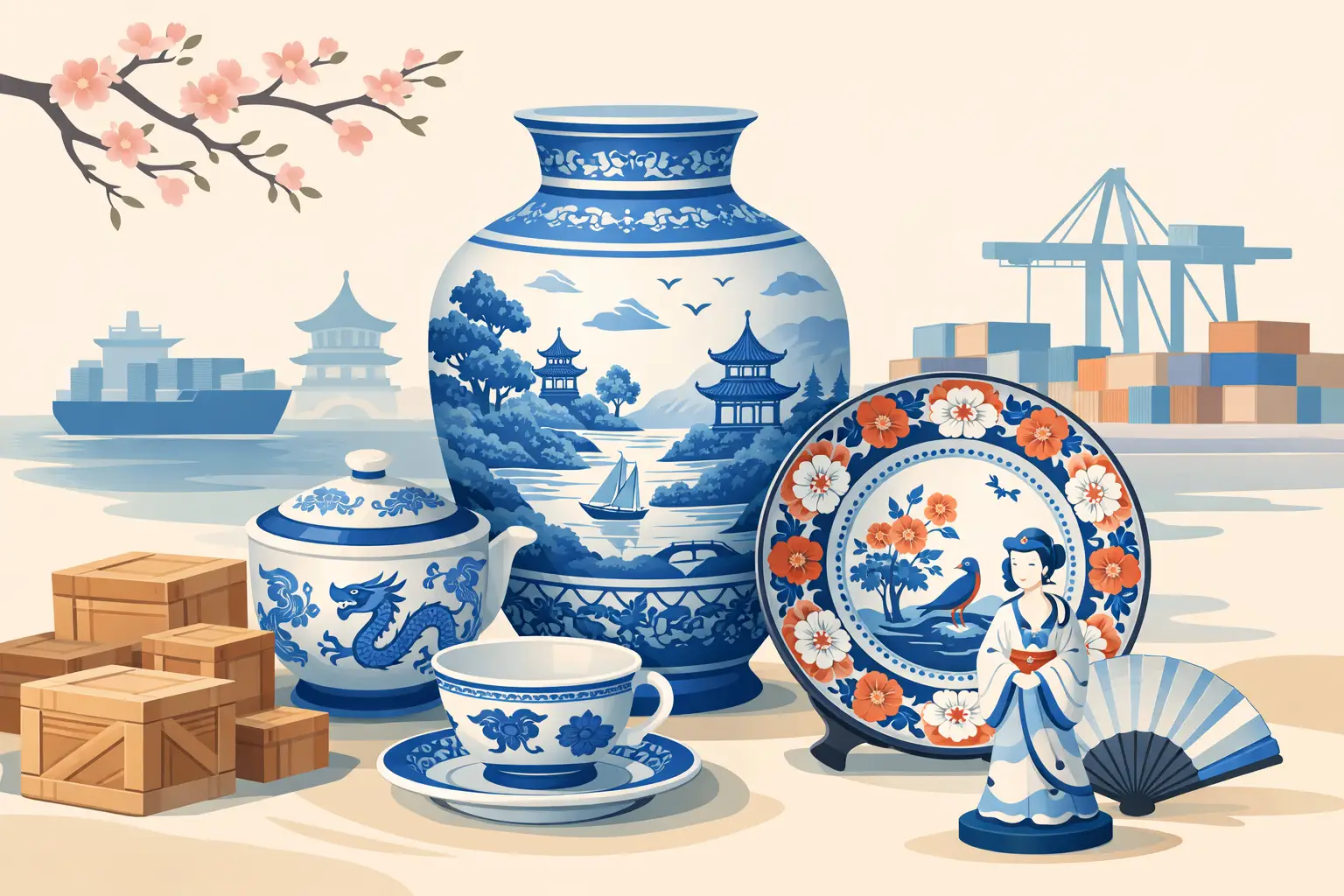

A bowl painted for a Dutch table, a charger made for a Persian court, a tea set shaped to suit British habits – Chinese export porcelain was never simply made in China and sent abroad. It was created through exchange: of taste, technology, trade, and ambition. That is what makes any guide to Chinese export porcelain so compelling. These objects are not only beautiful ceramics. They are evidence of the world becoming connected, one cargo hold at a time.
For visitors drawn to maritime history, collectors fascinated by provenance, and curious travellers seeking stories behind the surface, Chinese export porcelain offers an unusually rich way into the past. It sits at the meeting point of artistry and commerce, luxury and everyday use, empire and appetite. To understand it is to understand how Asia shaped global taste for centuries.
What Chinese export porcelain actually means
Chinese export porcelain refers to wares produced in China specifically for overseas markets. That definition sounds straightforward, but the category is wider and more nuanced than many people expect. Some pieces were made to suit European dining customs, some followed Islamic preferences for shape and decoration, and others were adapted for Southeast Asian buyers whose tastes had long been part of regional trade.
Most were made in Jingdezhen, the great porcelain centre of China, then decorated either there or in port cities once orders became more specialised. The finest examples balanced technical mastery with commercial flexibility. Potters could produce traditional blue and white wares in enormous quantities, yet they could also respond to foreign commissions, armorial designs, and unusual forms requested by distant clients.
That adaptability is one reason export porcelain matters. It was never static. It changed as markets changed.
A short guide to Chinese export porcelain by period
If you are new to the subject, dates can feel daunting. It helps to think in broad trading eras rather than memorising every dynasty mark.
Ming export porcelain
Early export porcelain under the Ming dynasty established many of the visual cues people still associate with Chinese ceramics today, especially blue and white decoration. During the 16th and early 17th centuries, increasing maritime trade carried these wares across Asia, the Middle East, and eventually Europe. Kraak porcelain, with its panelled designs and lively painted motifs, became especially well known.
These pieces were often light, elegant, and clearly designed for movement in bulk trade. They have a distinct energy – less restrained than court wares, more responsive to market demand.
Transitional wares
The late Ming to early Qing period produced what many specialists find particularly exciting: transitional porcelain. Political instability in China affected kiln production, but it also led to experimentation. Decoration became more painterly, landscapes more dramatic, and figural scenes more expressive.
For collectors and museum visitors alike, transitional wares often feel unusually vivid. They show a moment when artistic freedom and commercial trade met under uncertain conditions.
Qing export porcelain
Under the Qing dynasty, export production expanded enormously. The Kangxi, Yongzheng and Qianlong reigns are especially important. This was the era of famille verte, famille rose, armorial porcelain, Mandarin palettes, and highly tailored commissions for European elites.
By this stage, export porcelain was not merely being sold abroad – it was being designed around foreign lifestyles. Tea, coffee and chocolate services appeared in forms that reflected new habits of consumption. Plates and tureens suited Western dining. Heraldic services carried family coats of arms. Chinese craftsmanship was serving a global market with extraordinary confidence.
Why maritime trade is central to the story
Chinese export porcelain cannot be properly understood on a shelf alone. It belongs to the sea as much as to the kiln. Merchant vessels, monsoon routes, private traders, chartered companies, and port cities all shaped what was made, what survived, and what the world desired.
Shipwreck ceramics make this especially tangible. A recovered cargo can show what was being traded at one precise moment – not what later collectors preferred, but what merchants actually loaded, packed and risked transporting. Quantities, shapes, stacking methods, and even breakage patterns reveal the practical reality of global commerce.
This is where the subject becomes more than decorative art. Porcelain was a travelling commodity, a prestige object, and a witness to maritime exchange. In collections connected to shipwreck archaeology, it regains that sense of movement and adventure.
How to recognise Chinese export porcelain
A reliable guide to Chinese export porcelain should make one point clear: identification is rarely about one detail. It is the combination of body, glaze, decoration, form, and context that matters.
Blue and white is the most familiar category, but not every blue and white piece was made for export. Look instead at whether the form reflects foreign use, whether the decoration follows known export patterns, and whether the painting style suggests workshop production for trade rather than court consumption.
The foot rim can be revealing. So can the paste and glaze quality. Export wares were made in many grades, from fine commissions to practical large-volume cargo. A slightly uneven finish does not necessarily mean poor quality – it may indicate efficient production for maritime trade.
Then there is decoration. Panelled borders, radiating motifs, European coats of arms, pseudo-Latin inscriptions, and shapes such as sauceboats or punch bowls can point firmly towards export intent. Yet there are grey areas. Some wares served both domestic and overseas demand. That is where provenance, excavation records, or comparison with documented examples becomes invaluable.
Common styles collectors and visitors encounter
Kraak porcelain remains one of the easiest export categories to recognise, with its segmented borders and brisk blue decoration. Swatow ware, often bolder and more spontaneous in painting, was widely traded across Southeast Asia and speaks to regional consumption beyond Europe.
Later Qing export wares include famille rose services, armorial dinner sets, and pieces decorated in patterns tailored to Western taste. Rose medallion and Canton enamels are familiar to many, though these tend to be later and more decorative than the earlier blue and white cargoes often associated with maritime finds.
Each category carries a different mood. Early trade ceramics can feel direct and ocean-bound. Later commission pieces reflect status, ceremony and domestic display. Neither is inherently better – it depends on what story you want the object to tell.
What affects value and significance
People often ask whether age alone determines importance. It does not. Rarity, condition, provenance, historical relevance, and market taste all play a part.
A chipped shipwreck bowl may hold more cultural value than an immaculate later plate if it comes from a documented cargo with strong archaeological context. Equally, a finely painted armorial service with traceable ownership can command attention because it connects Chinese manufacture to a specific European family and moment in trade history.
Condition matters, of course, but so does honesty. Marine encrustation, firing flaws, glaze wear, and stacking scars can be part of an object’s biography rather than simple defects. The trade-off is clear: pristine pieces may appeal more immediately, while excavated or historically grounded examples often carry deeper interpretive power.
Why these wares still captivate modern audiences
Chinese export porcelain rewards close looking. At first glance, one sees elegance. At second glance, adaptation. Then something larger appears: a map of global desire.
These objects tell us how people ate, entertained guests, signalled status, and imagined foreign cultures. They reveal how Chinese makers responded to outside demand without surrendering their own visual language. They show that globalisation is not a modern invention but a centuries-old conversation, sometimes graceful, sometimes uneven, always transformative.
For a destination shaped by maritime memory, this is more than academic interest. In George Town, where histories of trade, migration and exchange are woven into the urban fabric, export porcelain feels especially resonant. At places such as Straits & Oriental Museum, seen through the lens of shipwreck recovery and regional storytelling, it becomes possible to read porcelain not as isolated treasure but as part of a wider seaborne world.
The best way to approach Chinese export porcelain
Start with curiosity rather than categories. Ask who the object was made for, how it travelled, and what habits or aspirations it served. Notice whether it feels courtly, commercial, regional, or cosmopolitan. Let the form speak alongside the decoration.
And if one piece leads you towards a shipwreck cargo, a dynasty, a port city, or a trade route, follow that thread. Chinese export porcelain is at its most rewarding when it opens outward. Every dish, ewer or cup is part of a larger passage – from kiln to port, from sea to table, from history into the present.
The pleasure lies not only in admiring porcelain, but in recognising that each surviving piece once belonged to a world in motion.