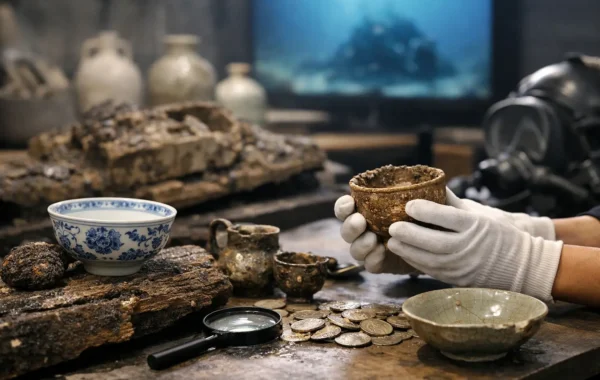

A porcelain bowl, resting for centuries beneath the sea, carries more than a beautiful glaze. It carries the ambitions of merchants, the skill of kiln workers, the appetite of distant households and the uncertain fate of a voyage across the monsoon routes. Chinese treasure in Penang is most compelling when seen in this wider light: not as a single precious object, but as physical evidence of Asia’s long conversation by sea.
For visitors to George Town, shipwreck ceramics offer an unusually direct encounter with that past. Their forms remain intimate – a dish that once held food, a jar made for storage, a cup intended for daily use – yet their survival is extraordinary. They invite us to look beyond the familiar story of Penang as a historic port and consider the maritime networks that shaped the region long before modern shipping lanes.
Chinese Treasure in Penang Has a Maritime Past
Chinese ceramics travelled widely because they were both useful and admired. From the great kiln centres of China, porcelain and stoneware moved through ports in vast quantities, carried aboard vessels bound for Southeast Asia, the Indian Ocean and beyond. Certain pieces were made for courtly taste; many others were produced for active commercial markets. Together, they reveal that trade was not only about luxury. It was about the objects people wanted in their homes, kitchens, places of worship and social rituals.
A shipwreck changes how we read these wares. In a palace collection, an individual bowl may be valued for its refinement or rarity. On a wreck site, it becomes part of a cargo. Its companions matter: stacks of similar dishes, storage vessels, glazed jars, coins, tools and the remains of the ship itself can reveal where a vessel travelled, who may have commissioned its goods and how maritime commerce was organised.
The sea is a harsh custodian, but it can preserve stories that would otherwise vanish. A vessel lost in a storm, on a reef or through navigational misfortune becomes a time capsule. Its cargo was never unpacked, sold, broken in a household or passed through generations. That arresting fact gives shipwreck ceramics a special emotional charge. They are objects caught between departure and arrival.
Why Porcelain Was Worth Carrying Across Oceans
The appeal of Chinese porcelain lies partly in technical achievement. A finely made body, controlled firing and luminous glaze transformed earth into something durable, elegant and often remarkably light. Blue-and-white decoration became especially recognisable across Asia, but the story is richer than one colour palette. Celadons, brown-glazed stonewares, white wares and painted ceramics each reflect changing fashions, kiln traditions and export demands.
For maritime traders, ceramics also made practical sense. They could be packed densely, protected in layers and sold in many ports. Large storage jars served shipping and domestic purposes alike, while bowls, plates and ewers met the needs of varied communities. A cargo could therefore be commercially broad, serving elite buyers alongside everyday consumers.
This is where easy assumptions deserve a pause. Not every ceramic on an Asian wreck was Chinese, and not every Chinese piece was rare when it left the kiln. Rarity today may result from survival, condition, provenance or historical importance rather than original cost. The greatest value of a wreck collection is often contextual. It shows how objects circulated, how tastes crossed borders and how closely the fortunes of coastal societies were connected.
A Journey Through the Wrecks
At Straits & Oriental Museum, authentic artefacts recovered from major Asian shipwrecks bring this maritime world into view. Collections associated with the Wanli, Turiang, Royal Nanhai, Nanyang, Xuande and Desaru wrecks create a journey across different periods, cargoes and trading environments.
The names themselves suggest the scale of the story. Each wreck belongs to a particular moment in the movement of goods and people across Asian waters. Seen together, the ceramics document shifts in design, manufacture and exchange. A visitor may notice a change in the curve of a vessel, the density of a painted motif or the tone of a glaze, then realise that such details can point towards a different kiln tradition, date or market.
This is not a collection that asks visitors to memorise every dynasty or technical term. It asks for closer looking. Why were some bowls made in sets? Why do certain jars have broad shoulders and small mouths? Why might a floral decoration have appealed to buyers far from the place where it was made? The answers connect art history with trade, food, ritual, status and the rhythms of port life.
The experience is especially meaningful in Penang. George Town has long been shaped by movement: communities arriving by sea, goods changing hands and cultural influences finding expression in architecture, cuisine and craft. Shipwreck porcelain does not stand apart from that living heritage. It helps explain the wider maritime world from which a place like Penang emerged.
How to Look at a Shipwreck Ceramic
The most rewarding museum visits begin with attention rather than expertise. Start with the object’s silhouette. A wide plate, a small cup and a heavy jar were designed for different uses, and their shapes often tell the first part of the story. Then look at the surface. Is the decoration painted beneath a clear glaze, carved into the body or created by the glaze itself?
Next, consider repetition. A single dish may be beautiful, but a group of nearly identical dishes indicates production on a commercial scale. Small differences are revealing too. They can show the hand of a painter, the variation of a firing or the realities of making thousands of pieces for trade.
Finally, imagine the object in motion. Before it became an artefact, it was cargo. It was packed, loaded, carried through changing weather and expected at a destination. That imagined journey does not replace scholarship; it gives the evidence human scale. A ceramic vessel becomes part of a chain of labour stretching from clay beds and kilns to warehouses, ships and marketplaces.
Beauty, Provenance and the Collector’s Eye
Collectors are often drawn first to visual distinction: a radiant glaze, an unusual form, a finely painted scene. Those qualities matter, but shipwreck material introduces another consideration – provenance. Knowing that a piece comes from a documented maritime context can deepen its historical significance and help distinguish a compelling artefact from an attractive object without a clear story.
Condition also needs thoughtful judgement. Sea burial can leave deposits, wear or encrustation. For some buyers, a pristine surface is the priority. For others, traces of the underwater environment are part of the object’s identity. Neither view is automatically right. It depends on whether one values decorative perfection, archaeological character, scholarly context or a combination of all three.
That distinction matters for any visitor considering antique ceramics. Age alone does not establish importance, and beauty alone does not establish authenticity. The strongest appreciation comes from asking informed questions about origin, material, condition and history. A well-presented collection makes those questions feel inviting rather than intimidating.
More Than a Display Case
The pleasure of heritage is not confined to quiet observation. A meaningful cultural outing leaves room for conversation, reflection and the simple enjoyment of being somewhere distinctive. An integrated museum setting allows a visit to continue naturally through art, food, drinks and considered keepsakes, turning an encounter with the past into a fuller day in the city.
For families, the objects can open lively discussions about voyages, weather, maps and the lives of people on board. For travellers, they offer a more tangible way to understand the Straits than a photograph ever could. For seasoned museum-goers and collectors, the chance to examine authentic maritime artefacts provides the depth that a conventional souvenir stop cannot offer.
The next time a painted porcelain dish catches your eye, linger over its quiet improbability. It survived the kiln, the voyage and the sea, then arrived centuries later with a story still waiting to be read.