
A single porcelain bowl can hold more than enamel and clay. In the right light, famille rose porcelain carries court taste, export ambition, changing trade routes and the refined habits of the tables and cabinets it once adorned. That is part of its enduring appeal – it is decorative, certainly, but it is also a record of how Asia’s ceramic traditions travelled, adapted and dazzled across centuries.
For visitors drawn to objects with both beauty and biography, this wares group has a particular magnetism. Its surfaces are immediately inviting: soft pinks, opaque whites, luminous greens, iron reds and gilt details arranged in scenes of flowers, birds, landscapes or auspicious symbols. Yet the real fascination begins once you look beyond colour and ask why this style emerged, how it was made and what separates a finely painted piece from one that is merely attractive.
What is famille rose porcelain?
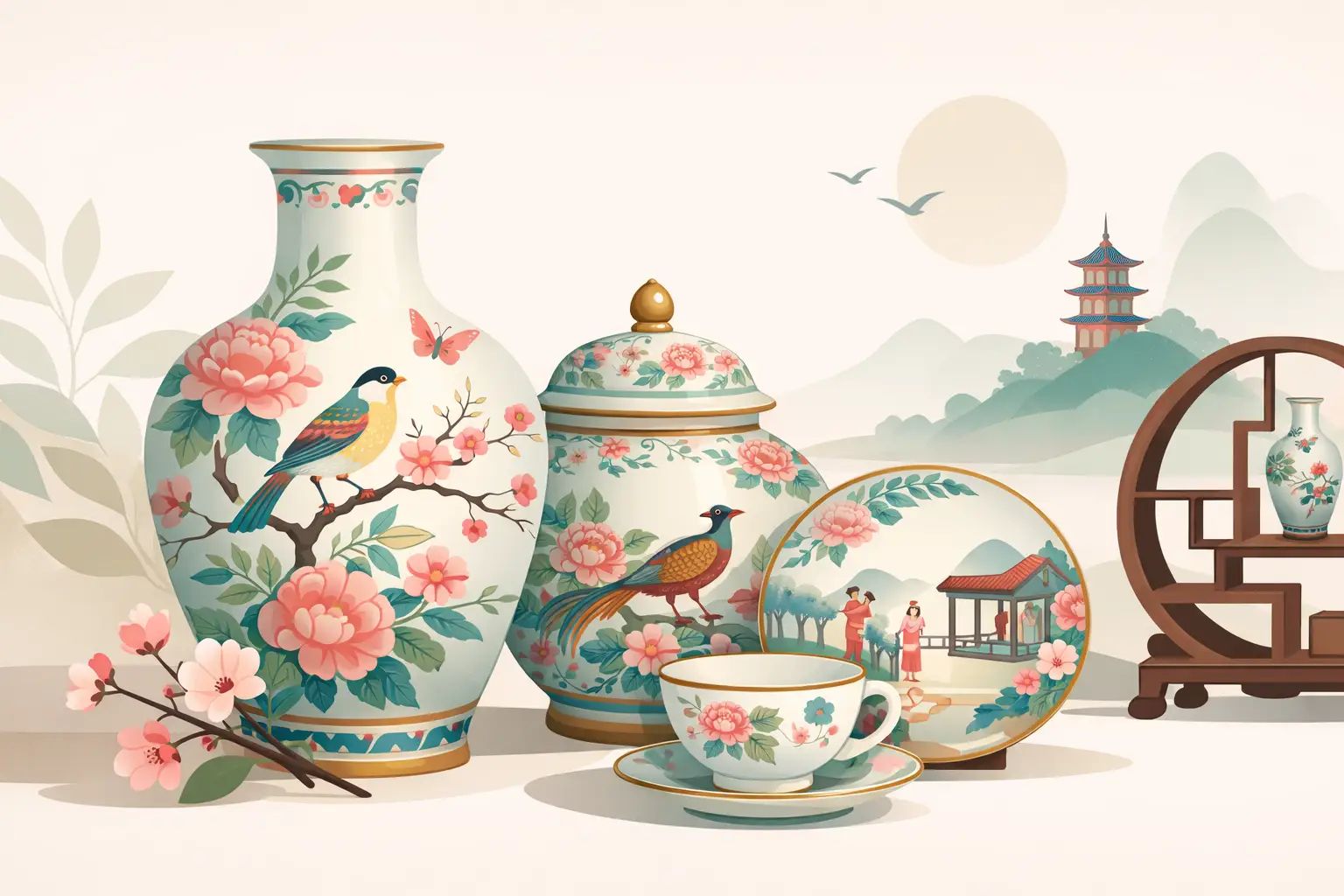
Famille rose porcelain refers to a type of Chinese enamel-decorated porcelain distinguished by its pink palette and delicate, layered painting. The term itself is European in origin, coined by collectors and dealers rather than imperial kilns, and it sits alongside related labels such as famille verte and famille noire. Even with the spelling variation often seen in modern searches, the idea points to the same visual family: wares decorated with rose-coloured overglaze enamels that became especially prominent during the Qing dynasty.
What made these pieces feel new was not simply the use of pink. It was the broader enamel technology that allowed painters to achieve softer tonal transitions, more painterly shading and a gentler mood than many earlier overglaze palettes. Figures could appear more expressive, petals more naturalistic and courtly scenes more theatrical. The result was porcelain that spoke not only of technical control but also of taste.
Why famille rose porcelain looks different
The charm of famille rose porcelain lies in its finish. Earlier decorative styles often favoured brighter contrasts and more linear patterning. Famille rose, by comparison, introduced a milky opacity in the enamel surface, creating colours that could be blended and softened. This gave artists greater range. A peony did not need to be a flat burst of pigment; it could unfold in shaded layers. A robe could carry folds, shadow and movement.
That painterly quality is one reason collectors continue to admire the style. Another is its versatility. Famille rose decoration appeared on bowls, dishes, vases, teapots, chargers, altar pieces and export wares made for distant markets. Some examples are richly crowded with symbolic motifs. Others are restrained and elegant, leaving white space to frame the scene. It depends on the period, the workshop, the intended buyer and the purpose of the object itself.
From imperial taste to global trade
Famille rose developed during a period when porcelain production in China was both technically accomplished and commercially expansive. Qing workshops supplied imperial demand, domestic consumers and international merchants on a remarkable scale. That matters because this style was never confined to one world. It belonged to the palace, the scholar’s table and the merchant cargo alike.
As maritime trade intensified, porcelain moved across the South China Sea, through the Straits and beyond to Europe, the Middle East and Southeast Asia. Shapes and decorative schemes began to respond to foreign preferences as well as Chinese conventions. Some pieces carried armorial motifs for European families. Others adopted forms suited to tea drinking, dining or display in homes far from Jingdezhen. In that sense, famille rose is not only a ceramic category. It is evidence of cultural exchange shaped by seaborne commerce.
For audiences interested in maritime history, this is where porcelain becomes especially compelling. A surviving object may represent not just artistry at the kiln but also the vast trading networks that connected ports, tastes and fortunes. In shipwreck archaeology, ceramics often outlast almost everything around them. They remain as eloquent cargo – durable witnesses to routes once busy with merchants, captains and collectors.
How to read a piece of famille rose porcelain
Looking at famille rose well requires patience. Colour is the first invitation, but it should not be the last thing you notice. Begin with the body. Good porcelain has a balance to it: neither clumsy nor heavy, with proportions that feel resolved. Then look at the foot rim, glaze surface and firing quality. Unevenness is not always a flaw in older wares, but careless finishing can tell you much about production level.
Next, consider the painting. Fine pieces show assurance in the brushwork. Petals are shaped, not merely filled in. Faces have expression rather than formula. Borders sit in harmony with central panels. Gilding, if present, should enhance rather than overwhelm. It is also worth asking whether the palette suits the supposed date. Colours, motifs and even the density of decoration shifted over time.
Marks can help, but they can also mislead. Reign marks were copied frequently, sometimes respectfully, sometimes strategically. A six-character mark alone does not confirm an imperial period. The whole object must make sense – paste, glaze, enamels, form, decoration and wear need to agree with one another. This is where expertise matters, because attractive later reproductions can borrow the language of earlier masterpieces with surprising confidence.
Collecting and authenticity – where judgement matters
One reason famille rose remains popular is that it offers a broad collecting field. There are museum-quality imperial wares of exceptional rarity, but there are also export examples and later pieces that allow newer collectors to enter the category. The trade-off is complexity. The more popular a style becomes, the more reproductions and optimistic attributions it attracts.
Condition matters enormously. Hairlines, chips, restoration and overpainting can alter value significantly, though the impact depends on rarity. A scarce documented piece with some damage may still command strong interest, while a more common object in compromised condition may not. Provenance also shapes confidence. A piece with a traceable collection history carries a different weight from one that relies only on verbal assurance.
Collectors often ask whether age is everything. It is not. A later nineteenth-century example can be visually superb and historically meaningful even if it does not belong to the earliest phase of the style. What matters is honesty of attribution, quality of workmanship and the story the object can still tell. The best collections are not built only on price or prestige. They are built on discernment.
Why this style still captivates modern audiences
Famille rose survives because it rewards more than one kind of looking. A first-time visitor may be drawn in by colour and elegance. A seasoned collector may notice kiln skill, enamel chemistry and market history. A traveller interested in Asia’s maritime past may recognise these wares as ambassadors of an age when luxury goods crossed oceans and reshaped taste.
That layered appeal suits contemporary museum audiences particularly well. People rarely want a static display of objects stripped of context. They want to understand who made them, who bought them, how they moved and why they mattered. Within that wider story, famille rose offers visual pleasure and historical depth in equal measure. At Straits & Oriental Museum, it sits naturally within a larger conversation about ceramic splendour, seaborne exchange and the lasting power of artefacts rescued from history rather than merely described by it.
There is also something refreshingly human about these pieces. However elevated their original setting, they were made for use, display, gifting or trade. They entered domestic life. They travelled in crates and ship holds. They were admired, handled, broken, preserved and passed on. Their survival is not abstract. It is intimate.
Famille rose porcelain in a wider heritage story
To appreciate famille rose fully, it helps to resist seeing it as an isolated luxury category. It belongs to a much larger heritage of ceramic innovation, imperial patronage, mercantile ambition and cross-cultural exchange. A bowl painted with roses and peonies may seem self-contained, yet it opens onto workshops, ports, dynasties and collecting traditions spread across continents.
That is why these objects continue to feel so alive in the present. They connect refined craftsmanship with movement – of goods, ideas, people and taste. For the traveller, they make history visible. For the collector, they sharpen the eye. For the curious visitor, they offer one of the most graceful entries into the world of Asian ceramics.
The next time you stand before a piece of famille rose, give it longer than a passing glance. Its colours will draw you in quickly, but its real reward arrives more slowly – in the recognition that beauty, when fired into porcelain and carried across the sea, can outlast the age that first admired it.