

A blue-and-white porcelain bowl raised from the seabed asks for a different kind of attention from a painting hanging in a bright white room. Both can be beautiful. Yet the museum vs gallery experience is shaped by more than what sits before you: it is shaped by where it came from, why it is shown, and what you are invited to feel.
For visitors planning a cultural day in George Town, understanding that difference can make every stop more rewarding. A museum may place an object within centuries of trade, craftsmanship and human movement. A gallery may invite you to meet an artist’s idea in the present tense. Neither is the better experience by default. Each offers its own pace, pleasures and possibilities.
Museum vs gallery experience: the essential difference
At its heart, a museum is a keeper of material evidence. Its collections may include archaeological finds, historical objects, ethnographic materials, natural specimens, decorative arts or works of art. The most memorable museum visits do not simply display these things. They give them context.
A ceramic dish recovered from a shipwreck, for example, is never only a dish. It can reveal the refinement of a kiln, the tastes of distant buyers, the sea routes that connected ports across Asia, and the peril faced by crews carrying precious cargo. Labels, maps, archival images and thoughtful display help turn an object into a story with real stakes.
A gallery, by contrast, is often built around viewing art as an encounter. It may represent a living artist, introduce emerging talent, present a temporary curatorial theme, or offer works for sale. The atmosphere can be deliberately spare, allowing colour, scale, texture and concept to carry the conversation. You may leave with questions rather than chronology, and that can be precisely the point.
There is overlap, of course. Major museums exhibit contemporary art, while galleries may present historically significant works. The distinction is less about rigid categories than emphasis. Museums typically prioritise stewardship, interpretation and public learning. Galleries commonly foreground artistic practice, discovery and the relationship between artwork, viewer and collector.
In a museum, the object carries a longer story
Museum objects often arrive with a traceable past. Their value may lie in rarity, age, provenance, cultural meaning or the insight they offer into a particular period. This gives the visit a satisfying sense of depth, especially for families, history enthusiasts and travellers seeking a stronger connection to a place.
The experience is usually more structured. A visitor might move from one era to another, follow the development of a craft, or discover how trade transformed a coastal settlement. That structure need not feel formal. At its best, it creates a feeling of gradual revelation: the small detail seen in one case becomes more meaningful in the next room.
Maritime collections are particularly powerful in this regard. A shipwreck ceramic has survived not merely through time but through a dramatic interruption to its intended voyage. It was made to be handled, traded and used. Instead, it remained beneath the water for generations before re-entering the world as an artefact. Its surface may bear the marks of its passage, giving it an immediacy that no reproduction can match.
This is where a museum visit rewards patience. Spend a little longer with the accompanying text. Notice differences in glaze, motif and form. Ask who made the object, who was expected to buy it, and how it travelled. The pleasure is not only visual. It comes from recognising that history can be held in a single, finely made thing.
In a gallery, your response takes centre stage
A gallery visit can feel more open-ended. Instead of being guided through a broad historical narrative, you are often encouraged to form a direct response to the work in front of you. A painting may prompt an emotional reaction before you know its title. A sculpture may alter your sense of space. A photograph may make an ordinary street, face or gesture seem newly significant.
This freedom is one of the gallery’s great strengths. There may be less information to absorb, which can make the experience feel lighter and more immediate. For a visitor with limited time, a gallery can offer a concentrated burst of visual stimulation. For a prospective collector, it is also an opportunity to understand personal taste beyond a screen or catalogue.
The commercial aspect of some galleries should not be mistaken for a lesser cultural role. Selling work can sustain artists and support the production of new ideas. It also creates a useful intimacy between visitor and artwork. When you can imagine a piece in your own home, you begin to look more closely at its craft, presence and enduring appeal.
That said, galleries can feel intimidating to first-time visitors, particularly when the work is conceptual or the setting seems exclusive. The best approach is simple: begin with what you genuinely notice. Is there an image, material or detail that holds your attention? Why might the artist have chosen it? You do not need specialist language to have a valid response.
Choose the experience that suits your day
A museum is often the stronger choice when you want a sense of place. If you are visiting Penang for the first time, a heritage collection can add texture to the streets, ports and communities you encounter beyond its walls. It offers context that makes the destination itself more legible.
It is also well suited to mixed groups. Adults may be drawn to history and craftsmanship, while younger visitors can connect with tales of voyages, buried treasure and faraway ports. The key is to resist trying to see everything at speed. A focused visit, with time for a handful of objects and a good conversation afterwards, is usually more memorable than rushing through every display.
A gallery may be the better choice when you want to see what is being made now, find creative inspiration or enjoy a quieter pause between larger attractions. It can be especially rewarding for repeat visitors, as exhibitions change more frequently than permanent museum displays.
For many cultural travellers, the ideal answer is not museum or gallery but both. Begin with history, then move towards contemporary interpretation. Look at what has endured, then look at what artists are saying now. The contrast can sharpen your appreciation of each.
When heritage and hospitality belong together
The most compelling cultural destinations recognise that a meaningful visit does not end at the display case or gallery wall. Time to pause over a meal, discuss a favourite object, browse a considered gift selection or return for an evening programme can turn an outing into a fuller occasion.
This is the spirit behind an integrated heritage and lifestyle museum. At Straits & Oriental Museum, rare ceramics recovered from Asian shipwrecks are presented as evidence of the region’s maritime histories, while art, dining, hospitality and cultural programming extend the experience beyond conventional museum-going. It is a setting designed for visitors who want historical substance without separating it from the pleasures of a well-spent day.
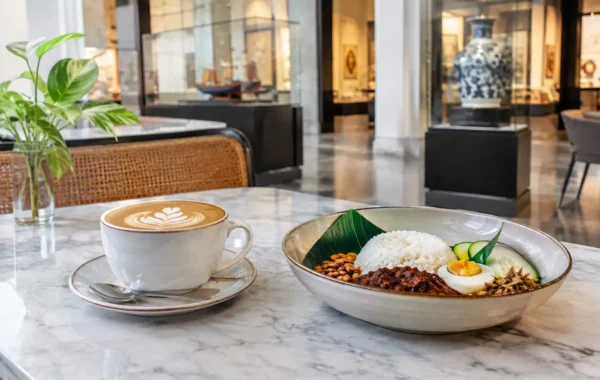
There is a balance to protect. Food, retail and events should complement the collection rather than distract from it. When thoughtfully curated, however, they give heritage a more natural place in contemporary life. A conversation over coffee may lead back to a porcelain pattern noticed upstairs. A carefully chosen gift can carry the memory of a visit home.
How to look more closely in either setting
Whether you enter a museum or a gallery, give yourself permission to slow down. Choose one object or artwork that initially seems quiet, and stay with it for a minute longer than feels necessary. Look for evidence of the hand that made it: a painted line, a repaired edge, a mark in the clay, a brushstroke, a decision about scale.
In a museum, read enough to understand the object’s life before it reached the case. In a gallery, look first and read later, so that your own response has room to form. Photograph only where permitted, and do not let documentation replace attention.
Most of all, let the experience continue after you leave. A museum may send you back into the city noticing its connections to the sea, commerce and migration. A gallery may change the way you see colour on a wall, light on a pavement or an overlooked scene on the journey home. The best cultural visits do not demand that you know everything. They simply leave you seeing more than you did before.