
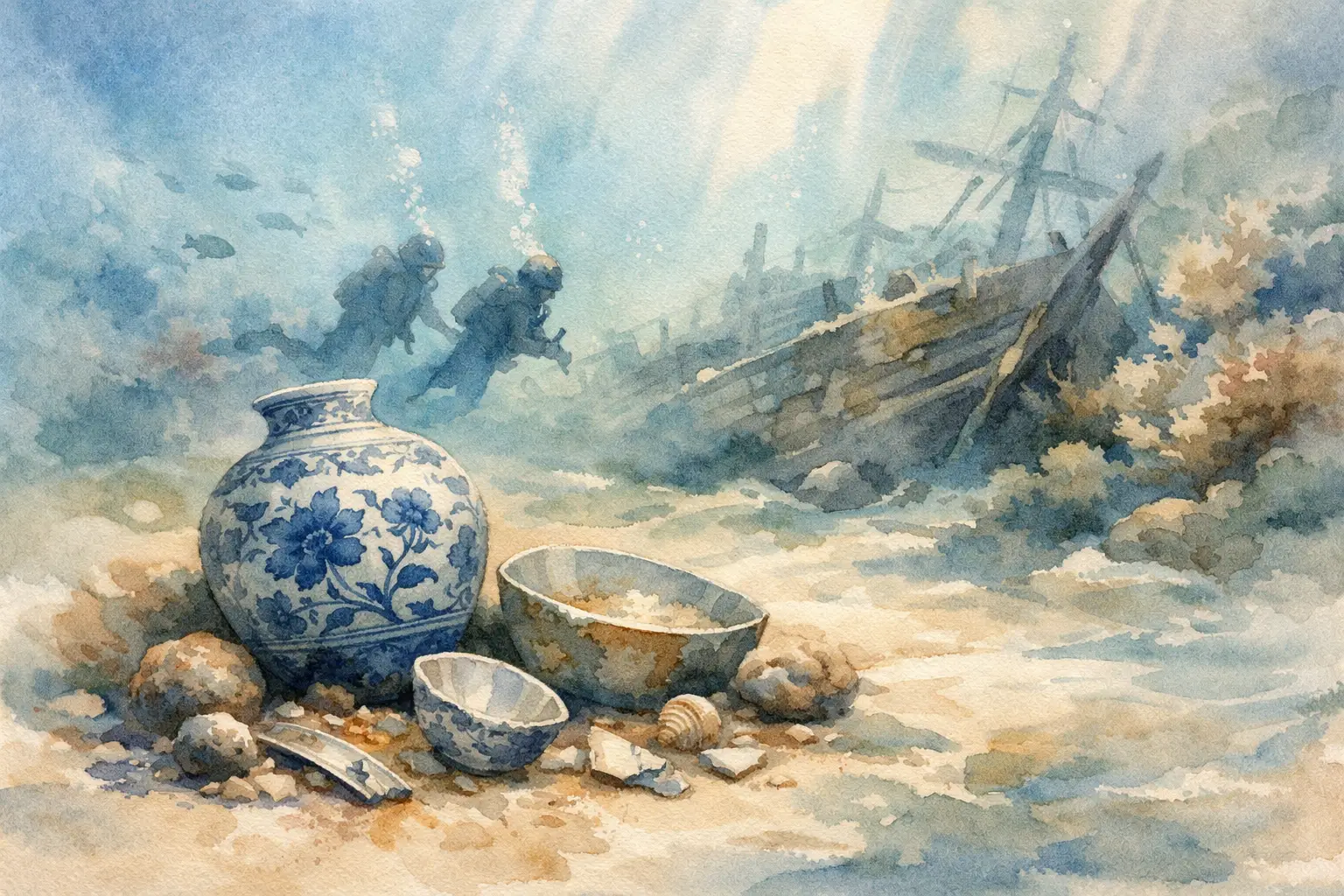

A ship sinks once. Its story can disappear for centuries.
The Royal Nanhai porcelain recovery story matters because it turns a silent wreck into something far larger than a cache of beautiful objects. It reveals how ceramics moved across sea routes, how merchants calculated risk and value, and how everyday vessels became unintended time capsules at the bottom of the sea. For visitors drawn to maritime history, this is where porcelain stops being decorative and starts becoming evidence.
Recovered shipwreck ceramics have a particular power. They arrive in the present carrying traces of trade, taste, empire, craftsmanship and accident all at once. In the case of the Royal Nanhai, the recovery opened a rare window onto the maritime networks that once linked ports, producers and consumers across Asia. What survives is not merely cargo. It is a record of movement.
Why the Royal Nanhai porcelain recovery story stands out
Not every shipwreck speaks with the same clarity. Some are too disturbed, too fragmentary or too poorly documented to tell us very much beyond the fact of loss. The Royal Nanhai stands out because the porcelain assemblage offers both visual richness and historical depth. The recovered material helps scholars and the public read a moment in maritime commerce through forms, glaze, kiln traditions and patterns of distribution.
That matters for a simple reason. Trade history can feel abstract when it is reduced to dates, routes and dynasties. Porcelain makes it tangible. A bowl, a dish or a storage vessel can tell us who made it, where it may have been headed, what level of market it served, and how refined or practical its purpose was. When hundreds or thousands of such objects are recovered together, the cargo begins to read like a ledger written in clay and glaze.
The appeal is also emotional. Shipwreck ceramics preserve a sense of interruption. These were goods in transit, selected for sale, packed for a journey, and never delivered as intended. Their survival beneath the sea gives them a poignancy that ordinary surviving ceramics do not always possess. They are survivors of commerce, weather and time.
What recovery really means
When people hear the word recovery, they often imagine a dramatic salvage moment – divers descending, crates rising, history reclaimed in a single sweep. The reality is more careful, and rightly so. Maritime archaeological recovery involves surveying, recording, stabilising and interpreting. The object itself is only one part of the process. Context is everything.
That is especially true with porcelain cargoes. A plate removed without documentation may retain aesthetic value, but it loses much of its scholarly importance. Where it sat in the wreck, how it was stacked, what accompanied it, and what condition it was found in all shape the story it can tell. Proper recovery protects meaning, not just material.
There is also a delicate balance between public fascination and archaeological discipline. Shipwreck ceramics are visually seductive. Yet the most responsible recoveries avoid treating them as treasure in the romantic sense. Their real worth lies in what they can teach us about production centres, trade demand, shipping practices and the fragility of life at sea.
Reading the cargo through porcelain
The strength of the Royal Nanhai porcelain recovery story lies in the cargo itself. Porcelain is not a single category but a broad field of forms, qualities and intended markets. A recovered assemblage may include utilitarian wares alongside finer pieces, reflecting the layered nature of trade. Some goods were likely destined for affluent buyers, others for wider commercial circulation.
This is where nuance matters. A cargo of ceramics does not always point to a single consumer culture or a narrow route. Maritime trade was adaptive. Merchants loaded mixed consignments to meet varied tastes across different ports. The result is that a wreck like the Royal Nanhai can illuminate not only what was being exported, but how flexible and responsive regional trade had become.
Ceramics also preserve manufacturing histories. Glaze tone, decoration, body composition and shape can point towards kiln traditions and dating. Even when pieces look familiar to casual viewers, specialists can often detect distinctions that place them within precise production contexts. Recovery therefore allows porcelain to function as both artefact and document.
The human story beneath the sea
For all the attention given to cargo, every shipwreck is also a human story. Behind the Royal Nanhai porcelain recovery story are merchants, sailors, port workers, kiln labourers and buyers who never knew that their world would one day be reconstructed from a seabed. Maritime history becomes most vivid when we remember that trade routes were lived experiences, not just lines on a map.
A porcelain cargo represents decisions made on land and risks accepted at sea. What was loaded reflected confidence in demand. What was lost reflected the uncertainty of monsoon weather, navigation and long-distance transport. Recovery gives us access to those calculations in material form. It lets us see commerce not as inevitability, but as a chain of precarious choices.
This is one reason shipwreck collections resonate so strongly with modern audiences. They connect elegance with vulnerability. A finely potted vessel may appear timeless in a gallery case, yet it reached us only because of catastrophe. That tension – beauty shaped by accident and survival – gives the collection its distinctive presence.
Why shipwreck porcelain captivates visitors
There is an immediate visual pleasure in viewing recovered ceramics. The forms are graceful, the surfaces often luminous, and the range of decoration can be striking. But what sustains attention is the narrative attached to them. Visitors do not simply look at porcelain from the Royal Nanhai. They look at objects that travelled, sank, waited and returned.
That sequence changes the experience entirely. An ordinary ceramic display may invite admiration. A shipwreck display invites imagination. One begins to think about cargo holds, sea routes, the economics of exchange and the lives tied to each consignment. The objects become anchors for a much larger story about Asia’s maritime world.
For families and travellers, this makes the experience especially memorable. The material is authentic, visually compelling and easy to engage with, yet it also rewards deeper attention. Collectors may focus on rarity and condition. History enthusiasts may be drawn to chronology and trade routes. Casual visitors may simply feel the thrill of standing before something truly recovered from the sea. Good interpretation allows all of those responses to coexist.
The value of preservation after recovery
Recovery is only the beginning. Once porcelain emerges from a marine environment, preservation becomes essential. Salt contamination, structural weakness and surface instability can all threaten the long-term condition of ceramics. Conservation work may be less dramatic than salvage, but it is what allows the public to encounter these objects generations later.
There is also an interpretive responsibility after conservation. How the porcelain is displayed shapes how the story is understood. If presented only as luxury objects, the broader maritime context can fade. If presented only as archaeological data, their aesthetic power may be underplayed. The most compelling displays respect both dimensions. They show craftsmanship and context together.
This is where a museum setting can do what a private collection often cannot. It can place the cargo within a wider story of regional exchange, shipwreck archaeology and cultural memory. At Straits & Oriental Museum, that approach helps visitors move beyond admiration into recognition – of how deeply the sea shaped the history of this region, and how porcelain became one of its most eloquent witnesses.
What the Royal Nanhai still teaches us
The Royal Nanhai porcelain recovery story remains relevant because it reminds us that maritime history is not remote. It shaped cities, cuisines, collecting cultures, trading fortunes and cross-cultural taste throughout Asia. Porcelain was one of the clearest vehicles of that exchange, carrying not just utility but status, fashion and technical achievement from one shore to another.
It also reminds us that recovery is never a simple act of bringing the past back whole. Some things are preserved, some are lost, and some can only be inferred. That partialness is not a weakness. It is part of what makes maritime archaeology so compelling. We are always reading fragments against the vastness of the sea.
Perhaps that is the enduring pull of shipwreck ceramics. They do not merely survive history – they expose how history travelled, broke apart and resurfaced. To stand before them is to encounter trade, craftsmanship and chance in a single frame. And once you have seen porcelain this way, it is very difficult to look at it as merely porcelain again.