
A bowl lifted from a shipwreck rarely looks like a treasure at first glance. It may be crusted with marine deposits, stained by salt, fractured by impact, or weakened by centuries on the seabed. Yet this is precisely where the story begins – and understanding how shipwreck ceramics are conserved reveals just how much skill, patience and judgement stand behind every piece seen in a museum gallery.
For visitors drawn to maritime history, conservation is one of the most fascinating parts of the journey. These objects have survived trade, catastrophe, burial and recovery. Preserving them is not about making them look new. It is about stabilising them, protecting the evidence they carry, and allowing their craftsmanship, origin and historical significance to be understood without erasing the marks of time.
Why conservation matters for shipwreck ceramics
Ceramics may seem durable compared with wood, textile or metal, but shipwreck conditions create their own complications. Porcelain and stoneware are often physically strong, yet they can trap salts within cracks, foot rings and porous areas. Earthenware is even more vulnerable. Once an object is raised from the sea and begins to dry, those salts can crystallise and cause fresh damage.
That means conservation starts with a simple but urgent principle: recovery is only the beginning. A jar, plate or kendi that has lain undisturbed underwater for centuries enters a new period of risk the moment it meets air, heat and handling. If the process is rushed, information can be lost and the artefact itself can deteriorate quickly.
There is also a deeper responsibility at work. Shipwreck ceramics are more than attractive survivals. They are evidence of trade routes, kiln technology, taste, status and exchange across the maritime world. A single cargo assemblage can illuminate how goods moved between China, Southeast Asia and beyond. Good conservation protects that evidence for research, interpretation and public display.
How shipwreck ceramics are conserved after recovery
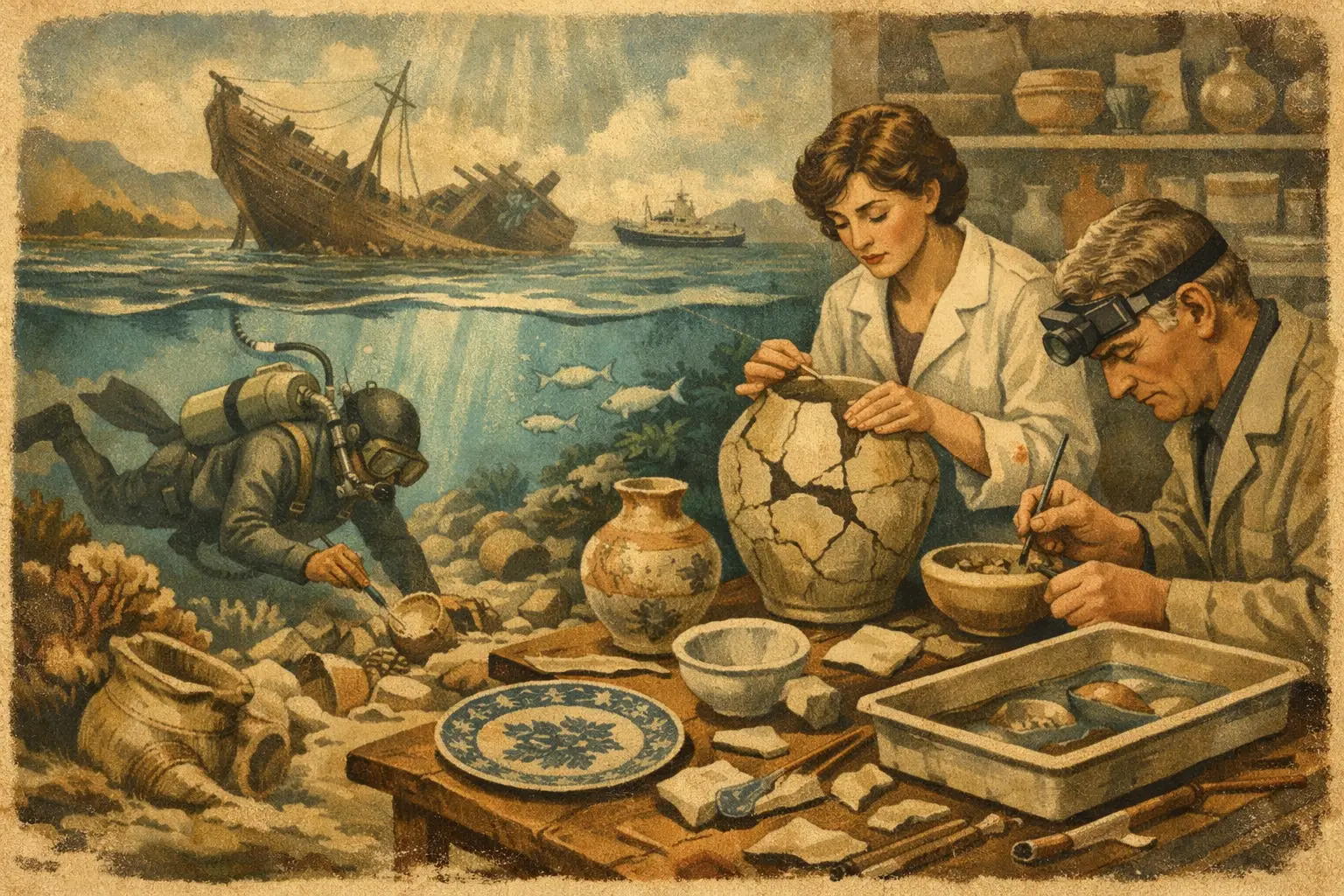
The first stage is careful documentation. Before any cleaning or repair begins, conservators record the object’s condition in detail. Measurements, photographs, visible inscriptions, glaze characteristics, areas of damage and marine accretions are all noted. This creates a baseline record and helps determine what treatment is appropriate.
The next concern is stabilisation. Newly recovered ceramics are often kept wet, usually in controlled containers of fresh water, to prevent salts from drying inside the body of the object. This stage can look deceptively modest, but it is essential. Allowing an artefact to dry too soon can lead to cracking, surface flaking or long-term weakness.
Desalination follows. In simple terms, this means drawing out the salts absorbed during centuries underwater. The ceramic is soaked in fresh water, and that water is changed repeatedly over time. Conservators monitor salt levels and adjust the process according to the object’s condition, fabric and fragility. There is no fixed timetable. Some pieces can be treated relatively quickly, while others require far longer.
This is one of the clearest examples of where conservation resists shortcuts. An object may appear stable on the surface, yet still contain harmful soluble salts. Patience here protects the piece later, especially once it enters gallery conditions.
Cleaning without erasing history
After stabilisation, cleaning begins with restraint. Marine growth, concretions and seabed deposits may obscure decoration, but they can also preserve evidence. Tool marks, firing flaws, residue, cargo numbering and traces of use all matter. The goal is not to strip the object to a showroom finish.
Cleaning methods depend on what is present. Soft mechanical cleaning with fine tools and brushes may be enough for loose deposits. In other cases, conservators may use water-based methods or highly controlled chemical treatment. Every decision involves a balance. Remove too little, and important features remain hidden. Remove too much, and original surfaces may be lost.
This is why shipwreck conservation is as much interpretive as technical. A crust on a jar might be visually distracting, but if it protects a fragile glaze or indicates burial conditions, partial retention may be the wiser choice. The most responsible treatment is not always the most dramatic one.
When damage is left visible
Museum visitors sometimes wonder why a conserved ceramic still shows chips, staining or fractures. The answer is straightforward: authenticity matters. Conservation aims to preserve original material and reveal the object’s true history, not disguise it. Signs of breakage can speak directly to the wreck event, cargo pressure, seabed movement or post-recovery condition.
A flawless reconstruction may look satisfying, but it can also mislead. In heritage practice, visible honesty is often more valuable than cosmetic perfection.
Repair, joining and filling
If a ceramic survives in fragments, conservators may reassemble it once the material is stable and clean. This involves testing joins, aligning edges and using conservation-grade adhesives chosen for strength, ageing behaviour and reversibility. Reversibility is especially important. Future conservators may have better materials or new information, so treatments should not trap the object in permanent, unchangeable repair.
Missing sections present another judgement call. Sometimes losses are left open, particularly if the form is still legible and the gap tells an important part of the story. In other cases, fills are added to support weak joins or help viewers understand the original shape. These fills are usually distinguishable on close inspection and should never be confused with original ceramic.
Retouching, where used, is kept controlled and respectful. The aim is visual coherence for display, not illusion. A restored section should support interpretation without pretending to be ancient.
The science behind the gallery case
Conservation does not end when a piece is repaired. Long-term care is just as important as treatment itself. Once shipwreck ceramics enter storage or exhibition, they need stable environmental conditions, secure mounts and thoughtful handling protocols.
Humidity and temperature matter because repaired joins, old cracks and residual salts can respond badly to fluctuation. Light is generally less destructive to ceramics than to paper or textile, but labels, packaging, associated organic residues and mixed-material repairs can still be affected by poor display conditions. Mounts must distribute weight safely, especially for large dishes, jars and stacked forms.
This quieter stage of conservation is easy to overlook because it happens behind the scenes. Yet it is what allows a centuries-old cargo object to remain safe in public view, where its beauty and significance can be shared with confidence.
How shipwreck ceramics are conserved for research as well as display
One of the most valuable aspects of conservation is that it makes close study possible. Once surfaces are stable and features are visible, specialists can examine glaze, clay body, kiln origin, decorative style, inscriptions and manufacturing marks. These details help place an object within wider histories of production and trade.
Cargo groups from wrecks such as those found across Asian maritime routes can reveal patterns far beyond a single object. Conserved ceramics may show whether a shipment was made for imperial use, export demand, regional markets or everyday commerce. They can suggest consumer taste, workshop practice and the scale of exchange across centuries.
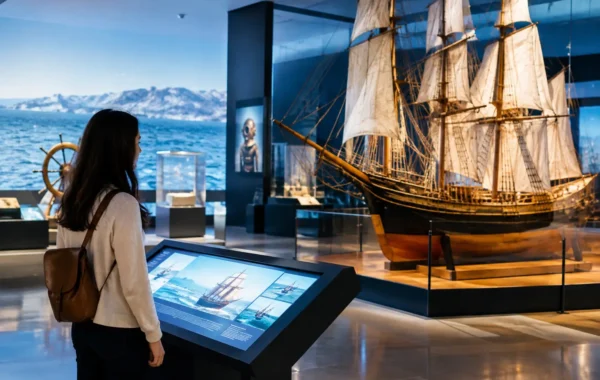
For a museum dedicated to documenting the splendour of porcelain and the maritime worlds that carried it, conservation is therefore not a backstage technicality. It is part of the storytelling itself. At Straits & Oriental Museum, the presence of authentic shipwreck ceramics invites visitors to appreciate not only what was made, but also what it took for these objects to survive into the present.
Why some ceramics are harder to conserve than others
Not every object responds in the same way. High-fired porcelain can be remarkably resilient, but thin sections, impact fractures and unstable enamel decoration still create challenges. Stoneware may hold up structurally while retaining stubborn deposits. Earthenware, with its more porous body, can absorb salts more deeply and suffer greater weakness after immersion.
There are also complications from the wreck environment itself. Objects buried in fine sediment may be better protected than those exposed to currents or collision. Pieces packed tightly in cargo can survive with little abrasion, while others may be crushed, scorched, stained by nearby metals or altered by biological growth. Conservation plans must reflect these differences rather than force every artefact through the same sequence.
That is why expertise matters so much. Good conservators understand materials, chemistry, archaeology and display needs all at once. They know when intervention will help, when restraint is safer, and when the most ethical choice is to preserve evidence rather than pursue visual perfection.
What visitors finally encounter in a museum case is not simply a rescued object. It is a carefully judged meeting point between survival, science and story. The next time you stand before a shipwreck bowl or jar, it is worth pausing for the unseen labour behind it – because conservation is what allows the sea to give up its history without losing it again.