
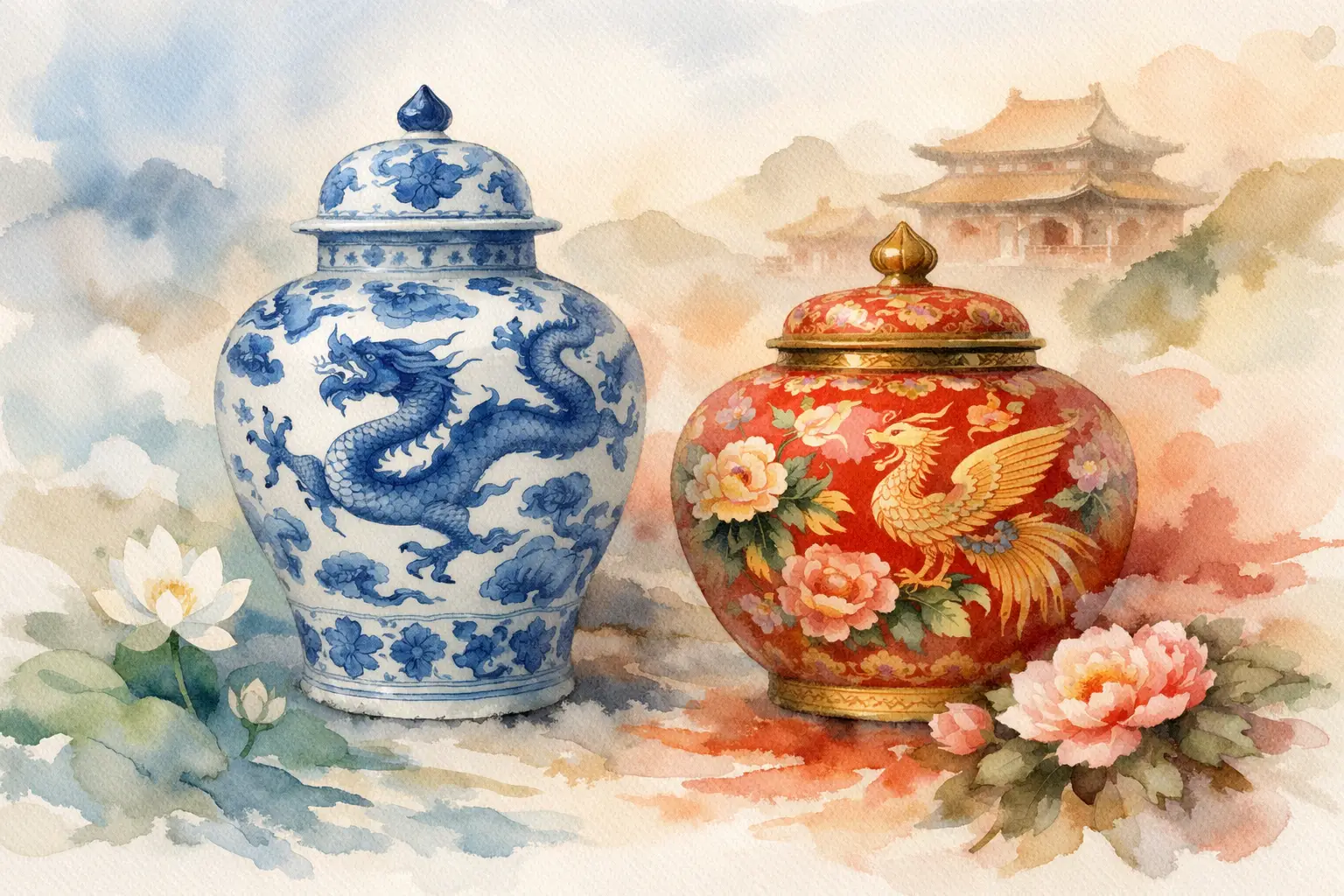

A dish made for an emperor was never just a dish. In imperial Ming and Qing porcelain, every curve, glaze and painted motif carried rank, ritual and a vision of order at the heart of the Chinese court. What survives today does more than please the eye. It reveals how power was staged, how taste was regulated and how porcelain became one of the most admired artistic achievements in the world.
For visitors drawn to heritage objects, imperial porcelain has a rare ability to feel both intimate and monumental. A bowl sits lightly in the hand, yet behind it stands an immense system of mining, kiln technology, court supervision, design control and long-distance trade. That tension is part of its fascination. These were objects of daily use at the highest level, but they were also instruments of prestige.
What makes imperial Ming and Qing porcelain imperial?
The word imperial matters. Not all Ming or Qing porcelain was made for the court, and not all fine porcelain can be called imperial. True imperial wares were commissioned for the emperor and the palace, usually produced under official supervision at Jingdezhen, the great porcelain centre whose kilns supplied the court for centuries.
These wares were governed by exacting standards. Forms were specified, decoration was planned, and the finest materials were reserved for palace use. Many pieces carried reign marks, which linked them to a particular emperor, though a mark alone is never enough to guarantee authenticity. Style, paste, glaze, footrim, painting quality and firing all matter.
That distinction is worth keeping in mind because the Ming and Qing periods were vast, sophisticated and commercially active. Alongside imperial production, private kilns produced extraordinary porcelains for domestic elites and overseas markets. The court set the highest bar, but it did not exist in isolation.
Why the Ming court changed porcelain history
Ming porcelain is often the first image that comes to mind when people picture Chinese ceramics. Blue-and-white, clear in design and luminous in effect, became one of the most recognised luxury goods in global history. Yet the Ming achievement was not only visual. It was administrative and technical.
Under the Ming, especially from the early fifteenth century, court patronage helped standardise and elevate porcelain production. Imperial kilns developed remarkable control over body, glaze and decoration. The famous cobalt blue under a transparent glaze could range from soft and misty to deep and intense, depending on pigment source, firing and painterly intent.
The Xuande period is especially admired for balance and authority in blue-and-white wares. The Chenghua period is celebrated for delicacy, subtle enamel decoration and small refined forms. The Wanli period, by contrast, often feels more exuberant, with denser ornament and a stronger sense of expansion – a reminder that imperial taste was never fixed.
Ming porcelain also mattered because it travelled. Court styles influenced private kilns, and Chinese wares circulated widely across Asia, the Middle East and Europe. For a maritime museum audience, this matters deeply. The story of porcelain is not confined to palace walls. It also belongs to ports, merchants, cargoes and shipwrecks, where ceramics became carriers of taste across oceans.
The Qing dynasty and the height of technical brilliance
If Ming established the prestige of imperial porcelain, Qing pushed its range and technical ambition to astonishing heights. The Qing court, particularly under the Kangxi, Yongzheng and Qianlong emperors, oversaw a period of exceptional experimentation in glaze, enamel and form.
Kangxi porcelain often has a confident energy. Its blue-and-white can be brilliant and crisp, while famille verte enamels brought fresh colour and narrative richness. Yongzheng wares are admired for precision, grace and restraint. Many connoisseurs see this reign as one of the high points of ceramic refinement, where proportion, glaze and decoration feel perfectly judged. Qianlong porcelain is more varied. At its best it is dazzling in technique, with virtuoso enamels, complex revival styles and a court appetite for innovation that could be both scholarly and sumptuous.
This is where comparison becomes interesting. Ming imperial porcelain often impresses through clarity and monumentality. Qing imperial porcelain can feel more experimental, more technically layered and, at times, more self-consciously luxurious. Neither is simply better. Preference depends on whether one values purity of line, painterly strength, enamel complexity or historical context.
Imperial Ming and Qing porcelain as court language
Porcelain at the Chinese court spoke a language of symbols. Dragons, phoenixes, lotus scrolls, peaches, bats and clouds were not merely decorative. They conveyed wishes for longevity, prosperity, harmony and imperial authority. Colour also mattered. Yellow, for instance, carried strong imperial associations, while dragon motifs with five claws were closely tied to the throne.
Even shape had meaning. Certain vessels served rituals, banquets or palace display. Some were linked to archaic bronze forms, showing the court’s desire to connect itself with an idealised ancient past. Others were made for birthdays, religious observances or seasonal ceremonies.
This symbolic world is part of what makes imperial porcelain so rewarding to look at slowly. A plate may appear simple at first glance, then open into a coded visual system. The more one learns, the more the object reveals. That sense of layered reading is central to its appeal for both newcomers and seasoned collectors.
How to look at imperial porcelain with a trained eye
You do not need to be a specialist to appreciate quality, but it helps to know where quality lives. First, look at the body. Fine imperial porcelain tends to have a refined paste and an assured sense of balance. Then study the glaze. Is it even, luminous and well controlled, or dull and heavy?
Next, consider the decoration. On the best pieces, painted lines have purpose. Blue underglaze should feel alive rather than flat. Enamels should sit cleanly and confidently. The composition matters too. Imperial design rarely feels accidental, even when it appears effortless.
The underside can be revealing. Footrims, marks and firing quality tell part of the story, though they should never be read in isolation. Many later copies carry convincing marks. In fact, Chinese ceramic history includes a long and respected tradition of homage and revival, so a copied reign mark does not always signal deceit. It may indicate admiration for an earlier style. The difficulty lies in knowing which is which.
That is why provenance, condition and expert assessment remain essential in the market. A small chip can significantly affect value, while an untouched surface and strong documented history can elevate a piece dramatically. Beauty matters, but scholarship matters too.
Why shipwreck ceramics add another layer of meaning
Imperial wares and maritime ceramics are not identical categories, yet they illuminate one another. Court porcelain represents the pinnacle of controlled production. Shipwreck ceramics show how porcelain moved through the world – as cargo, commodity and cultural ambassador.
For visitors interested in Asia’s connected past, this is where the subject becomes especially vivid. A porcelain object may begin as a courtly achievement at Jingdezhen, but its broader story belongs to sea routes, port cities and exchange between empires and merchants. Maritime finds remind us that porcelain was never static. It shaped dining, collecting and display far beyond China.
In that sense, the study of porcelain is also the study of circulation. It joins palace ritual to monsoon trade, artistic excellence to everyday use, and elite patronage to international desire. At a place such as Straits & Oriental Museum, that wider context feels particularly resonant because porcelain is presented not only as art, but as evidence of movement, encounter and memory.
Why imperial porcelain still captivates now
Part of its appeal is obvious. Imperial porcelain is beautiful. Yet beauty alone does not explain its endurance. These objects invite a rarer kind of attention. They reward patience, comparison and repeated viewing. A visitor may first notice the brilliance of a glaze, then the discipline of a painted dragon, then the political world implied by a single reign mark.
They also appeal because they sit at the meeting point of art and history. One can admire them formally, as masterpieces of design and firing, or historically, as products of empire, ritual and trade. The two approaches enrich one another.
For collectors, the attraction includes rarity, scholarship and market significance. For travellers and museum-goers, the pleasure is often more immediate: the sense of standing before an object that has survived dynastic change, ocean voyages, dispersal and time itself.
Imperial porcelain does not ask for haste. It asks for attention. Give it that, and even a small bowl can hold an entire court, a kiln town and a maritime world within its surface.