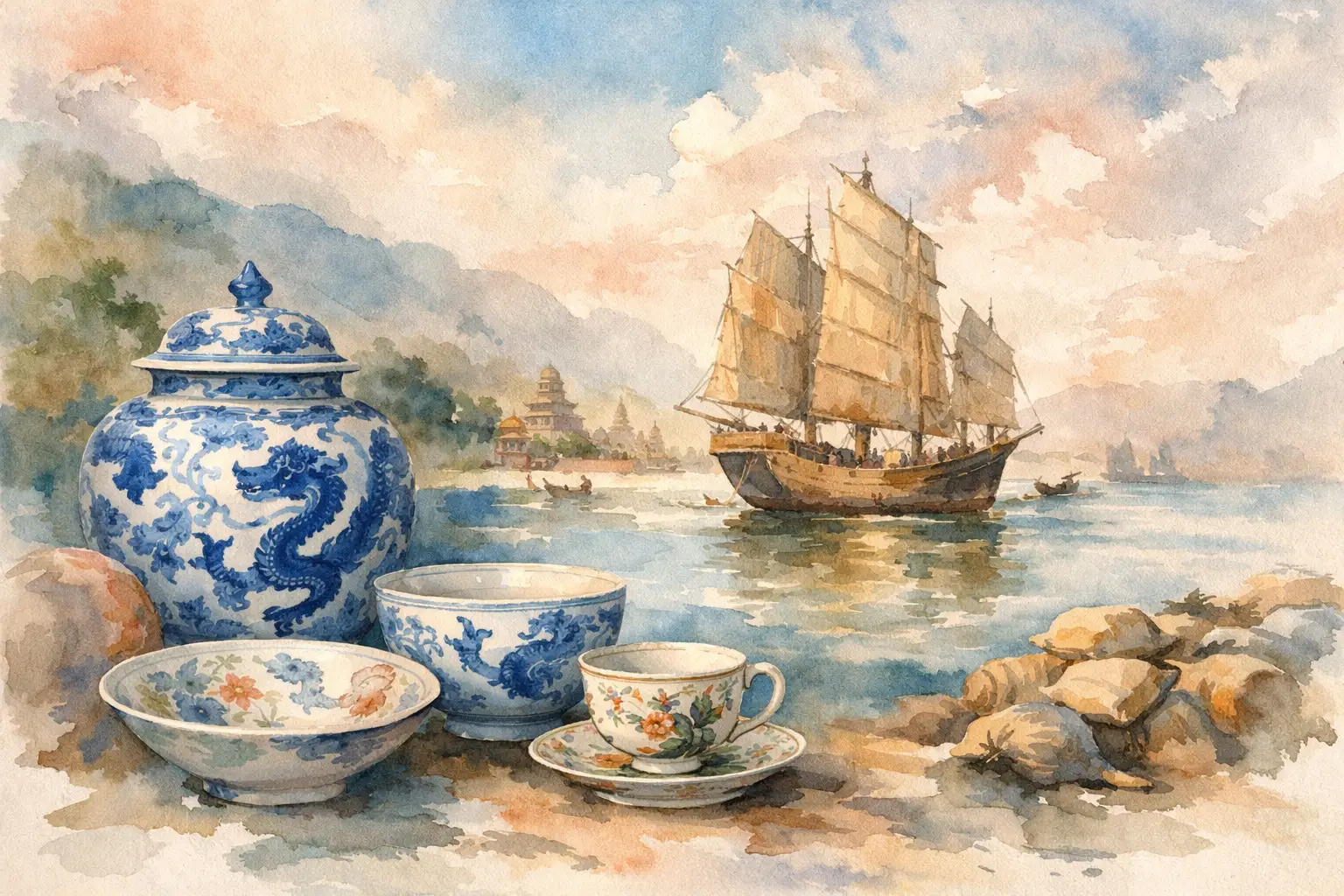

A bowl lifted from a shipwreck rarely arrives alone. It comes with a route, a market, a moment of risk at sea, and the tastes of people who ordered, packed, bought, gifted, used and treasured it. That is precisely how porcelain tells trade history – not as an abstract timeline, but as physical evidence of movement across ports, empires and everyday lives.
For visitors drawn to maritime heritage, this is where porcelain becomes far more than decorative art. Its clay body, glaze, form and ornament can reveal where it was made, who it was meant for, and how far it travelled before it was lost, sold or displayed. In the world of shipwreck archaeology, porcelain is one of the clearest records of commerce ever produced.
Why porcelain is such a powerful trade record
Porcelain survives where many other goods do not. Textiles decay, spices vanish, paper rots and wooden containers break down. Fired ceramics endure. Even when a vessel has lain underwater for centuries, plates, jars, kendi, bowls and dishes can remain intact enough to be studied in detail.
That endurance matters because trade history is often unevenly preserved. Written archives may tell us what rulers taxed, what companies insured or what officials thought worth recording. Porcelain tells us something more tangible. It shows what was actually loaded into cargo holds, what styles were in demand, and which trading networks were active at a given time.
It also sits at the meeting point of industry and desire. Porcelain was not merely moved from one port to another. It was made to satisfy specific markets. A dish produced in China might carry shapes favoured in Southeast Asia, decorative motifs appreciated in the Islamic world, or a size and function suited to household use elsewhere. In that sense, each piece is both an object and a negotiation.
How porcelain tells trade history through shipwrecks
Shipwrecks are extraordinary because they freeze trade in transit. A harbour inventory can suggest what was intended. A wreck shows what was truly on board when a voyage ended. It preserves a cargo before it could be broken up across multiple ports, private homes and merchant stores.
When archaeologists recover porcelain from a wreck, they are not simply finding beautiful objects. They are recovering evidence of route planning, market ambition and maritime risk. A single wreck can show links between Chinese kilns, Malay ports, regional entrepots and long-distance buyers. It can also reveal mixed cargoes, where ceramics travelled alongside metalware, spices or other goods, reminding us that maritime trade was rarely neat or singular.
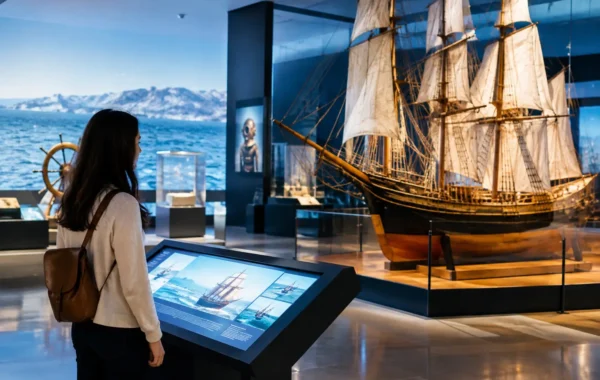
This is one reason shipwreck ceramics are so compelling in a museum setting. They allow visitors to encounter trade history at human scale. A bowl or storage jar makes commerce visible. You do not have to imagine a distant policy or a shipping ledger. You can stand in front of the cargo itself.
Cargoes show demand, not just supply
One common misconception is that porcelain tells us only where something was made. In reality, it also tells us who wanted it. Repeated forms across a cargo suggest established demand. Fine blue and white tableware points to one kind of market, while sturdier utilitarian wares suggest another. Large quantities of near-identical pieces imply organised production for export, not occasional exchange.
At the same time, trade was not uniform. Some voyages carried elite wares for wealthy buyers, others mixed practical ceramics for broader regional consumption. The balance matters. It helps historians distinguish between prestige exchange, commercial bulk trade and shifting consumer preferences.
Wreck sites reveal the geography of exchange
Where a ship sank can be as telling as what it carried. Maritime Southeast Asia sat at the heart of dense regional networks, where monsoon patterns, political alliances and port competition shaped movement at sea. Porcelain recovered from wrecks in these waters demonstrates how goods circulated through interconnected trading worlds rather than along a single line from maker to user.
That perspective is especially important for understanding Asia’s maritime past. Trade was not simply driven by one empire or one market. It relied on brokers, middlemen, local rulers, sailors, pilots and port communities. Porcelain, found in transit, makes those layered relationships easier to see.
Reading the clues in the porcelain itself
Trade history does not sit on the surface of porcelain in one obvious way. It has to be read through a combination of clues. Shape matters. Glaze matters. Decorative style matters. Even imperfections matter.
A vessel’s body and firing quality can point towards a particular kiln tradition. Painted motifs can place it within a dynasty, an export phase or a regional taste profile. Base marks and reign marks may help with dating, although they need careful interpretation because marks were not always straightforward guarantees of period. Stacking marks, kiln grit and firing flaws can be surprisingly useful too, because they reveal methods of mass production and handling.
This is where expertise matters. Two bowls may look similar to a casual visitor, yet differ significantly in date, kiln origin or intended market. The pleasure of looking deepens when you understand that details once treated as purely aesthetic are also commercial evidence.
Design changes can track changing markets
Porcelain was never static. Patterns changed because markets changed. Traders responded to consumer taste, political disruption, religious preferences and competition from other centres of production. A floral motif, a rim profile or a familiar blue and white palette may seem timeless, but each variation can mark a shift in who the buyer was and what they valued.
This makes porcelain unusually effective at showing cultural exchange without reducing it to a simple story of influence. Sometimes makers adapted. Sometimes buyers preferred established forms. Sometimes markets overlapped. The result is a material record of exchange that is dynamic rather than one-directional.
What porcelain can tell us – and what it cannot
There is a temptation to treat ceramics as definitive proof of everything. They are not. Porcelain is a powerful witness, but not a complete one.
A shipwreck cargo may show what was moving through a route, yet not every part of that trade survives equally. Luxury ceramics are easier to recover and display than perishable goods. That can tilt our view towards the visible and away from the vanished. Likewise, a wreck captures a single event. It is rich in detail but still only one moment within much larger systems of exchange.
Dating can be precise in some cases and more interpretive in others. Provenance may be strong, but not always absolute. And while porcelain can indicate intended markets, it does not always tell us exactly who used each object once it reached land. Trade history, like all history, is built through evidence in conversation, not one artefact speaking alone.
Yet this is not a weakness. It is part of what makes museum interpretation so rewarding. Porcelain invites questions as much as it offers answers. It asks us to consider movement, taste, status, technology and risk all at once.
Why this matters to visitors today
For many people, trade history can sound distant until it is attached to something vivid. Porcelain does that with remarkable grace. It translates commerce into objects of beauty, and beauty into historical insight. A visitor may first notice the refinement of a glaze or the elegance of a painted scene. Soon after, they begin to see monsoon routes, merchant ambition, changing demand and the hazards of maritime travel.
That shift in perspective is central to a meaningful heritage experience. It turns display into discovery. It also reminds us that ports were never only points on a map. They were places where languages met, goods changed hands, tastes evolved and identities were shaped by exchange.
In a destination with a strong maritime story, this way of looking at porcelain feels especially resonant. It connects the splendour of ceramic artistry with the wider world that carried it. At Straits & Oriental Museum, shipwreck collections make that connection tangible, showing how recovered cargoes can illuminate the sea lanes that linked Asia through commerce, craftsmanship and curiosity.
How porcelain tells trade history in a museum setting
The best museum encounters do not ask visitors to admire porcelain only for its finish or rarity. They invite them to read it. A dish becomes evidence of export. A jar becomes proof of storage, transport and consumption. A group of similar bowls becomes a sign of scale. A mixed cargo becomes a portrait of regional trade.
That is why display context matters. When porcelain is interpreted through shipwreck provenance, chronology and market use, it becomes legible in a richer way. Visitors begin to notice not just what an object is, but what it has done. It has crossed water, survived disaster, outlasted paper records and carried forward a story of human connection.
There is something quietly extraordinary in that. Porcelain was made to be handled, traded and used, yet centuries later it still speaks with clarity. If you want to understand trade history more intimately, start not with the map but with the bowl in front of you. It may tell you more than any ledger ever could.